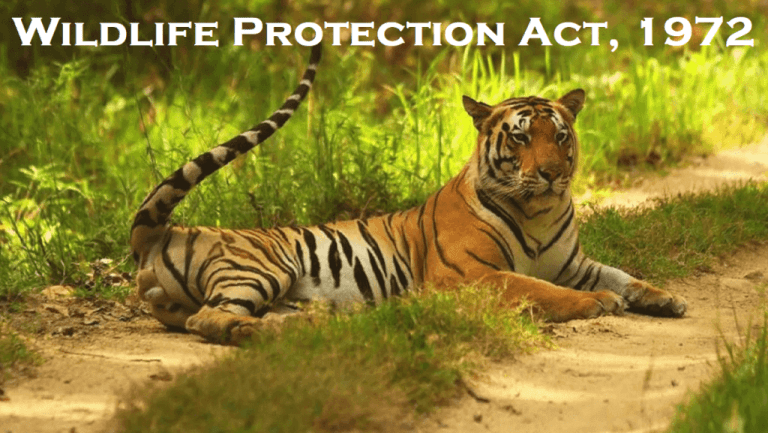
The Wildlife Protection Act (WPA) 1972 is the cornerstone of India’s environmental jurisprudence. Enacted to stem the rapid decline of India’s wild animals and birds, the Act provides a robust legal framework for the protection of various species of wild animals, management of their habitats, and the regulation of trade in wildlife products.
The Act has undergone significant evolution, most notably through the 2022 Amendment (which became fully operational recently), aligning domestic law with international treaties like CITES (Convention on International Trade in Endangered Species of Wild Fauna and Flora). This legislation remains the primary shield for India’s biodiversity, ranging from the majestic Royal Bengal Tiger to rare medicinal flora.
1. Origins and Primary Objectives
The WPA was enacted by the Parliament of India in 1972 and came into force in 1973. It replaced various colonial-era laws that were deemed insufficient for modern conservation needs.
1 Species Conservation: Protecting endangered species from extinction by prohibiting hunting and capturing.
2 Habitat Management: Providing for the establishment of National Parks, Wildlife Sanctuaries, and Conservation Reserves.
3 Trade Regulation: Controlling the commercial trade in trophies, animal skins, and derivatives to curb poaching.
4 Institutional Strength: Establishing statutory bodies like the National Board for Wildlife (NBWL) and the Central Zoo Authority (CZA).
5 Human-Wildlife Coexistence: Creating legal mechanisms to manage “man-eaters” or crop-raiding animals through designated authorities.
2. The Statutory Hierarchy: Understanding the Schedules
The most critical feature of the Act is the categorization of species into “Schedules” based on their conservation status. Following the 2022 Amendment, the complex six-schedule system was rationalized into four main categories:
| Schedule | Level of Protection | Key Examples |
| Schedule I | Highest Protection: Absolute ban on hunting; highest penalties for violations. | Tiger, Lion, Elephant, Great Indian Bustard. |
| Schedule II | High Protection: Significant protection, but slightly lower penalties than Schedule I. | Various species of birds and reptiles. |
| Schedule III | Protected Plants: Regulates the cultivation, collection, and trade of specified flora. | Beddomes’ cycad, Blue Vanda, Pitcher plant. |
| Schedule IV | CITES Species: Species listed under the Appendices of CITES for international trade regulation. | Various exotic species involved in global trade. |
3. Key Institutional Provisions
The Act creates a tiered administrative structure to ensure ground-level enforcement and high-level policy making.
1 Wildlife Advisory Board: Established in every State and Union Territory to advise the government on the selection of protected areas and tribal rights.
2 Chief Wildlife Warden (CWLW): The statutory authority at the state level who manages all wildlife matters and has the power to grant permits for scientific research or “problem animal” management.
3 National Board for Wildlife (NBWL): Chaired by the Prime Minister, it is the apex body for all wildlife-related clearances, especially for projects in and around protected areas.
4 Central Zoo Authority (CZA): A specialized body that sets standards for zoos across India, ensuring they contribute to ex-situ conservation and education.
- Protected Area Networks (PAs)
The WPA 1972 empowers the government to notify specific regions as protected zones, each with varying degrees of human activity allowed.
1 National Parks: Areas of high ecological significance where no human activity (like grazing or private land holding) is permitted. Boundaries cannot be altered except by a resolution passed by the State Legislature.
2 Wildlife Sanctuaries: Areas where certain rights, like grazing or collection of minor forest produce, may be allowed for local communities under strict regulation.
3 Community & Conservation Reserves: Areas acting as “buffer zones” or connectors between established National Parks, involving local communities in management.
5. The 2022 Amendment: A Paradigm Shift
The recent amendments have modernized the Act to meet 21st-century environmental challenges.
1 CITES Integration: Explicitly incorporates the provisions of CITES into Indian law, allowing for better regulation of the trade in exotic species.
2 Invasive Alien Species: For the first time, the Central Government is empowered to regulate or prohibit the import and spread of invasive species that threaten native biodiversity.
3 Gram Sabha Involvement: In scheduled areas, consultation with the Gram Sabha is now mandatory for the management of sanctuaries, enhancing “community-led conservation.”
4 Elephant Trade Controversy: A notable and controversial provision now allows for the commercial transfer of live elephants for religious or other purposes under specific conditions.
5 Penalty Hikes: General penalties for violations have been increased significantly, with fines for general offenses rising from ₹25,000 to ₹1,00,000.
6. Significance and Impact
1 Legal Deterrence: The Act has successfully deterred large-scale organized hunting that was prevalent during the early 20th century.
2 Recovery of Species: Success stories like Project Tiger and Project Elephant draw their legal strength from the WPA.
3 International Alignment: By rationalizing schedules and including CITES species, India has strengthened its position in global environmental diplomacy.
4 Judicial Activism: The Act has empowered the Supreme Court and High Courts to intervene in cases of habitat destruction or illegal mining in sensitive zones.
Frequently Asked Questions (FAQs)
CAN THE CHIEF WILDLIFE WARDEN PERMIT HUNTING?
Yes, but only under exceptional circumstances: if an animal (from Schedules I-II) becomes a threat to human life or is diseased beyond recovery.
WHAT IS THE MAIN DIFFERENCE BETWEEN A NATIONAL PARK AND A SANCTUARY?
National Parks have a higher degree of protection with zero human habitation or grazing, whereas Sanctuaries allow certain regulated human activities.
WHICH AMENDMENT INTRODUCED THE CITES SCHEDULE?
The Wildlife Protection (Amendment) Act, 2022 introduced Schedule IV specifically for species listed under CITES.
ARE ALL WILD ANIMALS STATE PROPERTY?
Yes, under the WPA, all wild animals (other than vermin) are considered property of the State/Union Government.
WHAT ARE “VERMIN” ANIMALS?
Traditionally, species in Schedule V (like rats or crows) were called vermin and could be hunted. Under current rationalized schedules, the government can specifically notify certain species as “vermin” for a limited period.
WHO CHAIRS THE NATIONAL BOARD FOR WILDLIFE?
The Prime Minister of India serves as the Chairperson of the National Board for Wildlife.
IS THE POSSESSION OF ANIMAL TROPHIES LEGAL?
Possession is illegal unless the individual holds a valid certificate of ownership issued by the government and has declared the item.
WHAT ROLE DOES THE GRAM SABHA PLAY IN WILDLIFE PROTECTION?
In Scheduled Areas, the government must consult the Gram Sabha before managing or notifying a sanctuary to protect tribal rights.
CAN INVASIVE SPECIES BE BANNED UNDER THIS ACT?
Yes, the 2022 amendment empowers the Central Government to prohibit the import, possession, and proliferation of Invasive Alien Species.
WHICH SCHEDULE PROVIDES THE HIGHEST PROTECTION?
Schedule I provides absolute protection with the most stringent penalties for any violation.