The Nobel Prize is universally recognized as the most prestigious accolade, honoring individuals and organizations that have conferred the greatest benefit to humankind. Established by the 1895 will of Swedish scientist Alfred Nobel—the inventor of dynamite—the prizes were first awarded in 1901. Since then, the honor has been bestowed in six categories: Physics, Chemistry, Physiology or Medicine, Literature, Peace, and Economic Sciences.
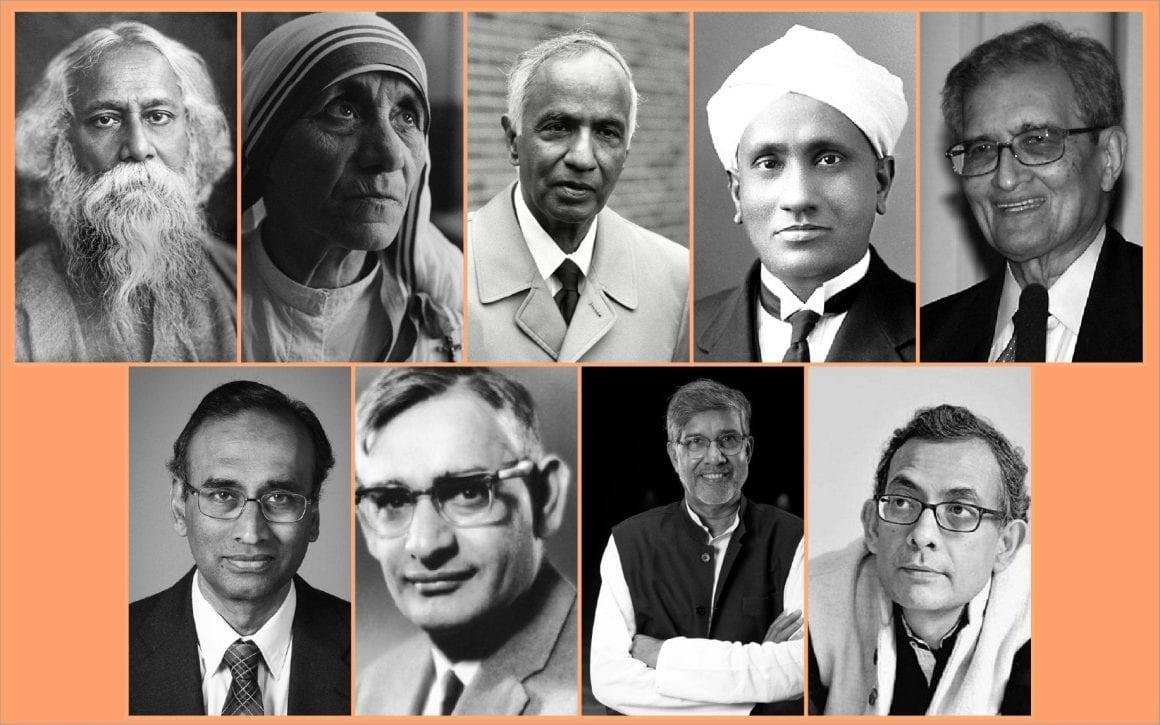
India’s intellectual and humanitarian footprint on the global stage is profound, with several laureates hailing from the subcontinent. From Rabindranath Tagore, the first Asian to win the prize in 1913, to modern economists like Abhijit Banerjee, Indian Nobel Prize winners have revolutionized science, literature, and social welfare.
Chronological List of Indian Nobel Laureates
The following table provides a comprehensive overview of individuals who were either Indian citizens at the time of the award or were Indians by birth who later acquired foreign citizenship.
| S.No | Name | Year | Category | Focus Area |
| 1 | Rabindranath Tagore | 1913 | Literature | Poetry and Spiritual Verse |
| 2 | C. V. Raman | 1930 | Physics | Light Scattering (Raman Effect) |
| 3 | Har Gobind Khorana | 1968 | Medicine | Genetic Code & Protein Synthesis |
| 4 | Mother Teresa | 1979 | Peace | Humanitarian Service |
| 5 | S. Chandrasekhar | 1983 | Physics | Stellar Evolution & Structure |
| 6 | Amartya Sen | 1998 | Economics | Welfare Economics & Famine Studies |
| 7 | Venkatraman Ramakrishnan | 2009 | Chemistry | Ribosome Structure & Function |
| 8 | Kailash Satyarthi | 2014 | Peace | Child Rights & Anti-Child Labor |
| 9 | Abhijit Banerjee | 2019 | Economics | Experimental Poverty Alleviation |
Profiles of Indian Nobel Prize Winners and Their Achievements
1. Rabindranath Tagore (Literature, 1913)
Rabindranath Tagore was the first non-European and first Indian to receive the Nobel Prize. He was recognized for his “profoundly sensitive, fresh and beautiful verse” in his collection, Gitanjali (Song Offerings).
- Literary Synthesis: His work bridged the gap between Eastern spiritual traditions and Western literary forms.
- Global Impact: Beyond poetry, he was a philosopher and social reformer whose writings on peace and nature gained a massive international following.
2. Sir C.V. Raman (Physics, 1930)
Sir Chandrasekhara Venkata Raman earned the prize for his discovery of the Raman Effect, which involves the scattering of monochromatic light when it passes through a transparent medium.
- Scientific Significance: The discovery proved that light changes its wavelength when scattered by molecules, providing a “fingerprint” for molecular structures.
- Legacy: His work laid the foundation for Raman Spectroscopy, used today in chemistry, medicine, and material science to analyze molecular vibrations.
3. Har Gobind Khorana (Physiology/Medicine, 1968)
An Indian-born American biochemist, Khorana shared the prize with Marshall W. Nirenberg and Robert W. Holley.
- Deciphering the Code: He helped interpret the genetic code, demonstrating how the order of nucleotides in nucleic acids (the cell’s “instruction manual”) determines the sequence of amino acids in proteins.
- Protein Synthesis: He was the first to chemically synthesize oligonucleotides, essentially showing how proteins are built based on genetic instructions.
4. Mother Teresa (Peace, 1979)
Born in Skopje and later moving to India, Mother Teresa founded the Missionaries of Charity in Calcutta in 1950.
- Humanitarian Service: She dedicated her life to caring for “the hungry, the naked, the homeless, the crippled, and the blind.”
- Global Recognition: Prior to the Nobel, she received the Pope John XXIII Peace Prize (1971) and the Nehru Prize (1972).
5. Subrahmanyan Chandrasekhar (Physics, 1983)
Chandrasekhar shared the honor with W.A. Fowler for his theoretical studies on the physical processes governing the structure and evolution of stars.
- The Chandrasekhar Limit: He discovered the maximum mass (approximately 44 times the mass of the Sun) that a white dwarf star can have while remaining stable.
- Astrophysical Legacy: His mathematical models were crucial for the later understanding of Supernovas, White Dwarfs, and Black Holes.
6. Amartya Sen (Economic Sciences, 1998)
Amartya Sen was recognized for his massive contributions to Welfare Economics.
- Famine Analysis: He famously argued that famines are often caused by a lack of “entitlements” or social inequality rather than just a lack of food.
- Social Choice Theory: Sen clarified conditions for collective decision-making and individual rights, helping to create better poverty indicators and human development indices.
7. Venkatraman Ramakrishnan (Chemistry, 2009)
Ramakrishnan, an Indian-born American and British structural biologist, shared the prize for his research on the ribosome.
- Mapping the Ribosome: Using X-ray crystallography, his team mapped the 3D structure of the ribosome.
- Antibiotic Development: Since ribosomes are the protein factories of cells, understanding their structure is vital for creating antibiotics that can block bacterial ribosomes without harming human ones.
8. Kailash Satyarthi (Peace, 2014)
Kailash Satyarthi shared the Peace Prize with Malala Yousafzai for their struggle against the suppression of children and for the right of all children to education.
- Bachpan Bachao Andolan: His organization has liberated over 100,000 children from child labor and slavery.
- Global March: He led the Global March Against Child Labour, which influenced international laws (ILO Convention 182).
- Policy Impact: He played a pivotal role in making education a fundamental right in the Indian Constitution.
9. Abhijit Banerjee (Economic Sciences, 2019)
Banerjee shared the prize with Esther Duflo and Michael Kremer for their experimental approach to alleviating global poverty.
- Randomized Control Trials (RCTs): Their methodology involves breaking poverty down into smaller, measurable questions (e.g., the impact of textbooks vs. school meals) and testing them through field experiments.
- Revolutionizing Policy: This approach has changed how development aid is allocated, ensuring resources go to proven, cost-effective interventions.
Frequently Asked Questions (FAQs)
WHO WAS THE FIRST INDIAN TO WIN A NOBEL PRIZE?
Rabindranath Tagore was the first Indian to win the Nobel Prize in 1913 in the category of Literature.
FOR WHICH DISCOVERY DID C.V. RAMAN WIN THE NOBEL PRIZE?
Sir C.V. Raman won the Nobel Prize in Physics in 1930 for his work on the scattering of light and the discovery of the Raman Effect.
IN WHICH CATEGORIES HAS INDIA WON THE NOBEL PRIZE?
India (including citizens and those of Indian origin) has won Nobel Prizes in all six categories: Physics, Chemistry, Physiology or Medicine, Literature, Peace, and Economic Sciences.
WHO IS THE ONLY INDIAN WOMAN TO WIN A NOBEL PRIZE?
Mother Teresa is the only Indian woman to have been awarded the Nobel Peace Prize (1979).
WHAT IS THE CHANDRASEKHAR LIMIT?
Discovered by Subrahmanyan Chandrasekhar, it is the maximum mass (about 1.4 times the Sun’s mass) that a white dwarf star can reach before collapsing into a neutron star or black hole.
WHICH NOBEL LAUREATE IS ASSOCIATED WITH THE BACHPAN BACHAO ANDOLAN?
Kailash Satyarthi, the 2014 Nobel Peace Prize winner, founded the Bachpan Bachao Andolan to fight child labor and exploitation.
HOW DID AMARTYA SEN CONTRIBUTE TO ECONOMICS?
Amartya Sen is known for his work in welfare economics and social choice theory, specifically for his research into the causes of famines and poverty.
WHO WON THE NOBEL PRIZE FOR RESEARCH ON RIBOSOMES?
Venkatraman Ramakrishnan won the Nobel Prize in Chemistry in 2009 for his studies on the structure and function of the ribosome.
WHO ARE THE RECENT INDIAN-ORIGIN NOBEL LAUREATES?
The most recent laureates are Abhijit Banerjee (Economics, 2019) and Kailash Satyarthi (Peace, 2014).
WHO FOUNDED THE NOBEL PRIZE?
The Nobel Prize was founded by Alfred Nobel, a Swedish chemist, engineer, and inventor of dynamite.