The Indus Valley Civilization (IVC) represents the earliest known urban culture in the northwestern regions of the Indian subcontinent. Flourishing approximately between 3300 BCE and 1300 BCE, it stands as one of the world’s three foundational civilizations alongside Mesopotamia and Ancient Egypt. Characterized by sophisticated urban planning, advanced metallurgy, and extensive trade networks, the IVC is also frequently referred to as Harappan Culture, named after the first site excavated in 1921.
1. Origin and Discovery of the Indus Valley Civilization
The civilization evolved from Neolithic villages in the Indus River basin, adopting a model of irrigated agriculture similar to that of Mesopotamia.
- Initial Settlers: The Indus Valley was among the first global hubs where humans transitioned to a highly sedentary and civilized lifestyle. It is also referred to as the Indus-Sarasvati Civilization due to the high density of sites found along the now-dry Ghaggar-Hakra river bed.
- Key Discoveries: The world learned of the IVC in 1924 when John Marshall announced its existence. Historically, Charles Masson was the first to note the ruins of Harappa in the 19th century. Systematic excavations in 1921 by Daya Ram Sahni (Harappa) and in 1922 by Rakhaldas Banerjee (Mohenjo-Daro).
- Geographical Advantages: The vast plains were highly fertile due to annual alluvial deposits from floods. Although the region is currently arid, the presence of diverse flora and fauna on Indus Seals suggests that moderate, wet climatic conditions prevailed during the civilization’s peak.
2. Chronology: The Three Phases of Harappan Culture
Using Radiocarbon dating, historians divide the civilization into three distinct developmental stages:
| Phase | Dates | Key Features | Important Sites |
| Early Harappan | 3300–2600 BCE | Fortification, grid planning, and incipient trade. | Kot Diji, Amri, Harappa |
| Mature Harappan | 2600–1800 BCE | Full-scale urbanization, emergence of writing, and global trade. | Mohenjo-Daro, Harappa, Dholavira |
| Late Harappan | 1800–1300 BCE | Decline of cities, rise of pastoralism, and site abandonment. | Rangpur, Rojdi, Cemetery H |
3. Map and Geographical Extent
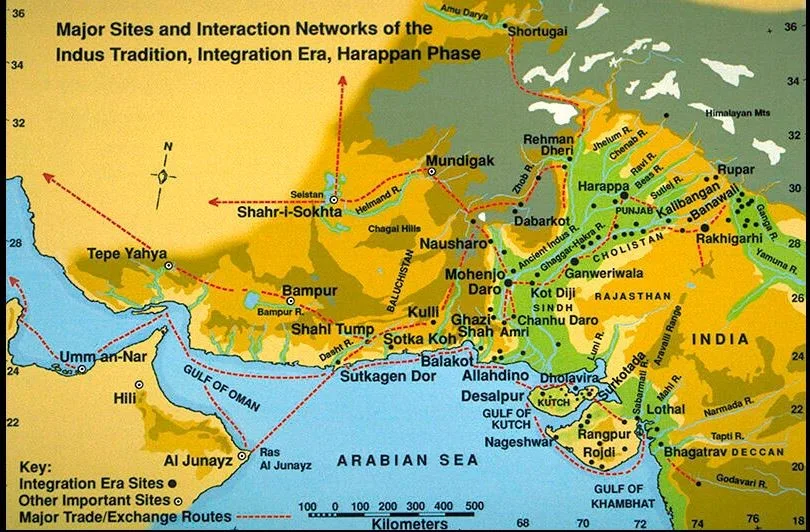
The IVC encompassed a massive area of approximately 1,299,600 square km, surpassing the geographical reach of contemporary Egypt and Mesopotamia.
- Northern Boundary: Manda (Jammu)
- Southern Boundary: Daimabad (Maharashtra)
- Western Boundary: Sutkagendor (Balochistan, Pakistan)
- Eastern Boundary: Alamgirpur (Uttar Pradesh)
The civilization thrived primarily in riverine lowlands but extended into the highlands of Balochistan and the coastal strips of Gujarat.
4. Major Indus Valley Sites and Significant Findings
Excavations across India and Pakistan have revealed unique features for each major settlement:
Harappa (Punjab, Pakistan – Ravi River)
1 Citadel and Lower Town: The city followed a dual-division layout.
2 Great Granary: Located within the citadel for food security.
3 Advanced Drainage: Utilization of baked bricks for subsurface sewage.
4 Burial Practices: Evidence of coffin burials was discovered here.
Mohenjo-Daro (Sindh, Pakistan – Indus River)
1 The Great Bath: A sophisticated ritualistic bathing site.
2 Iconic Art: The Bronze “Dancing Girl” statue and the steatite sculpture of the Bearded Man.
3 Seals: The famous Pashupati Seal depicting a proto-Shiva figure.
Rakhigarhi (Haryana, India – Sarasvati River)
1 Genetic Significance: DNA analysis suggests inhabitants had a distinct indigenous origin.
2 Urban Infrastructure: Features mud and burnt brick homes with proper sanitation.
3 Unique Artifact: A seal featuring an alligator symbol.
Dholavira (Gujarat, India – Rann of Kutch)
1 Three-Part Division: Consists of a citadel, middle town, and lower town.
2 Water Management: Renowned for its cascading water reservoirs and sophisticated harvesting systems.
3 UNESCO Status: Recognized as a World Heritage Site in 2021.
Lothal (Gujarat, India – Gulf of Khambhat)
1 Tidal Dockyard: The world’s earliest known artificial dockyard, making it a vital port town.
2 Industry: A significant bead factory was discovered here.
3 Agriculture: Revealed the earliest evidence of rice cultivation in South Asia.
Kalibangan (Rajasthan, India – Ghaggar River)
1 Agriculture: Home to the world’s earliest attested ploughed field.
2 Rituals: Discovery of fire altars suggests specific religious ceremonies.
3 Pottery: Presence of Mesopotamian pottery indicates strong international trade.
5. Distinctive Features of the Civilization
Town Planning and Infrastructure
1 Grid Pattern: Streets were wide and straight, intersecting at right angles (grid system).
2 Building Material: Extensive use of standardized burnt bricks for housing and public works.
3 Sanitation: An unparalleled drainage system where every house had a washbasin flowing into covered subsurface drains made of mortar, lime, and gypsum.
Economic and Social Life
1 Agriculture: The primary occupation, producing wheat, barley, and peas. They used wooden ploughshares and relied on annual flood irrigation.
2 Domestication: Animals like buffaloes, oxen, and camels were domesticated. However, the Harappans were generally unfamiliar with the horse.
3 Trade: Flourishing internal and external trade with Mesopotamia. Exports included jewelry, pottery, and grain.
4 Metallurgy: Advanced knowledge of copper, gold, and silver. The “lost wax” technique was used for metal casting.
Religious and Artistic Practices
1 Mother Goddess: Worship of female figurines representing fertility.
2 Proto-Shiva: A male deity depicted in a yogic posture (mulabandhasana) on seals.
3 Tree Veneration: Evidence of paying obeisance to the pipal tree.
4 Script: A pictorial script written in Boustrophedon style (alternating directions). It remains undeciphered.
5 Seals: Small steatite tablets used for trade, bearing animal motifs and text.
6. The Decline of the Indus Valley Civilization
By 1300 BCE, the civilization collapsed. Historians propose several theories for this decline:
1 Climatic Changes: A gradual shift toward extreme aridity made the region inhospitable for agriculture.
2 Natural Calamities: Large-scale floods or earthquakes may have destroyed urban centers.
3 Hydrological Shifts: The Indus and Sarasvati rivers changed their courses around 1900 BCE, disrupting irrigation and trade routes.
4 Aryan Advent: Some theories link the decline to the migration of Aryan groups into the subcontinent.
Frequently Asked Questions (FAQs)
WHAT IS THE PERIOD OF INDUS VALLEY CIVILIZATION?
The civilization thrived from 3300 BCE to 1300 BCE, with its urban peak (Mature Harappan phase) occurring between 2600 BCE and 1800 BCE.
WHY IS THE INDUS VALLEY CIVILISATION CALLED HARAPPAN CIVILISATION?
It is named after Harappa, which was the first site of this culture to be excavated in 1921.
WHAT IS HARAPPAN SCRIPT?
It is a pictorial script consisting of various symbols. It is written in a Boustrophedon style (right-to-left and left-to-right) and has not yet been deciphered.
WHAT ARE THE FEATURES OF HARAPPAN SEALS?
Harappan seals are usually small, rectangular, and made of steatite. They feature engravings of animals (unicorns, bulls, tigers), human figures, and a short script used primarily for trade.
WHICH SITE IS KNOWN FOR THE GREAT BATH?
The Great Bath is the most famous structure located at Mohenjo-Daro.
DID THE HARAPPANS KNOW ABOUT HORSES?
Current archaeological evidence suggests that while they were familiar with many animals, the Harappans were generally not familiar with the horse for domestic or military use.
WHAT WAS THE MAIN OCCUPATION OF THE IVC PEOPLE?
Agriculture was the primary occupation, supplemented by flourishing internal and international trade.
WHICH SITE HAS THE EARLIEST EVIDENCE OF A PLOUGHED FIELD?
The earliest attested ploughed field was discovered at Kalibangan in Rajasthan.
WHAT IS THE SIGNIFICANCE OF THE DOCKYARD AT LOTHAL?
The dockyard at Lothal is the earliest known artificial dock in the world, proving that the Harappans were maritime experts who traded across the Arabian Sea.