Important questions for UPSC Pre/ Mains/ Interview:
|
Context
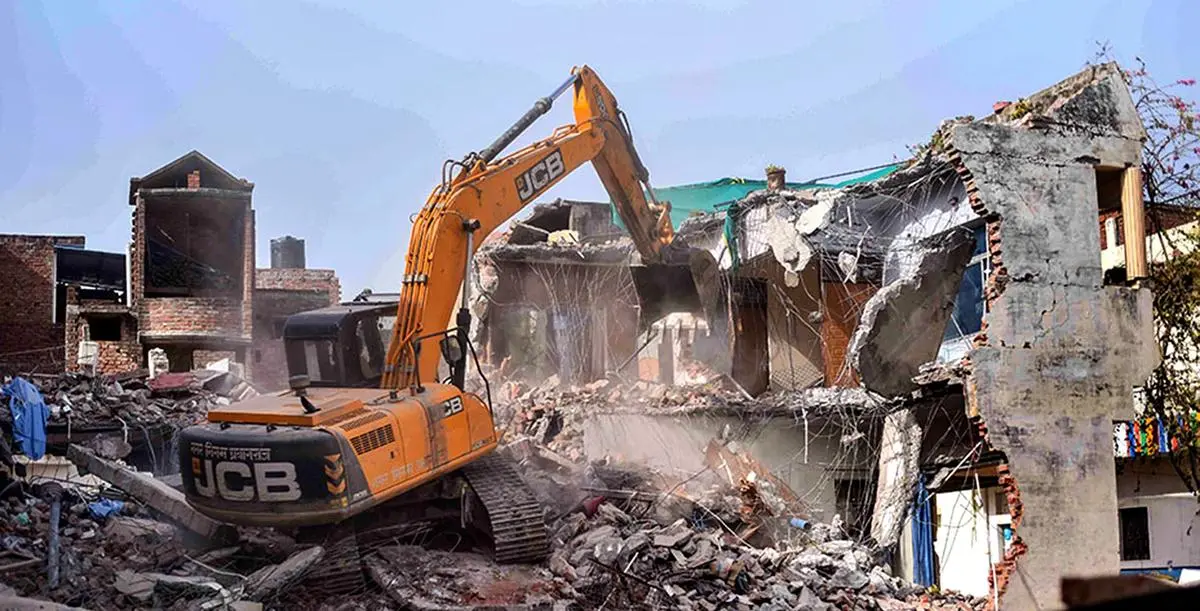
Recent observations by the Allahabad High Court have revived debate over “bulldozer justice” in Uttar Pradesh, where properties of persons accused of crimes are demolished soon after FIR registration. Despite Supreme Court directions in 2024 restricting such actions, concerns persist about executive overreach and violation of constitutional safeguards.
Q1. What is meant by ‘Bulldozer Justice’ and why has it become controversial?
- Refers to demolition of properties of persons accused of crimes.
- Often initiated soon after FIR registration.
- Targets homes or commercial establishments linked to accused individuals.
- Criticised for bypassing judicial adjudication.
- Seen as executive punishment without trial.
Q2. What legal framework governs demolition of properties in Uttar Pradesh?
- Governed by laws such as:
- Uttar Pradesh Municipal Corporation Act, 1959
- Uttar Pradesh Urban Planning and Development Act, 1973
- Demolition permitted only for unauthorised constructions.
- Mandatory procedural steps include:
- Identification of violation
- Written notice specifying grounds
- Opportunity to respond
- Consideration of objections
- Reasoned administrative order
- Provision for appeals and regularisation.
- Municipal powers are regulatory, not punitive.
Q3. What constitutional principles are implicated in such demolitions?
- Article 14: Equality before law and protection from arbitrary state action.
- Article 21: Protection of life and personal liberty, including due process.
- Presumption of innocence until proven guilty.
- Separation of powers between executive and judiciary.
- Prohibition of colourable exercise of power.
- Punishment is a judicial function; executive cannot assume this role.
Q4. What did the Supreme Court clarify in 2024 regarding demolitions?
- Property cannot be demolished merely because the owner is accused of a crime.
- Criminal guilt must be established through judicial process.
- Municipal powers cannot be used as parallel punitive mechanisms.
- Courts will examine:
- Timing of demolition
- Target selection
- Administrative intent
- Substance, not mere legal form, determines validity.
Q5. What concerns did the Allahabad High Court raise in the present case?
- Demolitions becoming routine after FIR registration.
- Petitioners not named as accused but faced sealing and notices.
- Framed constitutional questions:
- Whether demolitions violate Supreme Court directives.
- Whether rights under Articles 14 and 21 are infringed.
- Emphasised that punishment lies exclusively within judicial domain.
- Even threat of demolition may violate fundamental rights.
Q6. What are the broader governance implications of Bulldozer Justice?
Benefits Claimed by Supporters:
- Strong deterrent effect.
- Signals swift state response against crime.
- Projects strict law enforcement.
Constitutional Risks:
- Erosion of due process.
- Executive dominance over judicial function.
- Irreversible harm to families later found innocent.
- Weakening of institutional credibility.
- Politicisation of municipal enforcement.
Short-term optics may undermine long-term constitutional legitimacy.
Q7. How can regulation be balanced with constitutional safeguards?
- Strict adherence to procedural safeguards.
- Transparent documentation and reasoned orders.
- Separation of criminal proceedings from municipal regulation.
- Judicial review before irreversible action.
- Accountability mechanisms for misuse of authority.
Urban governance must distinguish clearly between regulation and punishment.
Conclusion
The debate over bulldozer justice reflects a deeper constitutional tension between executive assertiveness and judicial due process. While municipal authorities must enforce urban regulations, such powers cannot be transformed into instruments of punishment based on mere allegations. Upholding rule of law requires that accountability follow adjudication, not precede it.