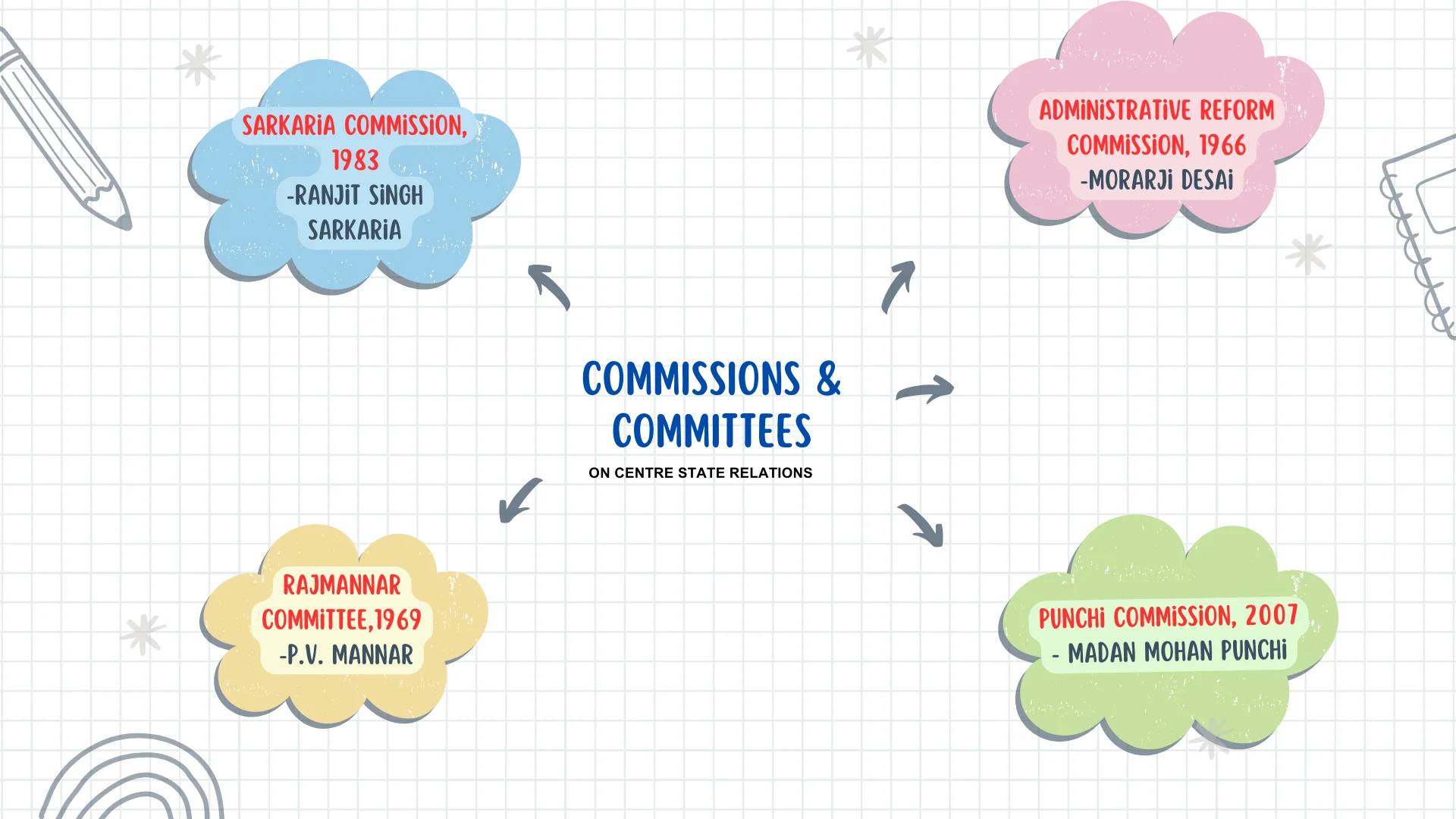
The Sarkaria Commission was a landmark initiative established in 1983 by the Government of India to review and revitalize the federal structure of the country. Chaired by Justice R. S. Sarkaria, a retired judge of the Supreme Court, the commission was tasked with examining the evolving dynamics between the Union and the States. Its primary focus was to mitigate the frequent “clash of interests” that disrupted democratic machinery and to promote the spirit of Cooperative Federalism.
It has eminent members such as Shri B. Sivaraman and Dr. S. R. Sen, the commission meticulously studied legislative, administrative, and financial relations. Its final report remains the most authoritative blueprint for balancing national integrity with regional autonomy in the Indian polity.
Sarkaria Commission on Emergency Provisions (Article 356)
One of the most critical areas addressed by the commission was the frequent and often controversial use of President’s Rule. The commission advocated for extreme restraint to prevent the subversion of state-level democracy.
1 The commission emphasized that Article 356 should be invoked very sparingly and only as a measure of last resort after all other alternatives to rectify a constitutional breakdown have been exhausted.
2 Before taking action, a formal warning should be issued to the errant State government, allowing them an opportunity to correct their course.
3 The Governor and the President must duly consider any explanation provided by the State before a proclamation is issued.
4 In the event of a political breakdown (hung assembly), the Governor is constitutionally bound to explore all possibilities of forming a government that enjoys majority support.
5 A crucial procedural recommendation stated that the State Legislative Assembly should not be dissolved until the proclamation under Article 356(1) has been laid before and approved by the Parliament.
Recommendations on the Inter-State Council
To institutionalize dialogue between different levels of government, the Sarkaria Commission proposed a permanent forum for coordination.
1 The commission recommended the establishment of a permanent Inter-State Council under Article 263, which it suggested calling the “Inter-Governmental Council.”
2 This Council was envisioned to have a General Body assisted by a smaller, more agile Standing Committee.
3 The General Body would be composed of the Prime Minister as Chairman, all State Chief Ministers, and relevant Union Cabinet Ministers.
Guidelines for the Appointment and Role of the Governor
The commission sought to depoliticize the office of the Governor to ensure it functioned as a “detached” constitutional bridge.
1 The Chief Minister of the concerned State must be consulted before the appointment of a Governor.
2 The appointee should be an eminent person in some walk of life and must be from outside the State to ensure impartiality.
3 The Governor should be a detached figure, not deeply involved in local politics or the active politics of the Union’s ruling party in recent years.
4 A politician from the ruling party at the Centre should not be appointed as Governor in a State governed by an opposition party.
5 The standard tenure should be five years, and the Governor should not be removed before the completion of this term except in highly exceptional circumstances.
Strengthening All-India Services (AIS)
Contrary to some regional demands for the abolition of these services, the Sarkaria Commission viewed them as essential for national unity.
1 The commission strongly opposed disbanding the All-India Services, viewing them as vital for maintaining administrative standards across the country.
2 It recommended a shift from “generalism” to greater specialization in specific areas of public administration.
3 selection, training, deployment, and promotion processes should be continuously improved and aligned with the need for specialized expertise.
Legislative and Financial Relations
The commission provided a nuanced view on how power should be distributed to ensure smooth policy implementation.
Legislative Recommendations
1 Residuary Powers: While residuary powers related to taxation should remain with the Parliament, all other residuary subjects should be transferred to the Concurrent List.
2 Mutual Consultation: The Union should consult States before legislating on subjects in the Concurrent List.
3 Education: While the Union sets standards (via the U.G.C.), the actual implementation of educational policies should be left entirely to the States.
4 Legislative Councils: If a State Assembly passes a resolution to create or abolish a Legislative Council, the Parliament should decide on the matter within a reasonable timeframe.
Financial Recommendations
1 Surcharge on Income Tax: The Union should not levy a surcharge except for a specific purpose and for a strictly limited period.
2 Expertise in Finance Commission: The Finance Commission should draw upon diverse experts from different parts of the country to ensure balanced fiscal federalism.
3 State-level Expert Bodies: The commission suggested creating bodies similar to the Finance Commission at the State level to manage funds for backward regions.
Other Administrative and Disciplinary Recommendations
1 State Bills: The Governor should not act against the advice of the Council of Ministers when dealing with State Bills, except when reserving them for the President under Article 200.
2 Ordinance Power: State governments should stop the practice of re-promulgating Ordinances without attempting to pass them as Acts in the Legislature.
3 Water Disputes: The Inter-State Water Disputes Act should be amended to allow the Union Government to appoint a tribunal suo motu (on its own motion) when a dispute is confirmed.
4 Local Language: Government work affecting the local population should be conducted in the local language to ensure transparency in a welfare state.
Significance and Legacy
The Sarkaria Commission’s report is a foundational document in Indian federalism. Although not every recommendation was adopted, it led to the formal establishment of the Inter-State Council in 1990. It set the stage for the Punchhi Commission and continues to be cited by the Judiciary in landmark cases involving the dismissal of state governments and the discretionary powers of Governors.
FAQs: Sarkaria Commission
WHAT WAS THE PRIMARY PURPOSE OF THE SARKARIA COMMISSION?
The primary purpose was to review the functional balance between the Central and State governments and recommend reforms to improve Centre-State relations.
WHO HEADED THE SARKARIA COMMISSION?
The commission was headed by Justice R. S. Sarkaria, a retired judge of the Supreme Court of India.
WHAT DID THE COMMISSION RECOMMEND REGARDING ARTICLE 356?
It recommended that Article 356 (President’s Rule) should be used only as a last resort in extreme cases of constitutional breakdown.
DID THE COMMISSION SUPPORT THE ABOLITION OF ALL-INDIA SERVICES?
No, the commission strongly opposed the abolition of All-India Services, stating they were essential for national integrity.
WHAT WERE THE GUIDELINES FOR APPOINTING A GOVERNOR?
The commission suggested that the Governor should be an eminent person from outside the state who is not involved in active local politics.
WHICH CONSTITUTIONAL BODY WAS ESTABLISHED BASED ON THE COMMISSION’S REPORT?
The Inter-State Council was established in 1990 following the recommendations of the Sarkaria Commission.
WHAT WAS THE COMMISSION’S VIEW ON RESIDUARY POWERS?
It recommended that residuary powers related to taxation should stay with Parliament, while others should be moved to the Concurrent List.
DID THE COMMISSION RECOMMEND CONSULTING CHIEF MINISTERS ON GOVERNOR APPOINTMENTS?
Yes, it emphasized that the State Chief Minister must be consulted before the appointment of a Governor.
WHAT WAS THE RECOMMENDATION REGARDING INTER-STATE WATER DISPUTES?
It suggested that the Union Government should have the power to appoint a water dispute tribunal on its own motion (suo motu).
WHEN WAS THE SARKARIA COMMISSION REPORT SUBMITTED?
The commission was set up in 1983 and submitted its comprehensive report in 1988.