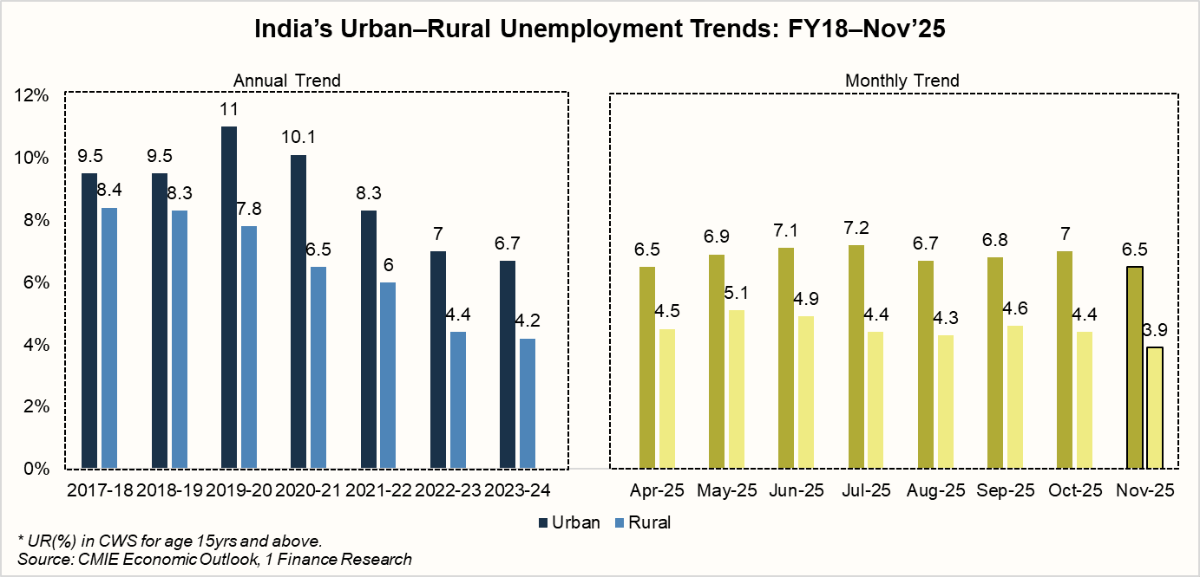
The unemployment rate in India serves as a vital barometer for the nation’s macroeconomic health. According to the Economic Survey 2024–25, India has witnessed a significant structural improvement, with the unemployment rate dropping from 6% in 2017–18 to 3.2% in 2023–24. Despite this positive trajectory, the labor market remains complex, characterized by rural-urban disparities, the rise of the gig economy, and the disruptive influence of Artificial Intelligence (AI).
To sustain this progress, the focus is shifting toward aligning education with industry demands and enhancing private sector participation to bridge the persistent skill gap.
Understanding Unemployment: Meaning and Definitions
Unemployment is a condition where individuals who are mentally and physically capable of working are actively seeking jobs but are unable to find productive work.
- Calculative Metric: The unemployment rate is determined by dividing the number of unemployed individuals by the total labor force (which includes both those working and those actively seeking work).
- ILO Definition: The International Labour Organisation (ILO) specifies that to be considered “unemployed,” an individual must be out of a job, available for work, and actively searching.
- The Non-Seekers: Individuals who have lost their jobs but are not looking for new opportunities are technically excluded from the unemployment statistics.
Major Types of Unemployment in the Indian Context
India’s diverse economy exhibits various forms of joblessness, ranging from transitionary phases to deep structural mismatches.
- Involuntary Unemployment: A situation where people are willing to work at prevailing wages but cannot find jobs due to excess labor supply (e.g., fresh graduates in urban hubs).
- Voluntary Unemployment: When individuals choose not to work despite jobs being available, often due to dissatisfaction with wages or job dignity.
- Structural Unemployment: Arises from a fundamental mismatch between the skills workers possess and the requirements of available jobs, often driven by technological shifts like automation.
- Seasonal Unemployment: Common in industries with fluctuating demand, such as agriculture or tourism, where workers are idle during the “off-season.”
- Cyclical Unemployment: Linked to the business cycle; layoffs occur during economic recessions and hiring resumes during recovery.
- Disguised Unemployment: A scenario where more people are employed than necessary, and their marginal productivity is zero (common in Indian agriculture).
- Frictional Unemployment: The temporary period of joblessness when an individual is in the process of moving from one job to another.
Root Causes of Joblessness in India
Multiple socio-economic factors contribute to the persistence of high unemployment levels among specific demographics.
- Sluggish Economic Growth: The economy occasionally fails to expand fast enough to absorb the massive annual influx of young workers.
- Overpopulation: Rapid demographic growth exerts immense pressure on available job opportunities.
- Seasonal Agriculture: Since a large portion of India depends on farming, many remain unemployed for several months a year.
- Informal Sector Fragility: A lack of job security in the unorganized sector leads to a perception of “inadequate” employment.
- Education-Industry Mismatch: Traditional education often fails to provide technical skills. For instance, reports suggest nearly 80% of engineering graduates are not industry-ready.
- Automation and AI: The Economic Survey 2024 highlighted AI as a potential disruptor that could reduce traditional roles while demanding highly specialized skills.
- Social and Physical Barriers: Caste-based discrimination, illiteracy, and lack of affordable childcare or transport limit workforce participation.
Present Unemployment Trends and Statistics (2024–2026)
The Ministry of Statistics and Programme Implementation (MoSPI) is transitioning to a more frequent reporting cycle to provide real-time data.
Current Metrics (Usual vs. Weekly Status)
- Usual Status (3.2%): Reflects long-term employment trends over a year.
- Current Weekly Status (4.9%): Captures short-term fluctuations based on the seven days preceding the survey.
- Monthly Reporting: Starting May 15, 2025, MoSPI began releasing monthly unemployment data to help policymakers implement district-level strategies.
How India Measures Unemployment: Methodologies
India uses a multi-agency approach to capture data across formal and informal landscapes.
- Periodic Labour Force Survey (PLFS): The primary annual survey by MoSPI measuring LFPR (Labour Force Participation Rate) and WPR (Worker Population Ratio).
- Decennial Census: Provides a 10-year snapshot of workforce distribution.
- CMIE Surveys: Shorter reference periods that offer real-time insights into the dynamic informal market.
- Administrative Data: Statistics from EPFO and Employment Exchanges provide a look at the organized sector.
Impact of Unemployment on Society and Economy
- Human Resource Waste: The “Demographic Dividend” can turn into a “Demographic Disaster” if the workforce is underutilized.
- Rising Poverty: Lack of steady income leads to high debt burdens and reduced consumption.
- Social Unrest: Joblessness is often linked to an increase in crime, unethical behavior, and political instability.
- Labor Exploitation: Desperation for work often forces individuals to accept sub-par wages and poor working conditions.
Government Initiatives to Boost Employment
The Government of India has launched a suite of schemes targeting different sectors of the workforce.
- MGNREGA: Guarantees 100 days of wage employment to rural households for unskilled manual work.
- PMKVY: Facilitates skill certification and industry-relevant training under the Ministry of Skill Development.
- PMEGP: A credit-linked subsidy scheme to help youth establish micro-enterprises.
- National Career Service (NCS): A digital platform for job matching, counseling, and internship information.
- DAY-NULM: Focuses on reducing urban poverty through self-employment and skill training.
- Future Skills PRIME: A MeitY initiative to reskill professionals in emerging technologies like AI and Blockchain.
FAQs: Unemployment in India
WHAT IS DISGUISED UNEMPLOYMENT?
It refers to a situation where more people are working than necessary, meaning the removal of some workers would not reduce total production.
WHAT IS THE DIFFERENCE BETWEEN LFPR AND WPR?
LFPR includes people working or seeking work, while WPR only counts those actually employed.
WHAT IS STRUCTURAL UNEMPLOYMENT?
It occurs when there is a mismatch between the skills workers have and the skills employers need.
HOW DOES THE GOVERNMENT MEASURE RURAL UNEMPLOYMENT?
The PLFS uses the “Usual Status” and “Current Weekly Status” methods to survey rural households.
WHAT IS THE ROLE OF MGNREGA?
It acts as a social safety net providing guaranteed manual work to prevent rural distress.
WHY IS UNEMPLOYMENT HIGH AMONG GRADUATES?
The primary reason is the skill gap, where academic degrees do not align with modern industrial requirements.
HOW DOES AI IMPACT THE JOB MARKET?
AI automates repetitive tasks, reducing traditional jobs, but creates new demand for high-tech specialized roles.
WHAT IS FRICTIONAL UNEMPLOYMENT?
It is the short-term unemployment experienced when a worker is searching for or transitioning between jobs.