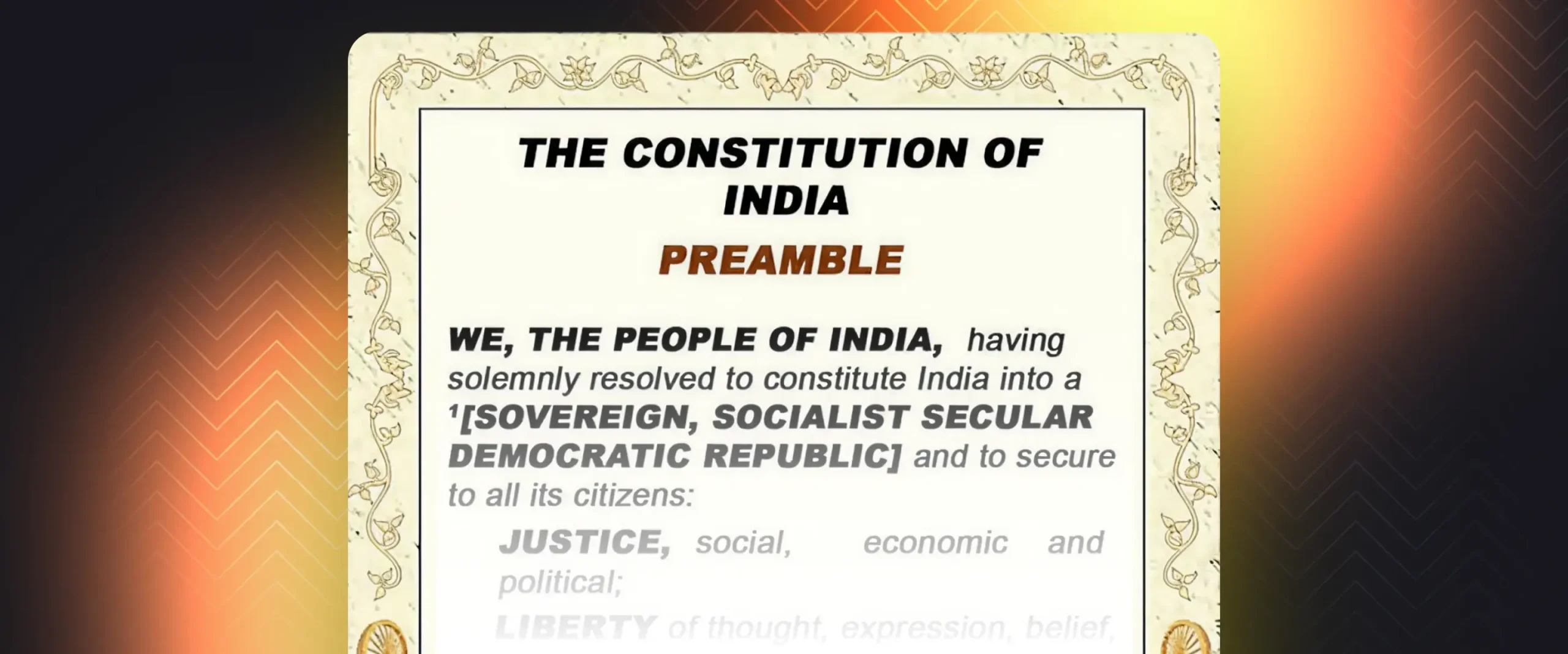
The Preamble of the Indian Constitution serves as the “identity card” and the moral compass of the world’s lengthiest written constitution. It is not merely an introductory statement but a profound declaration of the core values, philosophy, and objectives that embody the Indian state. By defining the source of authority and the ultimate goals of governance, the Preamble acts as the “soul” of the Constitution, providing a guiding light for judicial interpretation.
The Evolution and Historical Background
The Preamble is deeply rooted in the aspirations of the Indian freedom struggle. Its journey from a resolution to the cornerstone of the Constitution is marked by significant historical milestones:
The Objective Resolution
The foundation of the Preamble was laid by Jawaharlal Nehru on December 13, 1946, when he introduced the Objective Resolution in the Constituent Assembly. This resolution outlined the fundamental principles that would guide the drafting process.
- Sovereignty: It declared India an independent sovereign republic.
- Union of India: It envisioned all territories (British India and Princely States) forming a unified Union.
- Popular Sovereignty: It asserted that all powers and authority of the state are derived from the people.
- Social Justice: It guaranteed social, economic, and political justice, alongside freedoms of thought, expression, and belief.
- Minority Protection: It provided specific safeguards for minorities, depressed classes, and tribal areas.
Drafting and Adoption
- The Draft: N. Rao, the Constitutional Advisor, prepared an initial draft.
- Adoption of Resolution: The Constituent Assembly adopted the Objective Resolution on January 22, 1947.
- Final Adoption: The Preamble, in its final form, was adopted by the Constituent Assembly on November 26, 1949 (Constitution Day), and came into effect on January 26, 1950.
The Five Pillars: Ideals of the Indian State
The Preamble describes the nature of the Indian polity through five definitive terms:
- Sovereign: Signifies that India has supreme and independent authority. Internally, the government has ultimate decision-making power; externally, it is free from the control or interference of any foreign power.
- Socialist: Added by the 42nd Amendment (1976), it signifies a commitment to social and economic equality. India follows “Democratic Socialism,” aiming to end poverty, ignorance, and inequality of opportunity via a mixed economy.
- Secular: Also added in 1976, this reflects that the State has no official religion. It practices “Positive Secularism,” where all religions are treated with equal respect and protection.
- Democratic: This implies that the government derives its authority from the will of the people, exercised through regular, free, and fair elections and universal adult franchise.
- Republic: Indicates that the Head of State (the President) is an elected official and not a hereditary monarch. Power resides in the people’s mandate.
The Four Objectives: Aspirations of the People
The Preamble sets out four primary objectives to be achieved for all citizens:
- Justice: Secured in three forms—Social, Economic, and Political. While Fundamental Rights ensure political justice, the Directive Principles (DPSPs) aim for socio-economic justice.
- Liberty: Guarantees liberty of thought, expression, belief, faith, and worship. This is primarily protected through Fundamental Rights.
- Equality: Assures equality of status and opportunity. It prohibits discrimination and promotes affirmative action to ensure equal access to social and economic platforms.
- Fraternity: Aims to promote a sense of brotherhood and unity among all Indians, ensuring the dignity of the individual and the integrity of the nation.
Is the Preamble Part of the Constitution? Judicial Landmarks
The legal status of the Preamble has evolved through critical Supreme Court judgments:
| Case Law | Verdict / Significance |
| Berubari Union Case (1960) | The Court held that the Preamble is NOT a part of the Constitution and serves only as a general guide. |
| Kesavananda Bharati Case (1973) | A historic bench reversed the earlier view, declaring the Preamble IS an integral part of the Constitution. It also introduced the Basic Structure Doctrine. |
| LIC of India Case (1995) | Reaffirmed that the Preamble is an integral part but clarified it is non-justiciable (cannot be enforced in a court of law on its own). |
The 42nd Amendment Act, 1976
The Preamble has been amended only once in history. Based on the Sardar Swaran Singh Committee recommendations, three new words were added:
- Socialist
- Secular
- Integrity (added to the phrase “Unity and Integrity of the nation”)
10 FAQs: Preamble of the Indian Constitution
Who drafted the Preamble of the Indian Constitution?
The Preamble is based on the “Objective Resolution” drafted and moved by Jawaharlal Nehru.
Can the Preamble be amended?
Yes. In the Kesavananda Bharati Case (1973), the Supreme Court ruled that the Preamble can be amended under Article 368, as long as the “Basic Structure” remains untouched.
Which words were added by the 42nd Amendment?
The three words added in 1976 are Socialist, Secular, and Integrity.
What is the source of authority for the Indian Constitution?
The source is “We, the people of India,” indicating that sovereignty lies with the citizens.
Is the Preamble enforceable in a court of law?
No, the Preamble is non-justiciable, meaning its provisions cannot be directly enforced by a court, though it helps in interpreting other articles.
What are the three types of Justice mentioned?
The Preamble promises Social, Economic, and Political justice.
From which country did India adopt the idea of a Preamble?
The idea was inspired by the Constitution of the USA, which was the first to begin with a Preamble.
What date is mentioned in the Preamble?
It mentions November 26, 1949, the date on which the Constituent Assembly adopted and enacted the Constitution.
What does the term “Fraternity” signify?
It signifies a sense of brotherhood among all Indians and aims to maintain the dignity of the individual and the unity/integrity of the nation.
Why is the Preamble called the “Soul of the Constitution”?
It is called so because it encapsulates the fundamental values, the vision of the founding fathers, and the spirit of the entire legal document in a concise summary.