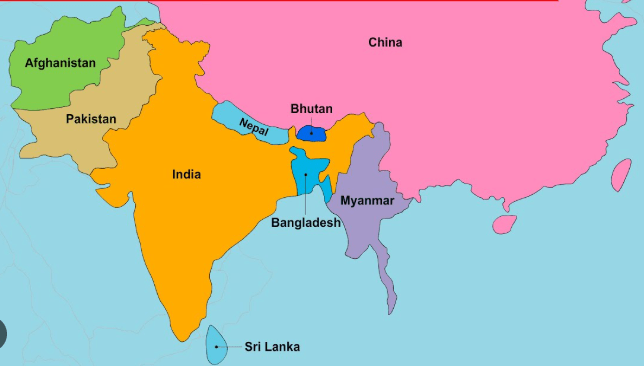
India, a prominent South Asian nation, stands as the seventh-largest country globally by land area. Occupying a central geopolitical position in both the Northern and Eastern Hemispheres, India possesses extensive borders that serve as gateways to diverse cultures, economies, and ecosystems.
India continues to manage its vast frontier of approximately 15,106.7 kilometers of land boundaries and a coastline stretching 7,516.6 kilometers. This geographic spread connects India with nine neighbors—seven by land and two by sea—shaping its “Neighbourhood First” policy and regional strategic interests.
India’s neighborhood is defined by a mix of high-altitude mountain ranges, fertile river plains, and strategic maritime corridors. Below is the essential breakdown of India’s international frontiers:
| Feature | Details |
| Total Neighbouring Countries | 9 (7 Land, 2 Maritime) |
| Land Neighbours | Afghanistan, Pakistan, China, Nepal, Bhutan, Bangladesh, Myanmar |
| Maritime Neighbours | Sri Lanka, Maldives |
| Total Land Border | 15,106.7 km |
| Total Coastline | 7,516.6 km (Mainland + Islands) |
List of Neighbouring Countries with Capitals and Borders
India shares its land and sea borders with nine countries, each maintaining distinct geographical and diplomatic ties.
| Country | Capital | Border Length | Bordering States/Union Territories |
| Bangladesh | Dhaka | 4,096.7 km | West Bengal, Meghalaya, Mizoram, Tripura, Assam |
| China | Beijing | 3,488 km | Ladakh (UT), Himachal Pradesh, Uttarakhand, Sikkim, Arunachal Pradesh |
| Pakistan | Islamabad | 3,323 km | Ladakh (UT), J&K (UT), Punjab, Rajasthan, Gujarat |
| Nepal | Kathmandu | 1,751 km | Bihar, Uttarakhand, Uttar Pradesh, Sikkim, West Bengal |
| Myanmar | Naypyidaw | 1,643 km | Arunachal Pradesh, Nagaland, Mizoram, Manipur |
| Bhutan | Thimphu | 699 km | West Bengal, Sikkim, Arunachal Pradesh, Assam |
| Afghanistan | Kabul | 106 km | Ladakh (PoK region) |
| Sri Lanka | Sri Jayawardenepura Kotte | Sea Border | Separated by the Gulf of Mannar and Palk Strait |
| Maldives | Male | Sea Border | Located in the southwest Indian Ocean, below Lakshadweep |
Profiles of India’s Nine Neighbouring Countries
India’s neighbours are categorized into seven land-sharing nations and two maritime partners.
1. Bangladesh (The Longest Border)
- Border Length: 4,096.7 km (Longest).
- Indian States: West Bengal, Assam, Meghalaya, Tripura, Mizoram.
- Strategic Ties: Built on the foundation of India’s support during the 1971 Liberation War. Focus areas include water-sharing agreements and counter-terrorism.
2. China (The Northern Giant)
- Border Length: 3,488 km.
- Indian States/UTs: Ladakh, Himachal Pradesh, Uttarakhand, Sikkim, Arunachal Pradesh.
- Strategic Ties: Relations are governed by the Panchsheel Agreement (1954), though strained by territorial disputes in Aksai Chin and Arunachal Pradesh.
3. Pakistan (The Northwestern Neighbour)
- Border Length: 3,323 km.
- Indian States/UTs: Ladakh, J&K, Punjab, Rajasthan, Gujarat.
- Strategic Ties: Roots lie in the 1947 partition. Despite conflicts like the 1965 and 1999 (Kargil) wars, cultural and linguistic links remain deep.
4. Nepal
- Border Length: 1,751 km.
- Indian States: Bihar, Uttarakhand, UP, Sikkim, West Bengal.
- Strategic Ties: A unique “open border” policy allows citizens to travel and work freely. Shared ties are reinforced through the Himalayas and Hinduism/Buddhism.
5. Myanmar
- Border Length: 1,643 km.
- Indian States: Arunachal Pradesh, Nagaland, Mizoram, Manipur.
- Strategic Ties: A critical pillar of the “Act East Policy.” Cooperation focuses on border trade (Moreh-Tamu) and counter-insurgency.
6. Bhutan
- Border Length: 699 km.
- Indian States: West Bengal, Sikkim, Arunachal Pradesh, Assam.
- Strategic Ties: Characterized by absolute trust. India significantly assists in Bhutan’s defense and hydropower development.
7. Afghanistan
- Border Length: 106 km (Shortest).
- Location: Touches Ladakh (in the PoK region).
- Strategic Ties: Historically linked via the Silk Route. India has invested heavily in Afghan infrastructure and education.
8. Sri Lanka
- Location: Southern maritime border across the Palk Strait and Gulf of Mannar.
- Strategic Ties: Separated by just 30 km (Adam’s Bridge). Historical links through Buddhism and the Tamil population shape a deep, multi-layered partnership.
9. Maldives
- Location: Southwest of India, below the Lakshadweep Islands.
- Strategic Ties: A key maritime neighbor for security and disaster relief. India often acts as the “first responder” for the Maldives.
Physical Features and Strategic Interests
India’s borders are defined by diverse climates and terrains, which directly influence trade and security.
Land Boundaries
- The Northern Frontier: Dominated by the Himalayas, which act as a natural barrier between India, China, Nepal, and Bhutan. This region is high-altitude, earthquake-prone, and critical for India’s water and energy security via hydropower.
- The Eastern Frontier: Shared with Bangladesh and Myanmar, characterized by dense river networks (Ganga-Brahmaputra-Meghna delta) and tropical forests. It is vital for the “Act East Policy” and counter-insurgency operations.
- The Western Frontier: Borders Pakistan and Afghanistan. It includes the Thar Desert and the fertile Punjab plains. This region is geologically active and strategically sensitive due to cross-border dynamics.
Maritime Boundaries
- The Southern Frontier: The Indian Ocean serves as a strategic theater. Sri Lanka and Maldives are key to India’s maritime domain awareness and the security of international sea lanes.
Key Bilateral Relations and Regional Frameworks
- India-China: A complex relationship involving both significant trade and strategic competition along the Line of Actual Control (LAC).
- India-Pakistan: Historically strained, with de facto borders like the Line of Control (LoC). Cooperation is primarily focused on managing shared rivers like the Indus.
- Neighbourhood First Policy: India prioritizes regional connectivity, infrastructure development (like the IMT Highway), and economic assistance to neighbors like Bhutan and Nepal.
- SAARC & BIMSTEC: While SAARC (est. 1985) has faced suspension due to political tensions, India has pivoted toward BIMSTEC to foster cooperation with eastern neighbors.
Ten FAQs on India’s Neighbours
Which country shares the longest border with India?
Bangladesh shares the longest border with India, measuring approximately 4,096.7 km.
How many countries share a land border with India?
Seven countries—Pakistan, China, Nepal, Bhutan, Bangladesh, Myanmar, and Afghanistan—share land borders with India.
Which neighbor is separated from India by the Palk Strait?
Sri Lanka is separated from mainland India by the Palk Strait and the Gulf of Mannar.
What is the capital of Myanmar?
The capital of Myanmar is Naypyidaw (formerly Yangon).
Which Indian state shares its border with the maximum number of neighbors?
States like West Bengal, Sikkim, and Arunachal Pradesh share borders with three different countries each.
What is the length of India’s border with Afghanistan?
India shares its shortest land border of 106 km with Afghanistan in the Ladakh (PoK) region.
Which body of water lies between India and the Maldives?
The Maldives is located in the Arabian Sea/Indian Ocean, southwest of India’s Lakshadweep Islands.
What are India’s two maritime neighbors?
Sri Lanka and the Maldives are India’s two maritime neighbors.
Which Himalayan kingdom is a landlocked neighbor to India’s northeast?
Bhutan is a landlocked neighbor situated between India and China.
What is the name of the border line between India and China?
The border line in the northeastern sector is known as the McMahon Line, while the de facto border is the Line of Actual Control (LAC).