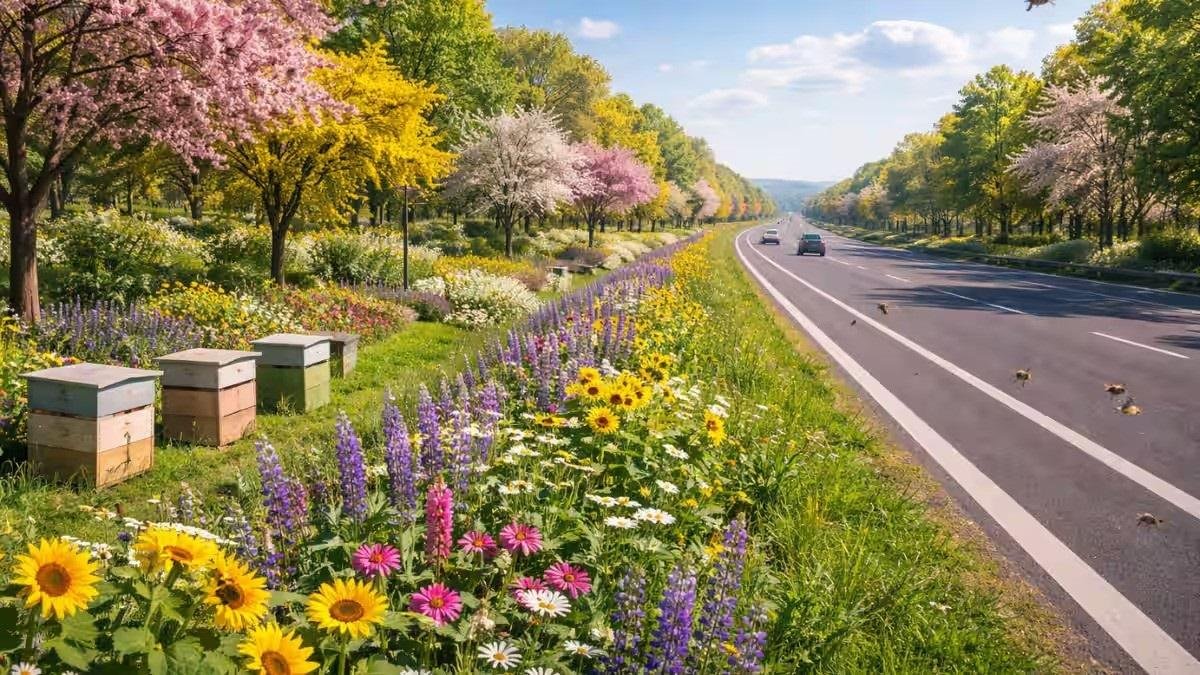
- As the population of honeybees were declining (due to habitat loss, climate stress, & reduced availability of flowering plants), National Highways Authority of India (NHAI) introduced BeeCorridors along the National Highway.
- What are BeeCorridors: They are continuous linear belts of bee-friendly vegetation (like flowering trees, nectar-rich shrubs and pollen producing plants) planted along highways which form a green pathway running parallel to the road.
- Importance: They help reduce ecological pressure on bees, reconnect fragmented habitats, improve survival chances of pollinators in urban and semi-urban landscapes and strengthen biodiversity along transport infrastructure.
- Bees and their importance:
- Bees only feed on sugary nectar (energy source) and protein rich pollen (for growth and reproduction). So, their survival directly depends on flowering plants.
- Only female bees possess stingers which are actually modified ovipositors (organs originally meant for laying eggs).
- They are important because nearly one-third of global food production depends on bee pollination. They help plants reproduce by transferring pollen between flowers. Many fruits, vegetables, nuts, and oilseeds rely on bees.
- Without bees, crop yields would fall sharply, food diversity would reduce and ecosystems would weaken.
FAQs
Q1. What are BeeCorridors?
They are continuous belts of bee-friendly vegetation planted along highways to support pollinators.
Q2. Why were BeeCorridors introduced?
To counter honeybee decline caused by habitat loss, climate stress, and reduced flowering plants.
Q3. How do BeeCorridors help bees?
They reconnect fragmented habitats, provide nectar and pollen, and improve survival chances.
Q4. Why are bees important for humans?
Nearly one-third of global food production depends on bee pollination for fruits, vegetables, nuts, and oilseeds.
Q5. Do all bees sting?
No, only female bees have stingers, which are modified egg-laying organs (ovipositors).