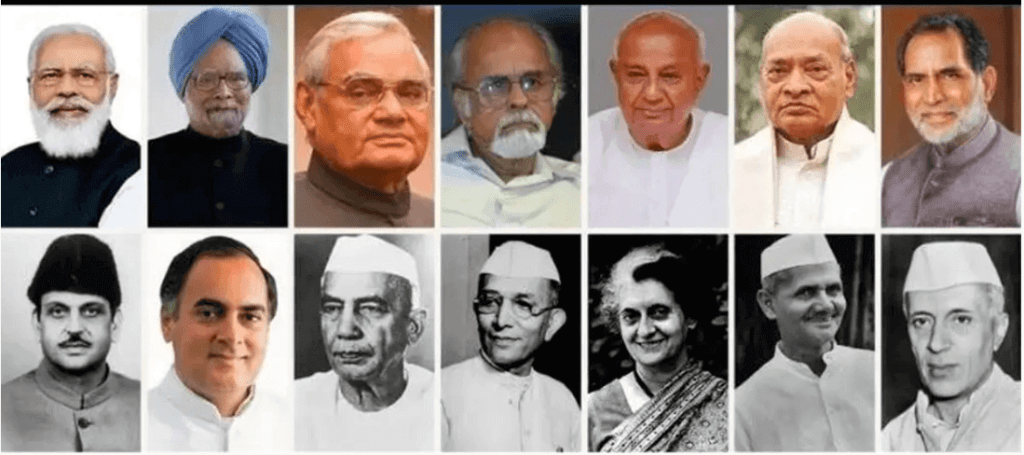
The Prime Minister (PM) of India is the real executive authority (de facto executive), presiding over the Council of Ministers and acting as the primary link between the President and the Cabinet. Since independence in 1947, India has witnessed the leadership of 15 unique individuals (including the incumbent) who have navigated the nation through wars, economic shifts, and technological revolutions.
As of February 19, 2026, Shri Narendra Modi continues to serve in his historic third consecutive term, recently hosting the India AI Impact Summit 2026 to solidify India’s position as a global technology leader.
This table outlines the chronological order, tenure, and political affiliation of India’s Prime Ministers.
| No. | Prime Minister | Term Start | Term End | Party |
| 1 | Jawaharlal Nehru | 15 Aug 1947 | 27 May 1964 | INC |
| – | Gulzarilal Nanda (Acting) | 27 May 1964 | 09 Jun 1964 | INC |
| 2 | Lal Bahadur Shastri | 09 Jun 1964 | 11 Jan 1966 | INC |
| – | Gulzarilal Nanda (Acting) | 11 Jan 1966 | 24 Jan 1966 | INC |
| 3 | Indira Gandhi | 24 Jan 1966 | 24 Mar 1977 | INC |
| 4 | Morarji Desai | 24 Mar 1977 | 28 Jul 1979 | Janata Party |
| 5 | Charan Singh | 28 Jul 1979 | 14 Jan 1980 | Janata Party |
| (3) | Indira Gandhi | 14 Jan 1980 | 31 Oct 1984 | INC |
| 6 | Rajiv Gandhi | 31 Oct 1984 | 02 Dec 1989 | INC |
| 7 | V. P. Singh | 02 Dec 1989 | 10 Nov 1990 | Janata Dal |
| 8 | Chandra Shekhar | 10 Nov 1990 | 21 Jun 1991 | SJP (R) |
| 9 | P. V. Narasimha Rao | 21 Jun 1991 | 16 May 1996 | INC |
| 10 | Atal Bihari Vajpayee | 16 May 1996 | 01 Jun 1996 | BJP |
| 11 | H. D. Deve Gowda | 01 Jun 1996 | 21 Apr 1997 | Janata Dal |
| 12 | I. K. Gujral | 21 Apr 1997 | 19 Mar 1998 | Janata Dal |
| (10) | Atal Bihari Vajpayee | 19 Mar 1998 | 22 May 2004 | BJP (NDA) |
| 13 | Manmohan Singh | 22 May 2004 | 26 May 2014 | INC (UPA) |
| 14 | Narendra Modi | 26 May 2014 | Incumbent | BJP (NDA) |
Detailed Profiles and Key Contributions
1. Jawaharlal Nehru (1947–1964)
The longest-serving PM, Nehru is known as the Architect of Modern India.
- Key Contributions: Established the Planning Commission, IITs, AIIMS, and large-scale public sector industries (“temples of modern India”).
- Foreign Policy: Formulated the Non-Aligned Movement (NAM) to maintain strategic independence during the Cold War.
2. Lal Bahadur Shastri (1964–1966)
Known for his simplicity and integrity, he led India during the 1965 war with Pakistan.
- Key Contributions: Coined the slogan “Jai Jawan, Jai Kisan”. He initiated the White Revolution (milk production) and laid the seeds for the Green Revolution to achieve food security.
3. Indira Gandhi (1966–1977; 1980–1984)
India’s first and only female PM, she was a decisive and often controversial leader.
- Key Contributions: Nationalized 14 major banks (1969), abolished Privy Purses, and led India to victory in the 1971 war, resulting in the creation of Bangladesh.
- Milestone: Directed India’s first nuclear test, Smiling Buddha (1974).
4. Morarji Desai (1977–1979)
The first non-Congress PM.
- Key Contributions: Dismantled the authoritarian laws imposed during the Emergency. He is the only Indian to receive Pakistan’s highest civilian award, Nishan-e-Pakistan.
5. Charan Singh (1979–1980)
Often called the “Champion of India’s Peasants.”
- Key Contributions: Focused heavily on agricultural and rural land reforms. Notably, he never faced the Parliament during his brief tenure.
6. Rajiv Gandhi (1984–1989)
India’s youngest PM (age 40).
- Key Contributions: Spearheaded the Telecom Revolution and computerization. He lowered the voting age from 21 to 18 and introduced the anti-defection law.
7. V. P. Singh (1989–1990)
- Key Contributions: Implemented the Mandal Commission report, providing 27% reservation for Other Backward Classes (OBCs) in government services.
8. Chandra Shekhar (1990–1991)
- Context: Led a minority government during a severe balance-of-payments crisis and political instability.
9. P. V. Narasimha Rao (1991–1996)
Regarded as the Father of Indian Economic Reforms.
- Key Contributions: Launched Liberalization, Privatization, and Globalization (LPG) He shifted the focus of foreign policy to Southeast Asia with the “Look East Policy.”
10. Atal Bihari Vajpayee (1996; 1998–2004)
The first non-Congress PM to complete a full five-year term.
- Key Contributions: Conducted the Pokhran-II nuclear tests (1998). Launched the Golden Quadrilateral (highway project), Sarva Shiksha Abhiyan, and Pradhan Mantri Gram Sadak Yojana.
11. H. D. Deve Gowda (1996–1997)
12. I. K. Gujral (1997–1998)
- Key Contributions: Gujral is famous for the “Gujral Doctrine,” which sought to improve relations with neighbors through non-reciprocal concessions.
13. Manmohan Singh (2004–2014)
A renowned economist PM.
- Key Contributions: Enacted the Right to Information (RTI) Act, MNREGA, and finalized the Indo-US Civil Nuclear Deal. India achieved its highest-ever GDP growth rates during his tenure.
14. Narendra Modi (2014–Present)
Currently serving his third term after the 2024 elections.
- Key Contributions: Implemented GST, Swachh Bharat Abhiyan, and Digital India. Revoked Article 370, introduced the Make in India initiative, and is currently driving the IndiaAI Mission (2026) to make India a global AI hub.
Important Facts
- Longest Serving: Jawaharlal Nehru (16 years, 286 days).
- Shortest Tenure: Atal Bihari Vajpayee (13 days during his first term in 1996).
- Youngest PM: Rajiv Gandhi (40 years).
- Acting PM: Gulzarilal Nanda is the only person to serve as an acting PM (twice).
- First Female PM: Indira Gandhi.
- South Indian PMs: V. Narasimha Rao and H. D. Deve Gowda.
FAQs
Who was the first Prime Minister of India?
Pandit Jawaharlal Nehru served as the first Prime Minister from 1947 to 1964.
Who is the current Prime Minister of India in 2026?
Shri Narendra Modi is the current Prime Minister, currently serving his third consecutive term.
Who was the first female Prime Minister of India?
Indira Gandhi was the first and, to date, the only woman to serve as India’s Prime Minister.
Who served the shortest tenure as Prime Minister?
Atal Bihari Vajpayee served the shortest term of just 13 days in 1996.
Which Prime Minister introduced the “Jai Jawan, Jai Kisan” slogan?
Lal Bahadur Shastri introduced this slogan to honor the nation’s soldiers and farmers during the 1965 war.
Who is known as the architect of India’s 1991 economic reforms?
V. Narasimha Rao, along with Dr. Manmohan Singh, launched the Liberalization, Privatization, and Globalization (LPG) reforms.Who was the first non-Congress Prime Minister to complete a full five-year term?
Atal Bihari Vajpayee was the first non-Congress leader to complete a full term (1999–2004).
Who was the youngest person to become the Prime Minister of India?
Rajiv Gandhi became the youngest Prime Minister at the age of 40 in 1984.
Which Prime Minister initiated the Digital India and Swachh Bharat missions? Prime Minister Narendra Modi launched these flagship programs during his first term starting in 2014.
How many Prime Ministers has India had since 1947? Including acting and incumbent, India has seen 15 unique individuals hold the office of Prime Minister.