Kishtwar
Why in the News?
- A cloudburst hit Chisoti village in Jammu and Kashmir’s Kishtwar district, triggering flash floods and landslides.
- Death toll reached 60, with over 167 people injured and 69 reported missing during the Machail Mata pilgrimage.
- The deluge destroyed markets, community kitchens, houses, vehicles, and a security outpost, suspending the annual pilgrimage.
About Kishtwar
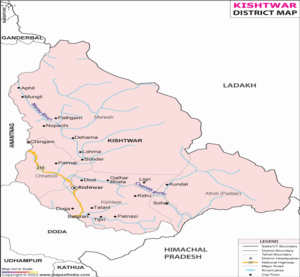
- Location: Kishtwar is a district in the Union Territory of Jammu and Kashmir, situated in the Chenab Valley region.
- Geography: It lies in the Himalayan mountain range, known for its rugged terrain, deep gorges, and high-altitude valleys.
- Elevation: The town of Kishtwar is located at around 1,638 meters (5,374 ft) above sea level.
- Major Rivers: The Chenab River and its tributaries flow through the region, making it prone to flash floods.
- Famous Attractions:
- Machail Mata Temple, a major pilgrimage site located at 9,500 feet.
- Dachhan Valley and Warwan Valley, known for scenic beauty and trekking.
- Economy: Primarily agrarian with apple orchards, saffron cultivation, and some hydroelectric projects.
- Special Feature: Kishtwar is known as the “Land of Sapphire and Saffron” because of its sapphire mines and saffron fields.
- Connectivity: The district is around 230 km from Jammu city and connected by road via the Batote–Kishtwar National Highway.
Humayun’s Tomb
Why in the News?
- A portion of a wall and roof of Dargah Masjid Pattawali, located near Humayun’s Tomb in New Delhi, collapsed amid heavy rains, causing six deaths and five injuries.
- Though the dargah is near the boundary wall of the 16th-century Humayun’s Tomb, a UNESCO World Heritage Site, it is not part of the tomb complex.
About Humayun’s Tomb
- Historical Significance: Built in 1565-1572 CE by Empress Bega Begum (Humayun’s widow), it was the first garden-tomb in the Indian subcontinent.
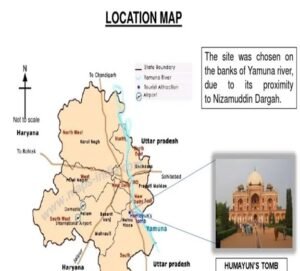
- Location: Situated in Nizamuddin East, New Delhi, along the Yamuna River.
- Architecture: Designed by Persian architect Mirak Mirza Ghiyas, it exhibits Mughal architecture with Persian influences, featuring a charbagh (four-part garden)
- Construction Material: Made primarily of red sandstone with white marble inlay.
- UNESCO World Heritage Site: Declared a UNESCO World Heritage Site in 1993 for its architectural and historical value.
- Inspiration for Taj Mahal: Served as a model for later Mughal architecture, including the Taj Mahal.
- Associated Monuments: The complex also houses Barber’s Tomb, Isa Khan’s Tomb, and several other smaller monuments.
- Renovation: The site has undergone major restoration efforts by the Archaeological Survey of India (ASI) and the Aga Khan Trust for Culture.