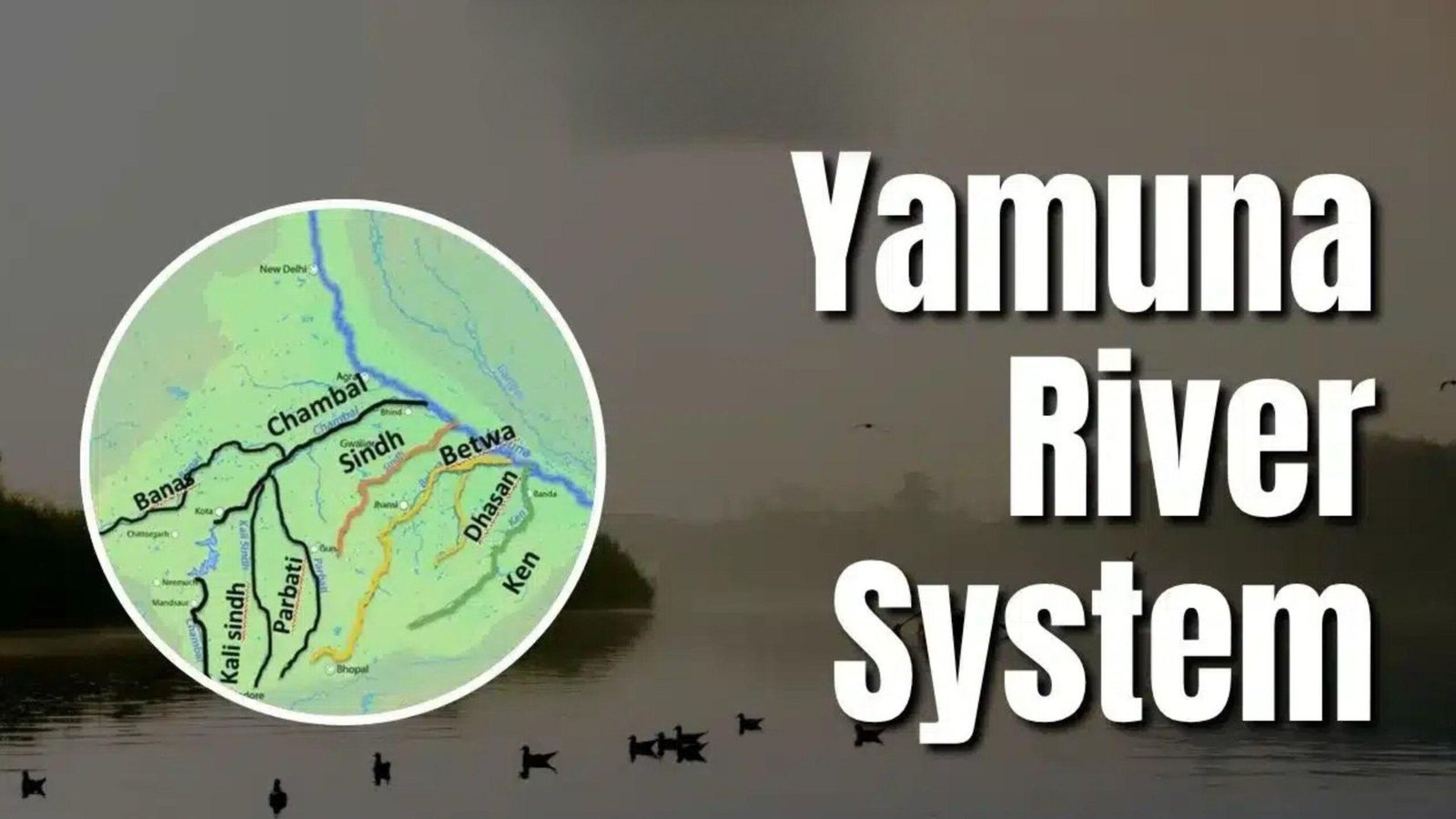
The Yamuna River System is the largest and most significant tributary of the Ganga River, forming a vital part of the Indo-Gangetic plain’s hydrological backbone. Spanning a total length of 1,376 km, the Yamuna is not merely a water body but a cultural and economic lifeline for Northern India, supporting a massive drainage basin of approximately 69,000 sq km.
The Yamuna remains central to India’s environmental and developmental discourse, particularly regarding the rejuvenation of its urban stretches and the strategic interlinking of its tributaries.
I. Origin Of Yamuna river
- Source: The Yamunotri Glacier, situated on the southwestern slopes of the Bandarpoonch Peak (Mussoorie range).
- Location: Uttarkashi district, Uttarakhand.
- Elevation: Approximately 6,387 meters above sea level.
- Initial Confluences: In its upper reaches, the river is joined by the Hanuman Ganga, Tons, and Giri rivers, which significantly augment its volume before it enters the plains at Paonta Sahib.
II. The Yamuna River System
The Yamuna traverses through five distinct administrative regions: Uttarakhand, Himachal Pradesh, Haryana, Delhi, and Uttar Pradesh.
- Upper Stretch: Flows through the mountainous terrain of Uttarakhand and Himachal Pradesh.
- Plain Stretch: Enters the Indo-Gangetic plains near Dakpathar (Uttarakhand) and Tajewala (Haryana), where its waters are diverted into the Western and Eastern Yamuna Canals for irrigation.
- The river at the Triveni Sangam in Prayagraj (Allahabad), where it merges with the Ganga and the mythical Saraswati.
III. Major Tributaries:
The Yamuna is enriched by several powerful tributaries, categorized primarily into Himalayan (Left-bank) and Peninsular (Right-bank) contributors.
1. The Himalayan Tributaries
- Tons River: The largest tributary of the Yamuna by volume. It originates from the Bandarpoonch mountain and joins the Yamuna near Kalsi (Dehradun). It actually carries more water than the main Yamuna stream at their confluence.
- Giri River: A major water source for Southern Himachal Pradesh, originating at Kupar Peak. It divides the Sirmaur district into the Cis-Giri and Trans-Giri
- Hindon River: A purely rain-fed river (~400 km) originating in the Saharanpur Shivaliks. It passes through the industrial hubs of Ghaziabad and Noida before meeting the Yamuna downstream of Delhi.
2. The Peninsular Tributaries
These rivers originate in the Vindhya Range or Central Highlands and join the Yamuna from the south.
- Chambal River: The longest tributary (~960 km), historically known as Charmanvati. It is famous for its “badland topography” (ravines) and major dams like Gandhi Sagar, Rana Pratap Sagar, and Jawahar Sagar.
- Betwa River (Betravati): Rises in the Vindhya Range (Madhya Pradesh) and joins the Yamuna at Hamirpur. The Ken-Betwa Link Project is a landmark interlinking initiative in this region.
- Ken River: Flows through the Bundelkhand region and the Panna Tiger Reserve, joining the Yamuna near Fatehpur.
- Sindh River: Originates on the Malwa Plateau and flows through Madhya Pradesh before its confluence in the Jalaun district.
- Sabi (Sahibi) River: A unique rain-fed river from the Aravalli Range that flows northward into Delhi, nourishing critical wetlands like Bhindrawas.
IV. Urban Corridors and Economic Significance
The Yamuna basin is one of the most densely populated and economically productive regions in the world.
Major Cities on the Banks
| State | Key Cities |
| Uttarakhand | Yamunotri |
| Himachal Pradesh | Paonta Sahib |
| Delhi | New Delhi |
| Uttar Pradesh | Noida, Mathura, Agra, Firozabad, Etawah, Kalpi, Hamirpur, Prayagraj |
Economic importance:
- Agriculture: Provides essential irrigation for the “Granary of India” (Haryana and Western UP), supporting wheat, rice, and sugarcane.
- Industrial Hub: Sustains textiles, chemical, and paper industries in the Delhi-NCR and Mathura-Agra clusters.
- Hydropower: Multiple projects on tributaries like the Tons and Giri generate renewable energy for the northern grid.
- Tourism & Religion: The river is a centerpiece for the Char Dham Yatra and the Kumbh Mela, attracting millions of tourists annually.
FAQs on the Yamuna River System
What is the exact origin of the Yamuna River?
It originates from the Yamunotri Glacier on the Banderpoonch peaks in the Uttarkashi district of Uttarakhand.
Which is the longest tributary of the Yamuna?
The Chambal River is the longest tributary, flowing approximately 960 km.
Which is the largest tributary of the Yamuna by water volume?
The Tons River is the largest tributary by volume, contributing more water than the main stream at their confluence.
Where does the Yamuna merge with the Ganga?
The confluence occurs at the Triveni Sangam in Prayagraj (Allahabad), Uttar Pradesh.
Which major tributary originates in the Aravalli Range?
The Sabi (Sahibi) River is the major northward-flowing river from the Aravallis that joins the Yamuna.
What are the primary Peninsular tributaries of the Yamuna?
The major peninsular tributaries include the Chambal, Sindh, Betwa, and Ken.
Through which states does the Yamuna flow?
It flows through Uttarakhand, Himachal Pradesh, Haryana, Delhi, and Uttar Pradesh.
- What is the total length of the Yamuna River?
The total length of the river is approximately 1,376 kilometers.
- Why is the Hindon River unique?
Unlike the glacier-fed Yamuna, the Hindon is an entirely rain-fed river originating in the Shivalik range.
- Which major Tiger Reserve is associated with a Yamuna tributary?
The Panna Tiger Reserve is located along the banks of the Ken River.