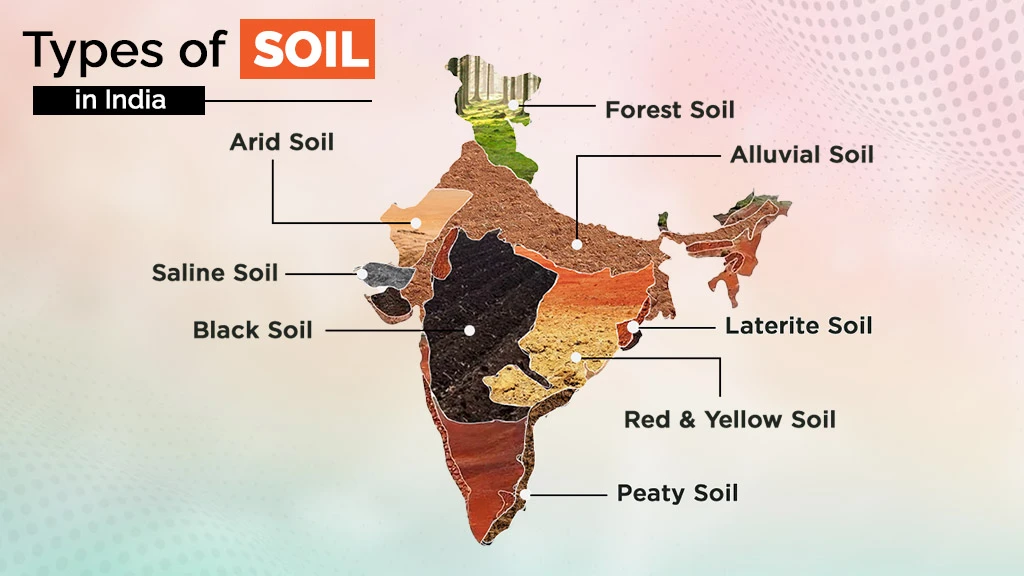
India’s vast geographical expanse and varied climatic conditions have led to the development of a diverse range of soil types. These soils are the primary capital of the nation’s agrarian economy, sustaining over 40% of the population directly. From the fertile plains of the North to the volcanic plateaus of the South, understanding the Soils of India is essential for grasping the country’s agricultural productivity and ecological health.
1 The Science of Soil Formation in India
Soil is a living entity formed through a complex interplay of several natural factors. The diversity we see in Indian soil is the result of thousands of years of the following processes:
- Parent Material: The original rock (such as igneous basalt or sedimentary rocks) determines the mineral composition of the soil.
- Climate: Temperature and rainfall are crucial. High rainfall leads to leaching (loss of nutrients), while dry climates can lead to salt accumulation.
- Topography: The slope of the land affects moisture levels and the thickness of the soil layer.
- Biological Activity: The decay of organic matter adds humus, which is vital for fertility.
- Time: Soil profiles evolve over long periods, eventually forming distinct layers or “horizons.”
2 Major Classification of Indian Soils (ICAR)
The Indian Council of Agricultural Research (ICAR) has classified Indian soils into eight major groups based on their physical and chemical properties.
Alluvial Soil:
Covering about 15 lakh square kilometres (45.6%) of India’s land area, this is the most widespread and fertile soil type.
- Formation: Created by the deposition of sediments by rivers, glaciers, and wind.
- Composition: Rich in potash and humus, but typically deficient in phosphorus.
- Types: Bhangar (Old Alluvium): Contains lime nodules (Kankar), is clayey and darker.
2. Khadar (New Alluvium): Lighter, more fertile, and renewed annually by floods. - Distribution: Indo-Gangetic plains (Punjab to Assam), Narmada and Tapti valleys, and coastal deltas.
- Major Crops: Rice, Wheat, Sugarcane, Cotton, Jute, and Pulses.
Black Soil (Regur):
Also known as Black Cotton Soil, it covers approximately 16.6% of India’s geographical area.
- Formation: Derived from the weathering of fissure volcanic rock (basalt) in the Deccan Plateau.
- Characteristics: High clay content (over 62%) giving it excellent moisture-retention When dry, it develops deep cracks that help in soil aeration—a phenomenon called self-ploughing.
- Composition: High in iron, lime, and alumina; poor in nitrogen and phosphorus.
- Major Crops: Cotton, Sugarcane, Millets, and Oilseeds.
Red Soil:
Occupying about 10.6% of the land, these soils are common in the low-rainfall regions of the Peninsula.
- Formation: Weathering of ancient crystalline rocks. The red colour is due to a high concentration of iron oxide.
- Characteristics: Sandy to loamy texture; moderately fertile. It requires irrigation and fertilizers to be highly productive.
- Major Crops: Groundnut, Tobacco, and Pulses.
Laterite Soil:
Named after the Latin word later (meaning brick), this soil hardens significantly when exposed to air.
- Formation: Occurs in areas with high heat and heavy rainfall, causing intense mineral leaching.
- Composition: Rich in iron and aluminium; very poor in lime and nitrogen.
- Usage: Often used in construction for making bricks and roads.
- Major Crops: Cashew nuts, Tea, Coffee, and Rubber.
3 Specialized Soil Categories
- Desert (Arid) Soil: Found in the Thar Desert (Rajasthan, Gujarat). It has high salt content and poor organic matter. It supports drought-resistant crops like millets and barley.
- Forest Soil: Located in the Himalayas and Western Ghats. It is rich in humus and organic matter but tends to be acidic. Ideal for spices and tea.
- Peaty Soil: Found in heavy rainfall areas like Kerala and the Sunderbans. It is black, heavy, and spongy due to high organic accumulation. Excellent for paddy cultivation.
- Saline Soil: Known locally as reh, usar, or kallar. These soils are infertile due to excess salt accumulation, often caused by poor drainage or over-irrigation.
4 Significance of Soil Health in India
- Economic Foundation: Agriculture is the backbone of the economy, and its success is 100% dependent on soil fertility.
- Ecosystem Balance: Soils support biodiversity and act as a filter for water.
- Carbon Sequestration: Properly managed soil can capture large amounts of atmospheric CO2, helping mitigate climate change.
- Disaster Resilience: Healthy soil absorbs water, reducing the severity of floods and maintaining moisture during droughts.
Soil Degradation :
Currently, 30% of India’s land is suffering from degradation. The primary drivers are:
- Unsustainable Farming: Overuse of chemical fertilizers.
- Deforestation: Leading to severe soil erosion.
- Urbanization: Encroachment on fertile agricultural lands.
- Poor Water Management: Leading to salinization and waterlogging.
FAQs
WHICH SOIL IS THE MOST FERTILE IN INDIA?
Alluvial soil, specifically the Khadar (new alluvium) found in floodplains, is considered the most fertile soil in India.
WHY IS BLACK SOIL CALLED REGUR?
The term Regur is derived from the Telugu word Reguda, which means black soil. It is specifically suited for cotton, hence the name Black Cotton Soil.
WHAT GIVES RED SOIL ITS DISTINCTIVE COLOR?
The reddish hue is caused by the wide diffusion of iron oxide in crystalline and metamorphic rocks.
WHICH REGIONS HAVE THE HIGHEST CONCENTRATION OF LATERITE SOIL?
It is found in the Western Ghats of Kerala and Karnataka, South Maharashtra, and parts of Assam and Tamil Nadu.
WHAT IS THE DIFFERENCE BETWEEN KHADAR AND BHANGAR?
Khadar is new, light-coloured, and more fertile alluvium, while Bhangar is older, darker, clayey alluvium containing lime nodules.
WHICH IS OFTEN USED CHEMICAL TO TREAT SALINE SOILS?
Gypsum is often used to reclaim saline and alkaline soils to make them suitable for cultivation again.
HOW MUCH OF INDIA’S GEOGRAPHICAL AREA IS COVERED BY ALLUVIAL SOIL?
Alluvial soil covers approximately 45.6% of India’s total land area, making it the largest soil group.
WHY IS DESERT SOIL LESS FERTILE?
Due to low rainfall and high evaporation, desert soil has high salt content, low organic matter, and poor moisture-retention capacity.
WHICH SOIL TYPE IS BEST FOR PADDY CULTIVATION?
Peaty and Marshy soils, found in areas with high moisture like Kerala and coastal Odisha, are excellent for paddy.
WHAT IS THE MAIN CAUSE OF SOIL DEGRADATION IN PUNJAB AND HARYANA?
Excessive irrigation over a long period has led to salinization, where salts accumulate on the soil surface, making it infertile.