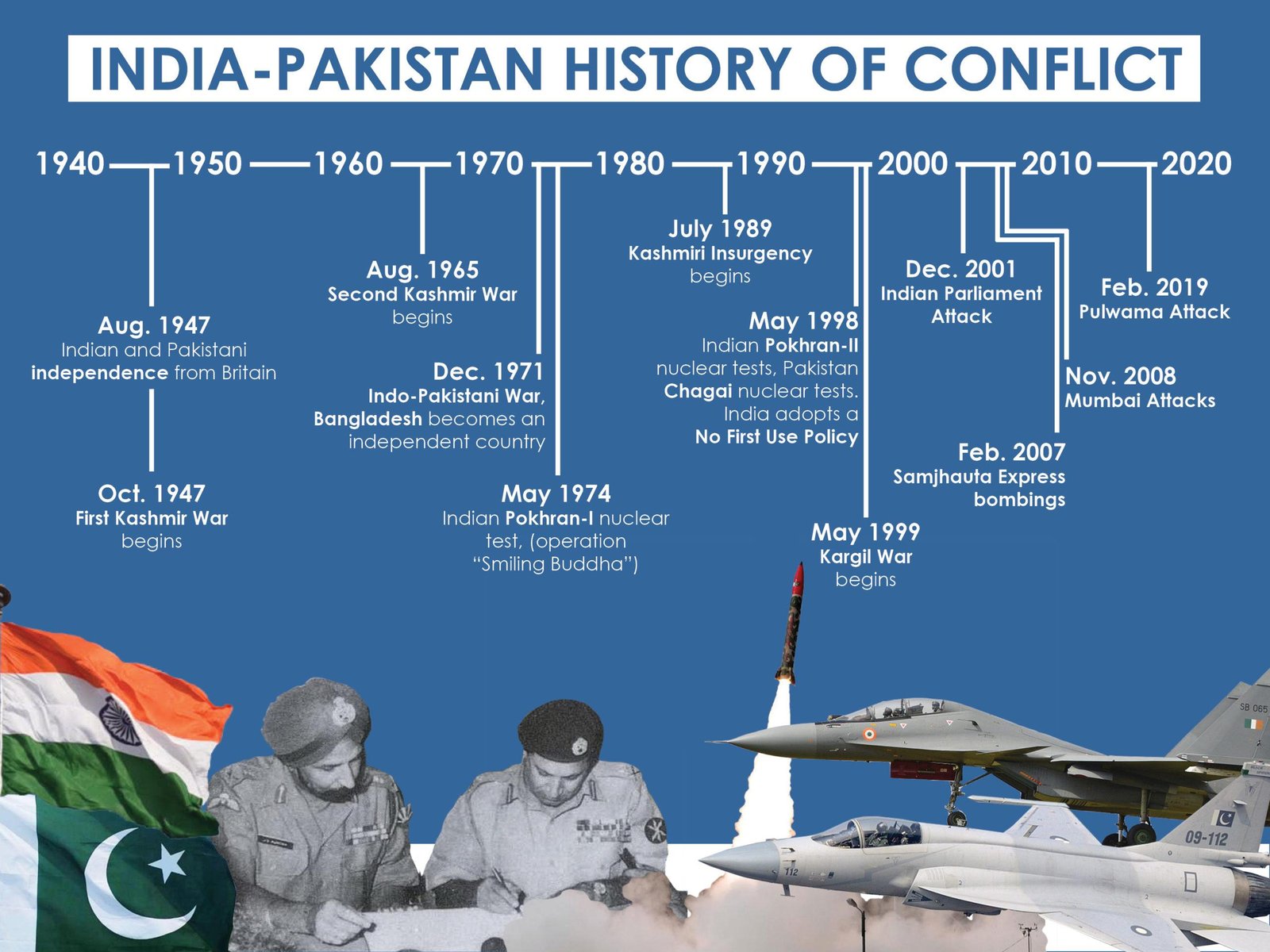
The history of India and Pakistan is a turbulent narrative of shared heritage fractured by partition, leading to four major wars and numerous strategic standoffs. Central to this friction is the unresolved status of Jammu and Kashmir, compounded by cross-border terrorism and evolving military doctrines.
Since 1947, the two nations have engaged in four full-scale wars and several high-stakes operations.
Major Wars and Outcomes
| Conflict / War | Year | Cause / Trigger | Key Outcome |
| First Kashmir War | 1947–1948 | Accession of J&K; tribal invasion | UN-brokered ceasefire; LoC established. |
| Second Indo-Pak War | 1965 | Pakistan’s Operation Gibraltar | Tashkent Agreement; Status quo ante bellum. |
| Indo-Pak War / Bangladesh | 1971 | Bengali independence; refugee crisis | Decisive Indian victory; Birth of Bangladesh. |
| Kargil War | 1999 | Pakistani intrusion in Kargil/Dras | India recaptured all posts; Pak diplomatic defeat. |
1. First Indo-Pak War (1947–1948): The Kashmir Genesis
- The Trigger: Following the Partition, the princely state of Jammu & Kashmir (J&K) faced a dilemma. Maharaja Hari Singh sought to remain independent, but a Pakistan-backed tribal invasion (Operation Gulmarg) in October 1947 forced his hand. He signed the Instrument of Accession on October 26, 1947.
- The Conflict: India airlifted the 1st Sikh Regiment to Srinagar. Key battles at Zoji La (where tanks were used at record altitudes) and Shalateng saved the Kashmir Valley.
- Outcome: The ceasefire on January 1, 1949, established the Cessation of Hostilities Line, later the Line of Control (LoC). India retained roughly two-thirds of the state, while Pakistan occupied the remainder (PoK).
2. Second Indo-Pak War (1965):
- The Trigger: Pakistan launched Operation Gibraltar, sending thousands of disguised soldiers into J&K to incite a rebellion. This failed, leading to Operation Grand Slam, a conventional Pakistani strike in the Chamb sector.
- The Conflict: India responded by opening a new front across the International Border (IB) in Punjab toward Lahore. The war saw the Battle of Asal Uttar, one of the largest tank battles since WWII, where Indian forces created a “horseshoe” trap, flooding sugarcane fields to bog down Pakistani Patton tanks.
- Outcome: The Tashkent Declaration (1966), mediated by the USSR, forced a return to pre-war boundaries. India’s CQMH Abdul Hamid was posthumously awarded the Param Vir Chakra for destroying seven enemy tanks.
3. Indo-Pak War of 1971:
- The Trigger: Brutal military crackdowns in East Pakistan (Operation Searchlight) led to a genocide and a massive influx of 10 million refugees into India.
- The Conflict: A 13-day war fought on two fronts.
- Eastern Front: India used a “lightning campaign” to bypass Pakistani strongpoints and reach Dhaka.
- Western Front: The Battle of Longewala saw 120 Indian soldiers (13th Kumaon) hold off an entire Pakistani armored regiment.
- Outcome: The Instrument of Surrender was signed on December 16, 1971, by Gen. A.A.K. Niazi. 93,000 Pakistani prisoners of war (PoWs) were taken, and the independent nation of Bangladesh was born.
4. Kargil War (1999): High-Altitude Valor
- The Trigger: During the winter, Pakistani regular troops (Northern Light Infantry) disguised as mujahideen occupied vacant Indian peaks in the Kargil-Drass sector, overlooking the vital NH-1A (Srinagar-Leh highway).
- The Conflict: India launched Operation Vijay (Army) and Operation Safed Sagar (Air Force).
- Tiger Hill: Recaptured by the 18 Grenadiers and 8 Sikh after a vertical climb under heavy fire.
- Tololing: The first major victory that turned the tide of the war.
- Outcome: India recaptured all territory by July 26 (Kargil Vijay Diwas). The war highlighted the heroism of Vikram Batra (“Yeh Dil Maange More!”) and Lt. Manoj Kumar Pandey.
5. 21st Century war and Operation Sindoor (2025)
The strategy shifted to punitive deterrence—responding to terror attacks with precision strikes.
- Surgical Strikes (2016): Responding to the Uri attack, Indian Para SF crossed the LoC to destroy terror launch pads.
- Balakot Airstrikes (2019): Following the Pulwama attack, IAF Mirage 2000s struck JeM camps deep inside Pakistan.
- Operation Sindoor (2025): Triggered by the Pahalgam terror attack on April 22, 2025 (26 civilians killed).
- The Retaliation: On May 7, India launched “Operation Sindoor,” a multi-dimensional strike using BrahMos missiles and Rafale jets against terror hubs in PoJK and Punjab.
- The “Drone War”: It marked the first significant Beyond Visual Range (BVR) drone engagement between the two nations, involving over 114 aircraft.
- Economic Blow: In a decisive move, India held the Indus Waters Treaty in abeyance, signaling that “blood and water cannot flow together.”
- Ceasefire: A truce was called on May 10, 2025, after Pakistan’s DGMO requested an end to hostilities following the destruction of several airbases and radars.
FAQs on India-Pakistan Wars
How many full-scale wars have India and Pakistan fought?
They have fought four full-scale wars: 1947, 1965, 1971, and 1999.
What was the primary cause of the 1971 war?
The 1971 war was caused by the independence movement in East Pakistan and the resulting humanitarian crisis.
Who won the Kargil War?
India won the Kargil War by successfully recapturing all occupied territory from Pakistani infiltrators.
What is the significance of the Simla Agreement?
Signed in 1972 after the 1971 war, it established the LoC and emphasized resolving disputes bilaterally.
What was “Operation Gibraltar”?
It was Pakistan’s covert plan in 1965 to infiltrate Kashmir and incite an uprising against Indian rule.
Which war led to the largest surrender of troops since WWII?
The 1971 war saw the surrender of 93,000 Pakistani soldiers in Dhaka.
What was “Operation Sindoor”?
It was a 2025 Indian military operation involving missile and air strikes in response to the Pahalgam terror attack.
When did the first Kashmir war start?
The first war began on October 22, 1947, after tribal militias invaded Jammu and Kashmir.
What is the difference between the LoC and the International Border?
The LoC is the military de facto border in Kashmir, while the International Border is the legally recognized boundary between the two nations.
Has there been a war since India and Pakistan became nuclear powers?
Yes, the 1999 Kargil War and the 2025 conflict occurred while both nations possessed nuclear weapons.