In the Indian federal structure, Union Territories (UTs) are distinct administrative units governed directly by the Central Government. While states have their own governments with substantial powers, UTs are administered by the President of India through an appointed representative, such as a Lieutenant Governor or an Administrator.
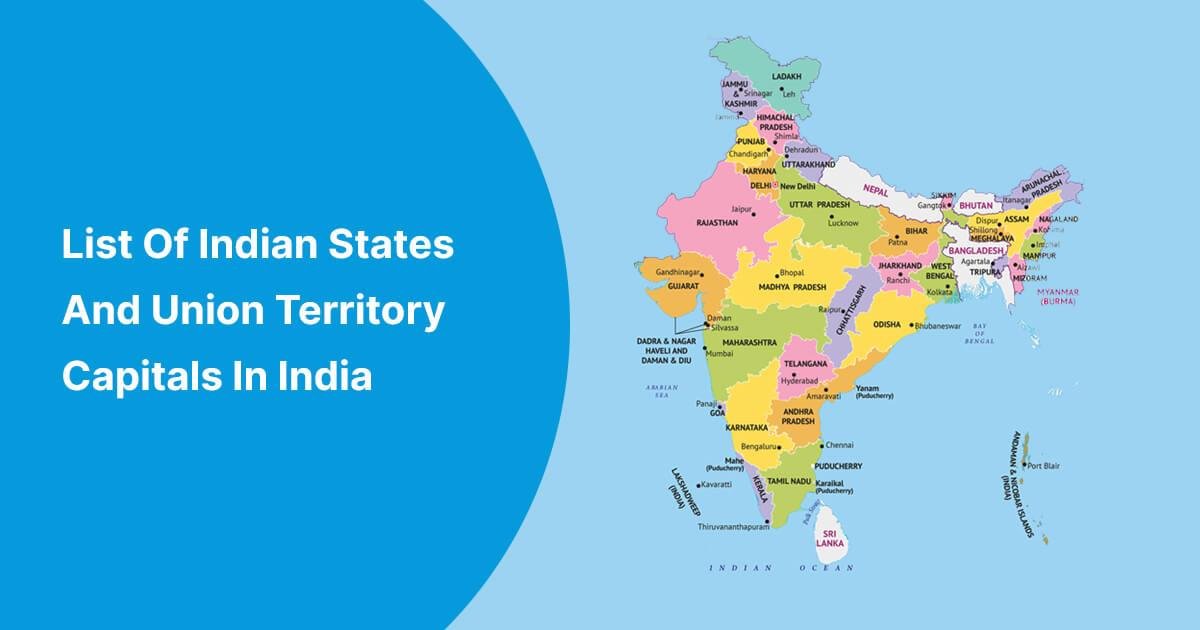
India consists of 8 Union Territories. These regions often hold unique historical, strategic, or cultural significance that warrants direct federal oversight.
The following table provides a comprehensive overview of the 8 UTs as they stand today:
| S.No | Union Territory | Capital | Date of Creation / Significance |
| 1 | Andaman and Nicobar Islands | Sri Vijaya Puram (Port Blair) | 1st Nov 1956 |
| 2 | Delhi (NCT) | New Delhi | 1st Nov 1956 (NCT status in 1991) |
| 3 | Lakshadweep | Kavaratti | 1st Nov 1956 |
| 4 | Puducherry | Puducherry | 1st Nov 1954 (De facto); 1962 (De jure) |
| 5 | Chandigarh | Chandigarh | 1st Nov 1966 (Shared capital of PB & HR) |
| 6 | Jammu and Kashmir | Srinagar (S) / Jammu (W) | 31st Oct 2019 (After abrogation of Art. 370) |
| 7 | Ladakh | Leh | 31st Oct 2019 (Bifurcated from J&K) |
| 8 | Dadra & Nagar Haveli and Daman & Diu | Daman | 26th Jan 2020 (Merger of two UTs) |
II. Constitutional Framework and Governance
The administration of Union Territories is outlined in Part VIII of the Constitution (Articles 239 to 241).
Key Articles
- Article 239: Empowers the President to administer UTs through an Administrator (with designations like Lieutenant Governor or Administrator).
- Article 239A: Parliament can create a Legislature or a Council of Ministers for specific UTs (currently applied to Puducherry and Jammu & Kashmir).
- Article 240: Grants the President the power to make regulations for the peace, progress, and good government of certain UTs (Andaman & Nicobar, Lakshadweep, Dadra & Nagar Haveli and Daman & Diu, and Puducherry—the latter only when the assembly is dissolved).
- Article 241: Allows Parliament to constitute or declare a High Court for a Union Territory.
The Special Case of Delhi (Article 239AA)
Introduced by the 69th Constitutional Amendment Act (1991), Delhi was redesignated as the National Capital Territory (NCT).
- Governance: It has a Legislative Assembly and a Council of Ministers headed by a Chief Minister.
- Restrictions: The Assembly can legislate on all subjects in the State and Concurrent lists except Public Order, Police, and Land.
- Appointments: Unlike states, the Chief Minister of Delhi is appointed by the President on the advice of the Lieutenant Governor.
III. Geographical and Cultural Highlights
Largest and Smallest UTs
- Largest (By Area): Ladakh is the largest UT, spanning approximately 59,146 sq. km. It is known for its high-altitude cold desert and strategic importance.
- Smallest (By Area): Lakshadweep is the smallest UT at just 32 sq. km. It is a coral archipelago in the Arabian Sea.
- Largest (By Population): Delhi is the most populous UT, serving as the nation’s political and economic heart.
Unique Cultural Entities
- Puducherry: Comprising four geographically unconnected districts (Puducherry, Karaikal, Mahe, and Yanam), it retains a distinct French architectural legacy.
- Andaman and Nicobar Islands: Home to some of the world’s last uncontacted indigenous tribes (e.g., the Sentinelese). Its capital was renamed to Sri Vijaya Puram in 2024 to honor its historical heritage.
- Chandigarh: A modernist marvel designed by Le Corbusier, it serves as a joint capital for Punjab and Haryana while remaining a separate administrative unit.
FAQs on Indian Union Territories
How many Union Territories are there in India in 2026?
There are exactly 8 Union Territories.
Which UT was formed by the merger of two territories in 2020?
Dadra and Nagar Haveli and Daman and Diu were merged into a single UT on January 26, 2020.
Which Union Territories have their own Legislative Assemblies?
Currently, Delhi, Puducherry, and Jammu & Kashmir have provisions for their own legislatures.
What is the smallest Union Territory in India?
Lakshadweep is the smallest UT, covering only 32 square kilometers.
Which UT serves as the shared capital of two states?
Chandigarh is the shared capital for both Punjab and Haryana.
Under which part of the Constitution are UTs mentioned?
Union Territories are detailed in Part VIII of the Indian Constitution.
Who appoints the Chief Minister of Delhi?
The Chief Minister of Delhi is appointed by the President of India.
Which UT has two capitals?
Jammu and Kashmir has two capitals: Srinagar (Summer) and Jammu (Winter).
Which amendment gave Delhi the status of NCT?
The 69th Constitutional Amendment Act of 1991.
What are the three subjects Delhi’s assembly cannot legislate on?
Public Order, Police, and Land.