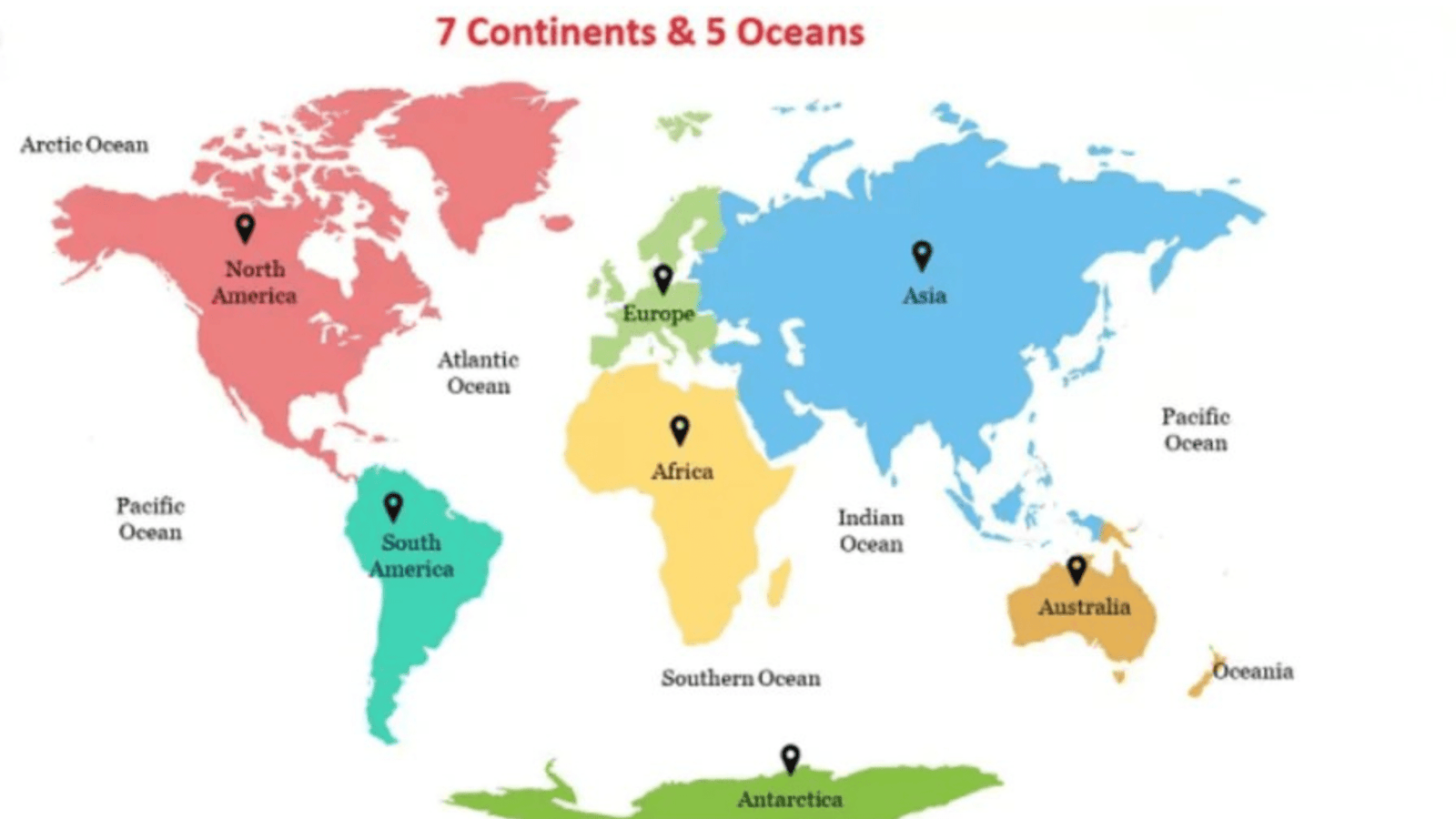
The geography of Earth is a dynamic arrangement of land and water, shaped over millions of years by the movement of tectonic plates. Originally, the supercontinent Pangea was surrounded by the massive ocean Panthalassa. Today, the planet’s surface is composed of 29% land (7 continents) and 71% water (5 oceans).
As of 2026, understanding these divisions is essential for grasping global climate patterns, economic trade routes, and biodiversity.
The 7 Continents of the World
Formed through the process of Continental Drift, the seven continents vary significantly in size, population, and ecological biomes.
Continental Comparison Table
| Continent | Area (Km²) | Population (approx.) | No. of Countries | Highest Point |
| Asia | 44,579,000 | 4.72 Billion | 48 | Mt. Everest |
| Africa | 30,370,000 | 1.40 Billion | 54 | Mt. Kilimanjaro |
| North America | 24,709,000 | 597 Million | 23 | Denali |
| South America | 17,840,000 | 438 Million | 12 | Mt. Aconcagua |
| Antarctica | 14,200,000 | 1,000–5,000 | 0 | Vinson Massif |
| Europe | 10,180,000 | 748 Million | 44 | Mt. Elbrus |
| Australia/Oceania | 8,486,460 | 43 Million | 14 | Mt. Kosciuszko |
Key Characteristics of the Continents
1. Asia
Asia is the largest and most populous continent, occupying about one-third of the world’s total land area.
- Geographical Extremes: It contains the highest point on Earth, Mount Everest (8,848m), and the lowest exposed point, the Dead Sea.
- Diverse Biomes: From the frozen Siberian Tundra in the north to the tropical rainforests of Southeast Asia and the arid Arabian Desert.
- Economic Powerhouse: It is home to the world’s two most populous nations, India and China, and represents a significant portion of global GDP through manufacturing and technology hubs.
- Water Bodies: It contains the Caspian Sea (the world’s largest inland body of water) and Lake Baikal (the deepest freshwater lake).
2. Africa
Africa is the second-largest continent and is centrally located on the globe, with the Equator, Tropic of Cancer, and Tropic of Capricorn all passing through it.
- Vast Deserts: The Sahara in the north is the world’s largest hot desert, while the Namib and Kalahari define the south.
- River Systems: It is home to the Nile, the world’s longest river, and the Congo, the world’s deepest river.
- Biodiversity: The Savannah grasslands host the highest concentration of large mammals (lions, elephants, rhinos) in the world.
- Resources: It is exceptionally rich in natural resources, including diamonds, gold, and 60% of the world’s uncultivated arable land.
3. North America:
Located entirely in the Northern and Western Hemispheres, this continent is bordered by three oceans: the Arctic, Atlantic, and Pacific.
- Economic Giant: It contains the USA, the world’s largest economy, and Canada, the world’s second-largest country by land area.
- Physical Features: The Rocky Mountains run along the west, while the Great Lakes (containing 21% of the world’s surface fresh water) sit in the north-center.
- Climate: It experiences nearly every major climate type, from the Arctic cold of Greenland to the tropical heat of Central America.
4. South America:
South America is characterized by high mountains in the west and vast river basins in the east.
- The Amazon: It houses the Amazon Rainforest, the “lungs of the planet,” and the Amazon River, which carries the highest volume of water globally.
- The Andes: The world’s longest continental mountain range, the Andes, runs along the western coast.
- Climate Extremes: It contains the Atacama Desert, known as the driest place on Earth, and the high-altitude Altiplano
- Wildlife: Home to unique species such as llamas, anacondas, and the jaguars of the Pantanal wetlands.
5. Antarctica
Antarctica is unique because it has no permanent residents and is not divided into sovereign nations.
- Ice Cover: Approximately 98% of the continent is covered by an ice sheet that averages 1.9 km in thickness.
- Freshwater Reserve: It holds nearly 70% to 80% of the world’s fresh water in the form of ice.
- Climate: It is the coldest, windiest, and driest continent, technically classified as a “Polar Desert.”
- Legal Status: Governed by the Antarctic Treaty System, it is reserved strictly for scientific research and peaceful purposes.
6. Europe:
Europe is the second-smallest continent by area but is highly influential due to its history of exploration, industry, and the European Union.
- Physical Geography: Bordered by the Arctic Ocean to the north, the Atlantic to the west, and the Mediterranean to the south.
- Climate: Primarily temperate, influenced greatly by the Gulf Stream, which keeps Western Europe warmer than other regions at the same latitude.
- Political Structure: Home to 44 countries, including the world’s smallest sovereign state, Vatican City.
- Landscape: Characterized by the Alps in the south and vast northern plains.
7. Australia/Oceania:
This is the smallest continent by land area and the second-least populated after Antarctica.
- Outback: Much of the Australian mainland is composed of arid “Outback,” while the coastal regions are fertile.
- Great Barrier Reef: Off the northeast coast lies the world’s largest coral reef system, visible from space.
- Isolation: Due to its long-term isolation, it has evolved unique “monotreme” and “marsupial” wildlife, such as the kangaroo, koala, and platypus.
- Archipelagos: Oceania includes thousands of islands across the Central and South Pacific, including New Zealand and Polynesia.
The 5 Oceans of the World
Oceans regulate the global climate and provide essential shipping routes for international trade.
Oceanic Comparison Table
| Ocean | Area (Km²) | Depth (Avg.) | Deepest Point | Share of Water |
| Pacific | 165,200,000 | 4,280 m | Mariana Trench | >40% |
| Atlantic | 106,400,000 | 3,646 m | Puerto Rico Trench | >22% |
| Indian | 73,556,000 | 3,741 m | Java Trench | 20% |
| Southern | 20,327,000 | 3,200 m | South Sandwich Trench | 15% |
| Arctic | 13,986,000 | 1,200 m | Fram Strait | 3–4% |
1. Pacific Ocean: The Titan of Waters
The Pacific is the largest and deepest ocean, covering nearly one-third of the Earth’s total surface area—more than all the world’s continents combined.
- Size & Depth: It spans about 165 million sq. km. It houses the Mariana Trench, where the Challenger Deep reaches approximately 10,994 meters below sea level.
- The Ring of Fire: The Pacific is encircled by the “Ring of Fire,” a massive zone of volcanic and seismic activity that causes the majority of the world’s earthquakes.
- Climate Driver: It is the primary stage for the El Niño and La Niña phenomena, which dictate weather patterns and rainfall across the entire globe.
- Islands: It contains over 25,000 islands, including the vast archipelagos of Polynesia, Micronesia, and Melanesia.
2. Atlantic Ocean:
The Atlantic is the second-largest ocean and serves as the most significant corridor for global commerce, connecting the “Old World” (Europe/Africa) with the “New World” (Americas).
- Mid-Atlantic Ridge: A massive underwater mountain range formed by plate tectonics, running through the center of the ocean where the seafloor is spreading.
- The Gulf Stream: This powerful, warm ocean current originates in the Gulf of Mexico and flows toward Europe, significantly warming the climate of Western European nations.
- Sargasso Sea: The Atlantic contains the only “sea” in the world without a land boundary; it is defined by a gyre of four currents.
- Salinity: It is the saltiest of the major oceans due to high evaporation and limited freshwater inflow relative to its size.
3. Indian Ocean:
The Indian Ocean is the third-largest and is unique for being landlocked to the north by Asia, making it a “closed” ocean compared to the Atlantic and Pacific.
- Monsoon Impact: Its unique heating and cooling patterns drive the Indian Monsoon, which is the lifeblood of agriculture in South Asia.
- Strategic Trade: It hosts the world’s most critical energy supply routes, including the Strait of Hormuz and the Strait of Malacca.
- Blue Economy: Under the UN Convention on the Law of the Sea (UNCLOS), India has been granted exclusive rights to mine polymetallic nodules (rich in manganese, cobalt, and nickel) from the Central Indian Ocean Basin.
- Warmest Waters: It is the warmest ocean in the world, which makes it particularly sensitive to climate change and coral bleaching.
4. Southern Ocean
Officially recognized as the fifth ocean by the IHO in 2000, it is the only ocean to flow completely around a continent (Antarctica) without being blocked by land.
- Antarctic Circumpolar Current (ACC): The Southern Ocean is characterized by the ACC, the world’s largest and strongest current, which transports 130 million cubic meters of water per second.
- Carbon Sink: It plays a massive role in sequestering carbon dioxide from the atmosphere, helping to mitigate global warming.
- Biodiversity: Despite the freezing temperatures, it is rich in nutrients and supports massive populations of krill, which form the base of the food chain for whales, seals, and penguins.
5. Arctic Ocean:
Centered around the North Pole, the Arctic is the smallest, shallowest, and coldest ocean. It is almost entirely surrounded by the landmasses of North America, Eurasia, and Greenland.
- Sea Ice: Much of its surface is covered by sea ice year-round, though this is rapidly declining due to global warming.
- The Northwest Passage: As ice melts, new shipping routes like the Northwest Passage and the Northern Sea Route are becoming navigable, creating new geopolitical interests.
- Low Salinity: It has the lowest salinity of all oceans because of low evaporation and the high inflow of freshwater from large Siberian and Canadian rivers.
- Unique Fauna: It is the exclusive home of the polar bear and the narwhal (the “unicorn of the sea”).
FAQs
Which is the largest continent by area and population?
Asia is the largest continent, accounting for approximately 30% of the world’s land and over 4.7 billion people.
Which continent has the most number of countries?
Africa contains 54 sovereign nations, the highest of any continent.
What is the deepest point in the world’s oceans?
The Challenger Deep in the Mariana Trench (Pacific Ocean) is the deepest point at approximately 10,994 meters.
Which continent is known as the “Frozen Continent”?
Antarctica is known as the frozen continent, with 98% of its land covered by ice.
Which ocean is the smallest and shallowest?
The Arctic Ocean is the smallest and shallowest of Earth’s five major oceans.
Which continent has no deserts?
Europe is the only continent in the world that does not have any deserts.
What is the longest river in the world?
The Nile River in Africa is the longest river on Earth, stretching approximately 6,650 km.
Which ocean is named after a country? T
he Indian Ocean is the only major ocean in the world named after a specific country (India).
What connects North and South America?
The narrow Isthmus of Panama connects the continents of North and South America.
What is the Great Barrier Reef?
Located in Oceania, it is the world’s largest coral reef system and a major natural landmark of Australia.