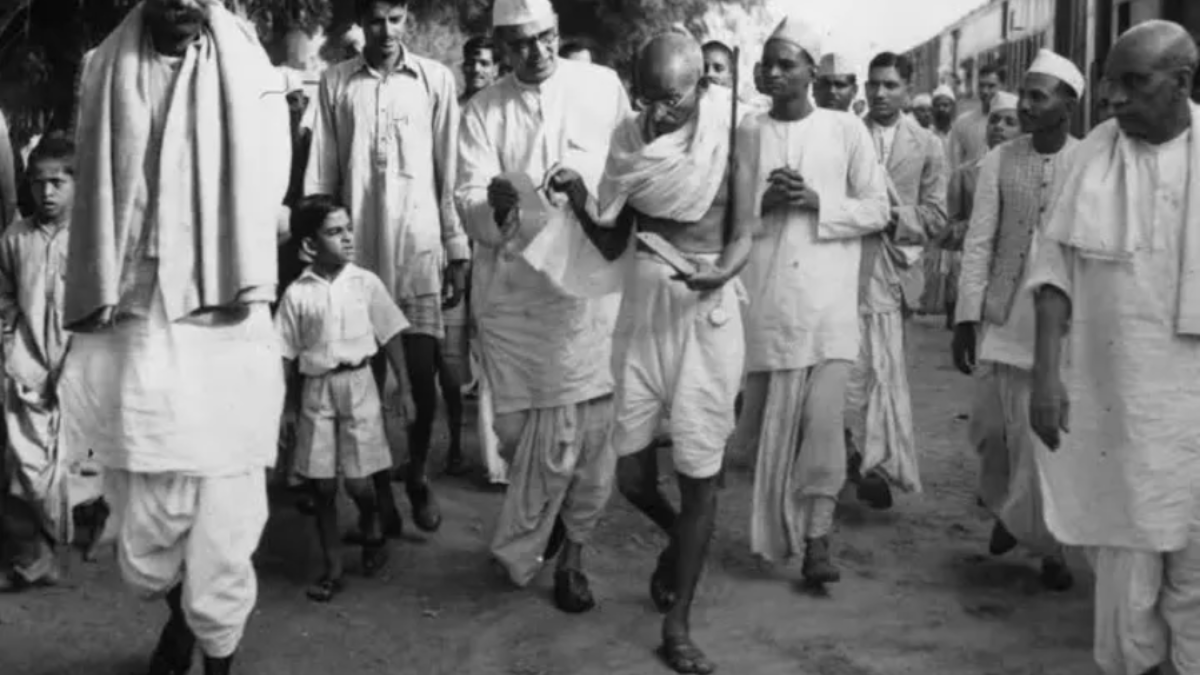
The Champaran Satyagraha of 1917 stands as a landmark event in India’s struggle for independence, marking the first time Mahatma Gandhi applied the principles of Satyagraha (non-violent resistance) on Indian soil. Located in the Champaran district of Bihar, this movement addressed the systematic exploitation of indigo farmers under the oppressive tinkathia system. The success of this agitation not only provided immediate relief to the peasantry but also transformed the Indian nationalist movement into a mass-based struggle.
Historical Background: The Exploitation of Indigo Farmers
The roots of the 1917 satyagraha lie in the long history of indigo cultivation in Bihar, which began in the late 18th century.
1 The Rise of Indigo and the Tinkathia System
- Dominant Crop: By 1850, indigo had surpassed sugar to become Champaran’s most vital commercial crop.
- Mandatory Cultivation: Under the tinkathia system, European planters legally forced tenant farmers (ryots) to cultivate indigo on 3/20th of their landholdings.
- Evolution of the System: In 1860, the reserved portion was originally 5 kathas per bigha (one-fourth of the land). By 1867, this was reduced to 3 kathas per bigha, giving the system its name (Teen = three, Kathia = unit of land).
2 Economic Distress and the Decline of Indigo
- Synthetic Competition: After 1900, the invention of synthetic indigo in Europe made natural indigo unprofitable in the global market.
- Planter Exploitation: To compensate for falling profits, European planters offered to release farmers from indigo obligations in exchange for heavy fines, known as tawan.
- Debt Traps: Farmers unable to pay these fines were forced into mortgage bonds and handnotes with exorbitant annual interest rates of 12 percent.
Causes of the Champaran Unrest
The satyagraha was triggered by decades of accumulated grievances against the “Planter Raj”.
1 Unfair Compensation: Farmers were paid a fixed price based on the area of land cultivated rather than the actual volume or quality of the indigo produced.
2 Harassment and Coercion: Ryots faced constant harassment from factory workers and were forced to grow indigo on their most fertile lands, leaving less space for food crops.
3 Deceptive Land Practices: European factory owners often took short-term leases from the Bettiah Raj (a large local zamindari) and used deceptive practices to maximize profits at the expense of the tenants.
4 Early Resistance: Discontent led to localized protests as early as 1867 in Lalsariya and again in 1907-08 in Sathi and Bettiah.
Mahatma Gandhi’s Role and Methodology
Mahatma Gandhi’s entry into the Champaran struggle redefined the Indian political landscape.
1 Invitation and Investigation
- Rajkumar Shukla: At the 1916 Lucknow session of the Indian National Congress, a local leader named Rajkumar Shukla and Brajkishore Prasad persuaded Gandhi to visit Bihar to investigate the farmers’ plight.
- The Muzaffarpur Inquiry: Gandhi arrived in Muzaffarpur in April 1917. He insisted on personally assessing the situation before taking any political action.
2 Defiance of British Authority
- Section 144: Citing fears of public unrest, British officials issued a notice ordering Gandhi to leave Champaran immediately.
- Disobedience: Gandhi refused to leave, declaring his willingness to face the legal penalty for disobedience. During his trial on April 18, 1917, he offered no defense, baffling officials and eventually leading the government to withdraw the case.
3 Documentation of Grievances
Gandhi, assisted by a group of prominent leaders, recorded the testimonies of thousands of farmers. These leaders included:
- Rajendra Prasad
- Mazharul Haq
- B. Kripalani
- Brajkishore Prasad
- Ramnavami Prasad
The Champaran Agrarian Act of 1918
Facing mounting evidence, the British Lieutenant Governor appointed a Committee of Inquiry, with Gandhi as a member. The committee’s recommendations were accepted, leading to the Champaran Agrarian Act of 1918.
Key Provisions of the Act:
1 Abolition of Tinkathia: The century-old tinkathia system was officially abolished.
2 Partial Refunds: Farmers who had paid the illegal tawan were refunded one-fourth of the amount.
3 Prohibition of Illegal Cesses: The realization of abwab (illegal taxes) was stopped.
4 Voluntary Cultivation: Any future indigo cultivation was to be strictly voluntary, with short-term contracts not exceeding three years, and farmers would choose the cultivation fields themselves.
Significance and Legacy of the Movement
The Champaran Satyagraha served as a crucial turning point for the Indian freedom struggle.
- First Civil Disobedience: It was the first successful application of civil disobedience in India, proving that the British could be forced to yield through non-violent means.
- Mass Mobilization: For the first time, a bridge was built between the middle-class intelligentsia and the peasantry, bringing rural India into the nationalist fold.
- Rise of Gandhi: The success of Champaran placed Gandhi at the forefront of the Indian nationalist movement.
- Training Ground: The lessons learned in Champaran paved the way for future movements in Ahmedabad and Kheda, eventually leading to the massive nationwide protests of 1919 and beyond.
FAQs on Champaran Satyagraha
Who led the Champaran Satyagraha?
The movement was led by Mahatma Gandhi, marking his first major political experiment in India.
What was the Tinkathia system?
It was an exploitative system where European planters forced farmers to cultivate indigo on 3/20th of their landholding.
Who invited Gandhi to Champaran?
A local farmer named Rajkumar Shukla persistently followed Gandhi and invited him to Bihar to see the plight of the indigo ryots.
When did the Champaran Satyagraha take place?
The movement occurred in 1917.
Why did indigo cultivation decline in the early 20th century?
Cultivation became unprofitable in the world market due to the invention of synthetic indigo in Europe.
What was the “Tawan” fine?
Planters imposed a heavy fine called tawan on farmers who wanted to be released from their obligation to grow indigo.
Which act officially ended the Tinkathia system?
The Champaran Agrarian Act of 1918 officially abolished the system.
Who were the key leaders assisting Gandhi in Champaran?
He was assisted by Rajendra Prasad, Brajkishore Prasad, Mazharul Haq, J.B. Kripalani, and Ramnavami Prasad.
What was the primary methodology used by Gandhi in this movement?
Gandhi used Satyagraha, which is a form of passive, non-violent resistance and civil disobedience.
How did the government react to Gandhi’s inquiry?
Initially, they tried to expel him from the district, but later they formed a Committee of Inquiry and appointed him as a member.