Context
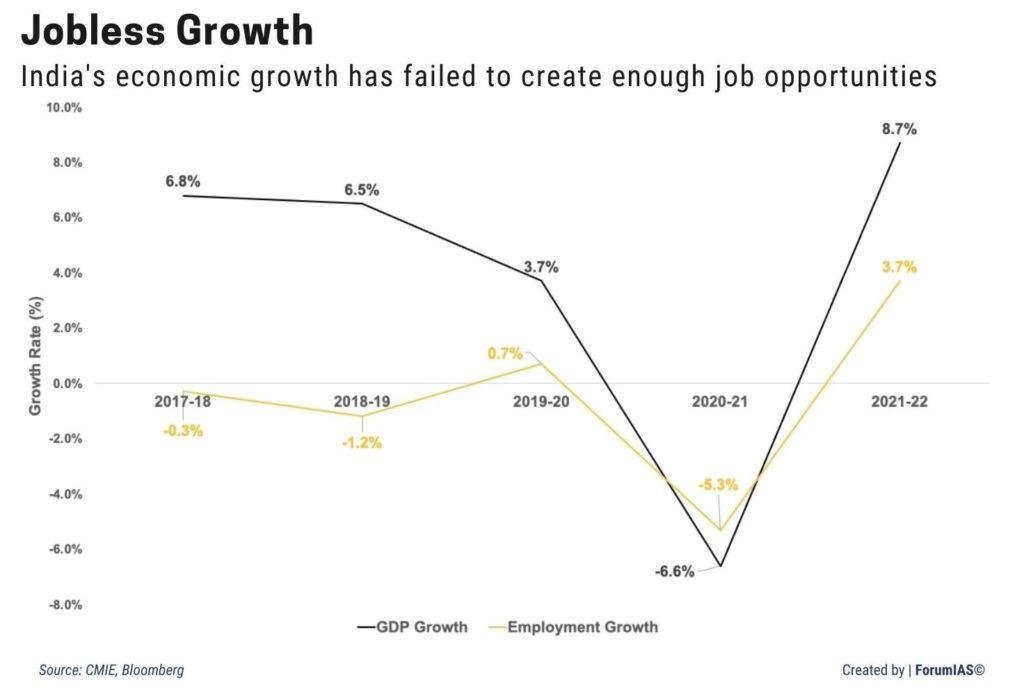
India’s labour market faces concerns that official data underestimates unemployment, while strong GDP growth has not translated into proportionate job creation, raising fears of jobless growth – a situation where economic growth does not generate enough employment opportunities.
Q1. What is Unemployment?
According to the International Labour Organization (ILO), unemployment refers to a situation in which a person who is able and willing to work at the prevailing wage rate is unable to find employment.
Q2. What are the key labour market indicators used to measure employment?
- Labour Force: It consists of all employed persons along with those unemployed but actively seeking work.
- Unemployment Rate: The unemployment rate measures the share of unemployed persons in the labour force. Unemployment Rate = (Unemployed / Total Labour Force) × 100
- Labour Force Participation Rate (LFPR): The percentage of the working-age population (15 years and above) that is either employed or actively seeking employment. India’s LFPR (January 2026) is 55.9%.
- Worker Population Ratio (WPR): WPR indicates the proportion of the total population that is employed. WPR = Employed Persons / Total Population.
Q3. How is unemployment measured in India?
- Employment data in India is compiled by the National Statistical Office (NSO) under the Ministry of Statistics and Programme Implementation through the Periodic Labour Force Survey (PLFS).
- Frequency of Data Collection: Annual, Quarterly and Monthly (introduced in 2025) Estimates
- Methods of Measurement:
- Usual Status (Long-term employment): Uses a 365-day reference period where the person is classified as principal status if worked for 183 days or more in a year and subsidiary status if worked for at least 30 days in a year.
- Current Weekly Status (Short-term employment): Reference period is last 7 days. If a person worked even one hour during the week, they are considered employed.
- Current Daily Status: Measures employment day-by-day based on hours worked.
Q4. What are the major types of unemployment in India?
- Disguised Unemployment: More workers are employed than required, so the additional worker contributes almost zero productivity. This is common in agriculture.
- Structural Unemployment: Occurs when there is a mismatch between workers’ skills and the requirements of industries.
- Cyclical Unemployment: Happens during economic slowdowns or recessions, when businesses reduce hiring.
- Frictional Unemployment: Short-term unemployment that occurs when people change jobs or search for new opportunities.
- Vulnerable Employment: Workers are employed but lack formal contracts, job security, or social protection, common in the informal sector and gig economy.
- Technological Unemployment: Jobs are lost due to automation, artificial intelligence, and technological changes.
Q5. What are the recent trends in unemployment in India?
According to PLFS 2026 data:
- Unemployment is higher in urban areas (7%) than in rural areas (4.2%). Overall unemployment rate is 5%.
- Even female unemployment is higher in urban areas (9.8%) than in rural areas (4.3%).
- Re-Agriculturalisation trend can be seen as people move back to agriculture due to high living cost in cities, rising urban inflation and limited employment opportunities in urban areas.
Q6. Why is unemployment high in India?
- Jobless Growth: Economic growth is concentrated in capital-intensive sectors such as IT, finance, and technology, which generate high output but limited employment.
- Skill Mismatch: The education system focuses more on academic degrees than practical skills, producing graduates who lack industry-relevant abilities.
- Slow Industrialisation: Manufacturing contributes only 16–17% of GDP, far below the national target of 25%.
- Low Female Labour Force Participation: Factors include social norms, safety concerns, and lack of workplace infrastructure.
- Weak MSME Sector: They face credit shortages, regulatory barriers, and limited market access.
- Large Informal Sector: Nearly 90% of India’s workforce is employed in informal jobs, often without stable wages or social security.
Q7. What are the implications of high unemployment?
- Economic Impacts: High unemployment reduces consumption, lowers purchasing power, and slows overall economic growth.
- Social Impacts: It fuels inequality, triggers social unrest or protests, and can lead to migration and brain drain.
- Psychological Impacts: Unemployment often causes stress, social pressure, and declining self‑confidence among individuals.
- Fiscal Impact: High unemployment increases government spending on welfare schemes and subsidies, creating pressure on public finances.
Q8. What steps has the government taken to address unemployment?
Several initiatives aim to promote employment generation and skill development:
- Viksit Bharat Guarantee Rozgar & Ajeevika Mission (VBG-RAMJI): Employment guarantee programme replacing Mahatma Gandhi National Rural Employment Guarantee Act with 125 days of employment guarantee.
- PM Viksit Bharat Rozgar Yojana (2026): Incentives for formal job creation.
- Pradhan Mantri Kaushal Vikas Yojana 4.0: Skill training initiatives.
- Pradhan Mantri Mudra Yojana: Collateral-free loans for small entrepreneurs.
- PM SVANidhi: Financial support for street vendors.
- Startup India and Stand Up India.
- Digital India and Smart Cities Mission.
Conclusion
India’s challenge is not just achieving high economic growth but ensuring that growth creates sufficient employment opportunities. Addressing issues such as skill mismatch, slow industrialisation, and informal employment will be essential to achieve inclusive and employment-intensive growth.