Important Questions for UPSC Prelims, Mains and Interview
|
Context
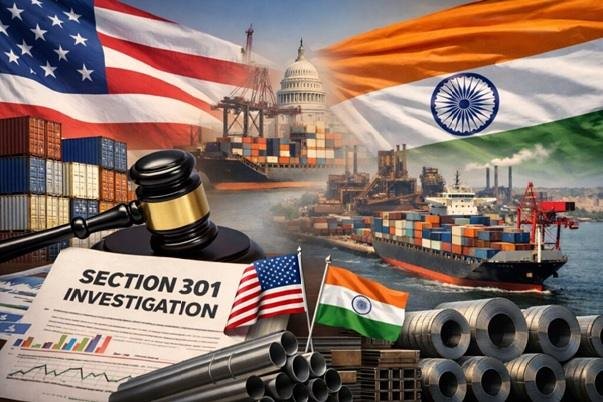
The United States has initiated a Section 301 investigation into multiple economies, including India, citing concerns about structural excess manufacturing capacity and trade imbalances. The probe may lead to new tariffs if the United States determines that these practices harm its domestic industries.
Q1. What is Section 301 of the US Trade Act, 1974, and how does it function as a tool to address alleged unfair trade practices?
- Section 301 is part of the US Trade Act of 1974 covering provisions from Sections 301–310.
- It authorises Office of the US Trade Representative (USTR) to investigate foreign trade practices.
- The law targets policies that are considered unfair, discriminatory, or harmful to US commerce.
- Investigations can be initiated by complaints from industries or stakeholders or directly by USTR.
- The investigation examines whether foreign government policies violate trade agreements or distort market competition. If violations are identified, the US government may impose tariffs, quotas, or other trade restrictions.
Q2. Why has the United States launched a Section 301 investigation against several countries including India, and what concerns has it raised about structural excess manufacturing capacity?
- The investigation aims to examine structural excess production capacity in global manufacturing sectors.
- The US believes that overcapacity can lead to large export surpluses in international markets.
- Excess production may result in lower global prices and competitive pressure on US industries.
- Countries with expanding industrial capacity are viewed as contributing to imbalances in global trade flows.
- The investigation also follows a US Supreme Court ruling that limited the use of emergency tariff powers under another law.
- As a result, Section 301 is now being used as the primary legal mechanism for trade action.
- Probe also reflects US efforts to strengthen domestic manufacturing & reshore supply chains.
Q3. What sectors in India have been identified by the United States as having excess production capacity or export surpluses?
- Solar energy manufacturing – due to rapid expansion in module production capacity. The US has noted that India’s solar module production capacity is much higher than domestic demand.
- Petrochemical sector – due to growing industrial output and export potential.
- Steel production has expanded through investments in large-scale industrial infrastructure.
- Textiles – major export sector with strong global demand & competitive production costs.
- Healthcare products and pharmaceuticals – strong export-oriented manufacturing ecosystems.
- Construction materials & automobile components – part of India’s expanding manufacturing exports.
Q4. How can a Section 301 investigation lead to the imposition of tariffs or trade restrictions, and what is the procedural framework followed by the United States?
- The USTR first conducts a formal investigation into foreign trade practices.
- Evidence is collected via economic data, industry complaints, and government policy analysis.
- Public consultations are organised, including written comments from stakeholders and public hearings involving industry representatives.
- Investigators assess whether the practices are unjustifiable, unreasonable, or discriminatory.
- If such practices are confirmed, the United States may impose tariffs or other trade restrictions.
- The decision is implemented by the US administration as part of trade enforcement policy.
Q5. What other legal instruments does the United States use to impose tariffs and trade restrictions in international trade disputes?
- International Emergency Economic Powers Act (IEEPA), 1977: Allows economic sanctions during national emergencies but has limited use for tariff imposition.
- Section 122 of the Trade Act, 1974: Enables temporary tariffs or import restrictions to address balance-of-payments problems.
- Section 232 of the Trade Expansion Act, 1962: Permits tariffs on imports considered a threat to national security. Section 232 has previously been used for tariffs on steel imports and aluminium products.
- Section 302(b) of the Trade Act, 1974: Allows the USTR to self-initiate investigations under Section 301.
Q6. What could be the economic and trade implications of the Section 301 investigation for India’s manufacturing and export sectors?
- The investigation could lead to higher tariffs on selected Indian exports to the US.
- Export-oriented industries may face reduced competitiveness in the American market.
- Companies operating in sectors such as solar equipment, steel, and textiles may experience uncertainty.
- Higher tariffs could disrupt supply chains connecting Indian manufacturers with US buyers.
- India may need to diversify export markets to reduce dependence on the US market.
- However, investigation may also prompt greater transparency & efficiency in industrial policies.
- Indian policymakers will need to carefully monitor developments to protect trade interests.
Q7. How might the investigation affect the ongoing India–United States trade negotiations and global supply chain dynamics?
- The probe comes at a time when both countries are negotiating a bilateral trade agreement.
- Tariff threats could complicate negotiations and delay finalisation of the trade deal.
- Trade tensions may influence decisions by multinational companies regarding supply chain investments.
- Countries may reassess industrial policies to avoid future trade disputes with major markets.
- The investigation may also reflect broader global debates about manufacturing overcapacity and trade imbalances. At the same time, continued dialogue could help both countries resolve differences through negotiations.
- The outcome will shape the future trajectory of India–US economic cooperation and global manufacturing networks.
Conclusion
The Section 301 investigation reflects the United States’ growing concerns about global manufacturing overcapacity and trade imbalances. For India, the probe highlights the importance of balancing export-driven growth with fair trade practices.