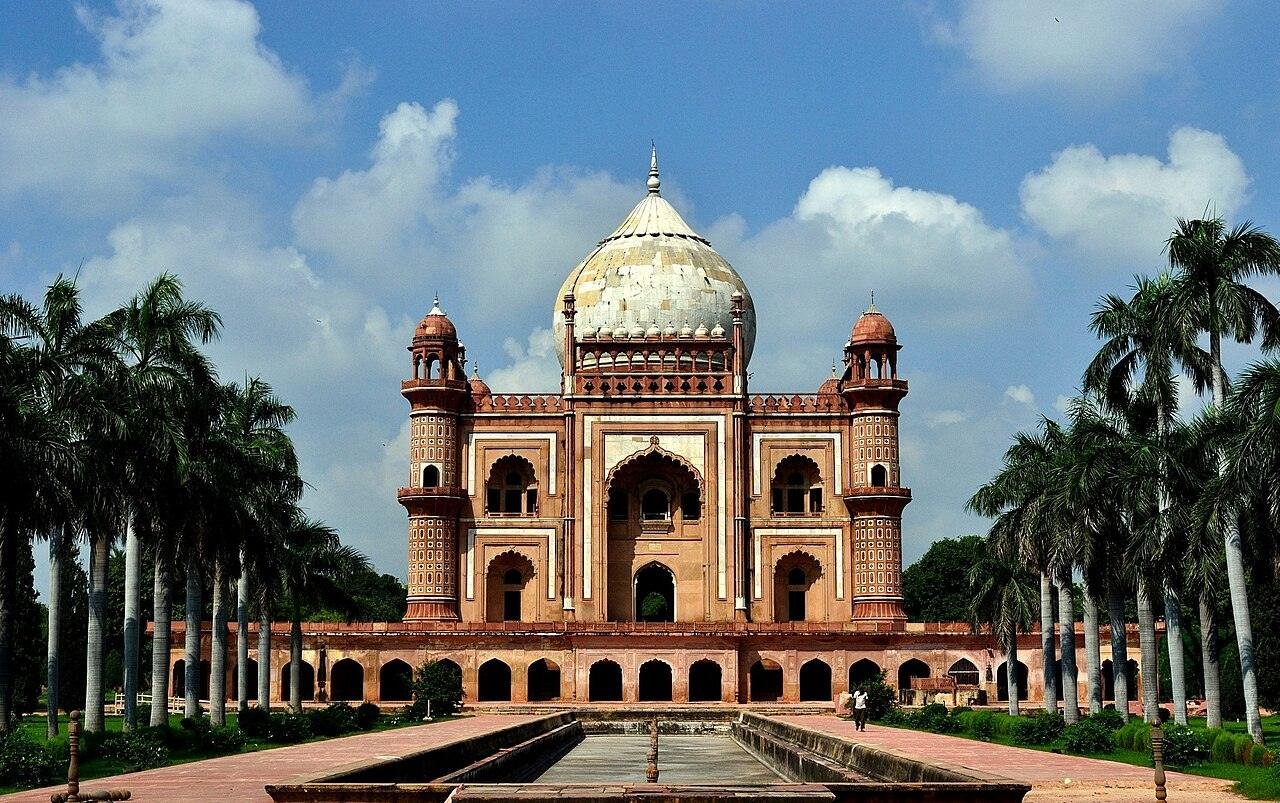
- Recently, Safdarjung Tomb’s Mughal garden architecture (charbagh style) is being discussed as a solution for dealing with a hotter and drier Delhi.
- About Safdarjung Tomb:
- It was constructed during 1753-54 (Late Mughal architectural period).
- It is historically significant because it is the last enclosed garden tomb ever built in Delhi.
- As the Mughal empire was declining at this time, the monument appears less grand and refined when compared to earlier masterpieces like Humayun’s Tomb and the Taj Mahal.
- It is located in Central Delhi near the Safdarjung area/airport zone.
- Building Materials: Mainly red sandstone and white marble.
- It follows a Charbagh Garden Style.
- The garden is divided into four equal sections
- Water channels run between these parts
- Structural Components of the Complex:
- At the centre stands the main mausoleum.
- Around it are smaller pavilion-type structures, including Moti Mahal (Pearl Palace), Jangli Mahal (Palace in the wild) and Bacha Mahal (Favourite residence area).
- Who Was Safdarjung:
- Mirza Muqim Abul Mansur Khan (also known as Safdarjung) was the second Nawab of Oudh (Awadh). His father, Saadat Khan was the founder of the Awadh state in the 1720s.
- Safdarjung later rose to prominence in Mughal politics and in 1748, he became the Grand Wazir (Prime Minister) under Mughal emperor Ahmad Shah Bahadur.
- He carried the title Wazir-ul-Mamalik-i-Hindustan, meaning chief administrator of India.
- Safdarjung’s son was Shuja‑ud‑Daula. He later became the third Nawab of Awadh and played a major role in the Battle of Buxar (1764), a decisive event that strengthened British control in India.
- Who Built the Safdarjung Tomb?
- Safdarjung passed away in Awadh after leaving Delhi.
- His son Shuja-ud-Daula sought permission from the Mughal Emperor and constructed this tomb in Delhi as a mausoleum for his father.
FAQs
Q1. When was Safdarjung Tomb built?
It was constructed in 1753–54 during the late Mughal period, marking the last enclosed garden tomb in Delhi.
Q2. What architectural style does Safdarjung Tomb follow?
It follows the Charbagh garden style, with four quadrants divided by water channels, and a central mausoleum surrounded by pavilions.
Q3. Who was Safdarjung?
Mirza Muqim Abul Mansur Khan, the second Nawab of Awadh, who later became Grand Wazir under Mughal emperor Ahmad Shah Bahadur.
Q4. Who built the Safdarjung Tomb?
Safdarjung’s son, Shuja‑ud‑Daula, constructed it in Delhi after seeking permission from the Mughal emperor.
Q5. Why is the Safdarjung Tomb historically significant?
Safdarjung Tomb reflects the decline of Mughal grandeur compared to earlier masterpieces like Humayun’s Tomb and the Taj Mahal, while still preserving Mughal garden traditions.