Context
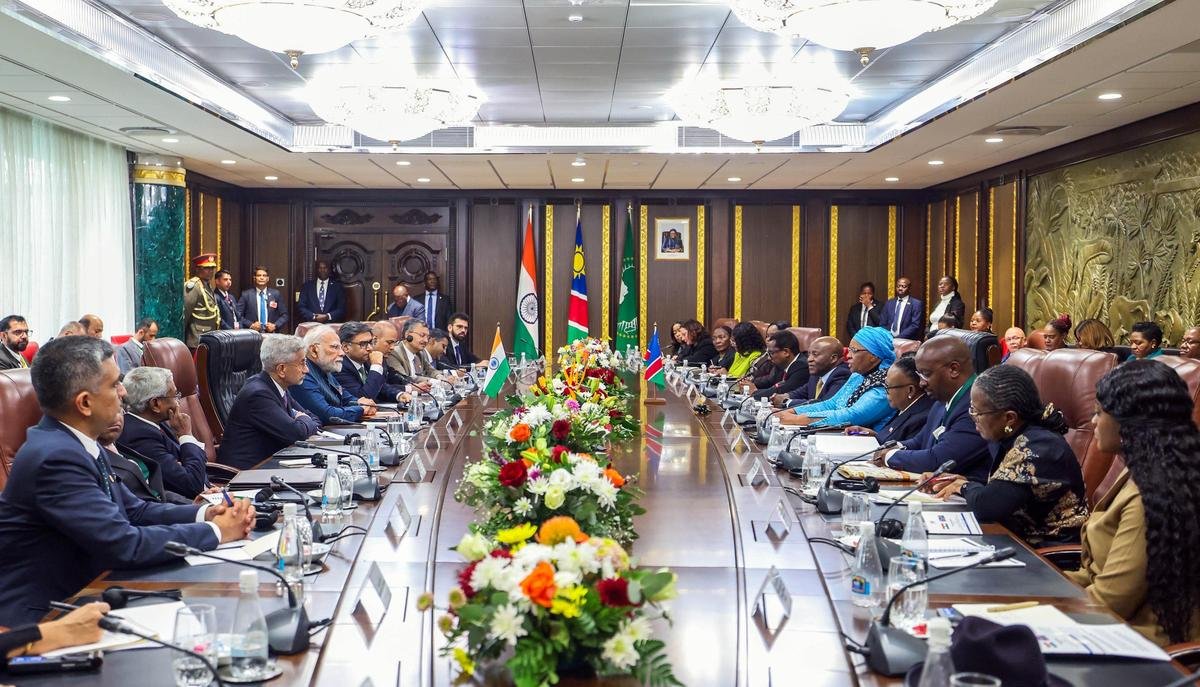
Various developments such as the African Union’s entry as a permanent member of the G20 during India’s presidency in 2023, Prime Minister Narendra Modi’s visits to Namibia and Ghana in July 2025, and his visit to Ethiopia in December 2025 have renewed focus on India-Africa economic relations.
What is the current status of India-Africa Economic Relations?
- India and Africa share a long history of cultural affinity and political solidarity.
- In recent decades, the relationship has increasingly become economic in nature.
- India is currently Africa’s fourth-largest trading partner.
- Bilateral trade between India and Africa has reached nearly $100 billion.
- In FY24, India exported goods worth around $38 billion to African countries.
- Major export destinations include Nigeria, South Africa, and Tanzania.
- Key Indian exports to Africa are petroleum products, engineering goods, pharmaceuticals, rice, and textiles.
- In 2024, Africa’s imports from India accounted for around 6% of its total imports, indicating scope for further expansion.
Why does India need to deepen economic ties with Africa?
India needs to deepen its economic engagement with Africa due to two major reasons:
- Unpredictability in Western Markets
- In FY24, around 40% of India’s exports were directed to the United States and the European Union.
- These markets are facing economic uncertainty and the risk of a slowdown.
- High dependence on a few Western markets makes India’s exports vulnerable to external shocks.
- Africa offers an alternative high-growth market for export diversification.
- China’s Dominance and India’s Untapped Opportunities
- China is Africa’s largest trading partner, with bilateral trade exceeding $200 billion.
- Around 21% of Africa’s total imports in 2024 came from China.
- Nearly 33% of Chinese exports to Africa fall under HSN 84 and 85, covering machinery, electrical equipment, and semiconductor devices, reflecting strong industrial presence.
- In comparison, India’s trade share remains modest, highlighting significant untapped potential.
- Recognising this gap, India has set a target to double its trade with Africa by 2030.
How India Can Unlock Africa’s Economic Potential (Five-Pillar Strategy)?
India can achieve its target of doubling trade with Africa by 2030 through the following five strategic pillars:
- Trade Liberalisation and Market Access
- Focus on removing trade barriers that restrict Indian exports.
- Negotiate Preferential Trade Agreements (PTAs) and Comprehensive Economic Partnership Agreements (CEPAs).
- Engage with regional economic communities and major African economies to improve market access.
- Shift to Value-Added Manufacturing and Joint Ventures
- Move away from low-value commodity exports to value-added manufacturing.
- Promote cross-border joint ventures and two-way manufacturing partnerships.
- Indian firms have not fully used manufacturing incentives offered by African governments.
- Setting up manufacturing units in Africa offers a dual advantage:
- Preferential access to the U.S. market through favourable tariff regimes.
- Direct access to Africa’s growing consumer base and industrial demand.
- Reducing dependence on petroleum and traditional exports is essential.
- Deeper engagement with the African Continental Free Trade Area (AfCFTA) can expand export opportunities.
- Support MSMEs through Trade Finance and Credit
- Africa provides strong opportunities for Indian MSMEs, unlike U.S. and EU markets.
- There is limited policy support for helping MSMEs enter African markets.
- Key measures required include:
- Scaling up Lines of Credit: Providing more government-backed loans to help Indian firms finance exports and projects in Africa.
- Improving access to trade finance: Making it easier for exporters, especially MSMEs, to get bank credit for international trade.
- Promoting trade in local currencies: Allowing trade payments in local currencies to reduce dependence on the US dollar and exchange-rate risks.
- Creating a joint insurance pool: Sharing political and commercial risks through insurance so firms and banks feel safer investing in Africa.
- These steps can reduce risk perception for MSMEs and banks and ensure sustainable trade.
- Improve Logistics and Connectivity
- High freight and logistics costs reduce India’s trade competitiveness in Africa.
- India should invest in:
- Port modernisation.
- Better hinterland connectivity.
- Development of India-Africa maritime corridors.
- Improved connectivity will lower costs and boost trade volumes.
- Expand Services Trade and People-to-People Links
- Scale up services exports, digital trade, and human exchanges.
- Leverage India’s strengths in:
- Information Technology
- Healthcare
- Professional services
- Skill development
- Services trade enables high-value exports and supports goods trade.
- Existing policy measures are insufficient and need significant strengthening.
| Preferential Trade Agreements (PTAs)
1. PTAs are trade agreements where countries reduce or remove tariffs on selected goods traded between them. 2. They do not cover all goods, only a limited list agreed upon by the partner countries. 3. The aim is to increase trade volumes by making certain imports cheaper. 4. PTAs are usually the first step towards deeper economic integration. Comprehensive Economic Partnership Agreements (CEPAs) 1. CEPAs are broad and deep trade agreements covering goods, services, investment, and economic cooperation. 2. They aim to eliminate or significantly reduce tariffs on most goods over time. 3. CEPAs also include rules on services trade, investment protection, intellectual property, and movement of professionals. 4. They promote long-term economic integration, not just tariff reduction. HSN 84 and 85 1. HSN (Harmonised System of Nomenclature) codes are used to classify traded goods globally. 2. HSN 84 includes machinery, mechanical appliances, boilers, and industrial equipment. 3. HSN 85 covers electrical machinery, electronics, telecom equipment, and semiconductor devices. 4. A high share of exports under HSN 84 and 85 indicates strong industrial and manufacturing capability. |
Challenges and Way Forward
| Challenges | Way Forward |
| India’s investments in Africa are overstated due to routing through Mauritius, often for tax-related reasons rather than real economic activity | Encourage direct investments into African economies and improve transparency in investment reporting |
| Bureaucratic hurdles, political instability, and high financing costs discourage Indian firms from investing in Africa | Strengthen bilateral investment agreements, provide risk mitigation mechanisms, and improve institutional support |
| Limited private sector participation in high-risk sectors | Public Sector Units (PSUs) should lead investments, especially in mining and mineral exploration, to crowd in private players |
| India-Africa engagement remains largely transactional | Shift focus towards long-term, sustainable partnerships in manufacturing, infrastructure, and technology cooperation |
Conclusion
Strengthening investments by Indian firms in manufacturing, agro-processing, infrastructure, renewable energy, and emerging technologies can further deepen India-Africa economic ties. As global supply chains realign and the world moves towards a multipolar economic order, Africa will remain central to India’s global economic ambitions. This is the right moment for India to recalibrate its strategy, innovate, and expand its long-term economic footprint across the African continent.
| Ensure IAS Mains Question
Q. Africa is emerging as a key pillar of India’s trade diversification strategy. Examine the economic rationale behind deepening India-Africa ties and evaluate the effectiveness of the five-pillar approach suggested to achieve this goal. (250 words) |
| Ensure IAS Prelims Question
Q. Consider the following statements regarding India-Africa economic relations: 1. India’s increasing engagement with Africa is partly driven by the rising uncertainty in traditional Western export markets. 2. Deepening engagement with regional trade frameworks such as the African Continental Free Trade Area can enhance India’s market access in Africa. Which of the statements given above are correct? a) 1 only b) 2 only c) Both 1 and 2 d) Neither 1 nor 2 Answer: c) Both 1 and 2 Explanation Statement 1 is correct: In FY24, around 40% of India’s exports were directed to the U.S. and EU, both facing economic uncertainty. This high dependence exposes India to external shocks, making Africa a crucial alternative market for export diversification. Statement 2 is correct: Engagement with frameworks like the African Continental Free Trade Area can help India access a larger integrated African market, reduce trade barriers, and expand value-added exports through regional value chains and manufacturing partnerships. |