Why in the News?
- The Reserve Bank of India (RBI)’s Monetary Policy Committee decided to pause rate cuts despite recent reductions, reflecting caution amid ongoing tariff uncertainties.
- This decision follows new tariffs imposed by the U.S., including an additional 25% on imports from India, complicating trade relations and impacting economic outlook.
| About the Monetary Policy Committee (MPC):
1. The MPC was created after an agreement between the Government of India and the RBI to manage inflation using a new policy framework. 2. The Finance Act, 2016 changed the RBI Act, 1934, to officially form the MPC. 3. Under Section 45ZB of the RBI Act, the government can set up a six-member MPC. 4. The MPC’s main job is to decide the repo rate to keep inflation within a set target. 5. It replaced the earlier Technical Advisory Committee. Composition: 1. The MPC has six members: the RBI Governor (Chairperson), the Deputy Governor in charge of monetary policy, one official nominated by the RBI Board, and three members appointed by the government. 2. The three government-nominated members serve for four years. 3. At least four members, including the Governor or Deputy Governor, must attend meetings. 4. Decisions are made by majority vote; if tied, the Governor’s vote counts twice. 5. MPC decisions are binding on the RBI. 6. The RBI’s Monetary Policy Department helps the MPC prepare policies. |
Key Highlights
- RBI’s Rate Cut Pause
- Since February 2025, RBI has cut rates by a total of 100 basis points (bps) (1%), but now paused further cuts.
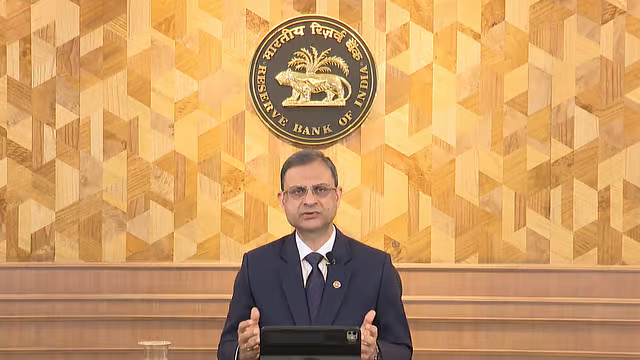
- Governor Sanjay Malhotra emphasized that the impact of these cuts is still working through the economy and further tariff developments are uncertain.
- The pause allows RBI to observe whether earlier rate cuts have had the desired effect.
- Tariff Uncertainties
- S. President Donald Trump approved an additional 25% tariff on imports from India, on top of an existing 25% reciprocal tariff.
- India is still negotiating a Bilateral Trade Agreement (BTA) with the U.S., and final tariff terms are undecided.
- Similar tariffs on countries buying Russian oil may affect India’s comparative advantage (ability to trade competitively).
- Credit Growth Slowing
- RBI data shows loan growth is slowing:
- Consumer durable loans contracted by 3% year-on-year.
- Housing loan growth fell sharply to 9.6% from 36% a year ago.
- RBI data shows loan growth is slowing:
- Vehicle loans slowed by 5 percentage points in the last year.
- Industrial loan growth dropped to 5.5% from 8.1%.
- This suggests reduced borrowing demand, despite ample liquidity in banks.
- Monetary Policy Limitations
- Simply lowering interest rates may not be enough to boost growth if borrowing demand remains weak.
- Governor Malhotra stressed the need for stronger policy frameworks across sectors, beyond just monetary policy.
- Government action is needed in targeted ways, not just broad increases in capital expenditure.
- Policy Recommendations for Growth
- Rationalising the Goods and Services Tax (GST) rates, which have been promised but delayed, can help businesses and consumers.
- Reducing fuel prices in line with global oil price declines can improve consumer confidence and spending.
- Unlike RBI, the government cannot “wait and watch” and needs proactive steps to support growth.
| Comparative Advantage
1. Comparative advantage is the ability of a country, individual, or company to produce a good or service at a lower opportunity cost than others. a. Opportunity cost is the cost of the next best alternative foregone. b. It means that the cost of the alternative that you could have done with given resources. 2. Countries benefit by specializing in products where they have comparative advantage and trading for others, leading to greater overall efficiency and gains. 3. Unlike absolute advantage, which looks at who can produce more, comparative advantage focuses on who can produce with the least relative cost or sacrifice. 4. It explains why countries export goods that they can produce relatively more efficiently and import others, helping improve global trade and welfare. For example: 1. Assume two countries: India and the USA. 2. India can produce either 10 units of textiles or 5 units of software per day. 3. The USA can produce either 6 units of textiles or 12 units of software per day. a. In India, the opportunity cost of producing 1 unit of textiles = 0.5 units of software (because making 10 textiles costs 5 software → 5/10 = 0.5). b. In India, the opportunity cost of producing 1 unit of software = 2 units of textiles (10/5 = 2). c. In the USA, the opportunity cost of producing 1 unit of textiles = 2 units of software (12/6 = 2). d. In the USA, the opportunity cost of producing 1 unit of software = 0.5 units of textiles (6/12 = 0.5). 4. India has a lower opportunity cost in textiles (0.5 < 2), so India should specialize in textiles. 5. The USA has a lower opportunity cost in software (0.5 < 2), so the USA should specialize in software. 6. If India specializes in textiles and the USA specializes in software, both can trade and enjoy more of both goods than if they try to produce both independently. |
Monetary Policy
- Meaning
- Monetary policy is the central bank’s strategy to manage the money supply and interest rates to achieve key economic goals like controlling inflation, supporting growth, and maintaining liquidity.
- It focuses on the demand side of the economy.
- Monetary Policy in India
- The Reserve Bank of India (RBI) uses monetary policy to regulate money flow and stimulate economic growth.
- It employs tools like open market operations (OMOs), bank rate policy, reserve requirements, and credit controls to adjust interest rates and liquidity.
- For example, RBI can lower interest rates by buying bonds, increasing money supply.
- Monetary Policy vs Fiscal Policy
| Aspect | Fiscal Policy | Monetary Policy |
| Definition | Government adjusts spending and taxes | Central bank controls money supply & rates |
| Controller | Government | Reserve Bank of India |
| Main Goal | Influence overall economic condition | Control inflation and money supply |
| Key Tools | Public spending, taxation, borrowing | Bank rate, CRR, SLR, repo rate |
- Monetary Policy Tools in India
- Quantitative Tools: Control overall credit amount and cost
- Bank Rate: Interest rate at which RBI lends to banks; higher rate reduces money supply.
- Cash Reserve Ratio (CRR): Percentage of deposits banks must keep with RBI; higher CRR reduces lending capacity.
- Quantitative Tools: Control overall credit amount and cost
- Statutory Liquidity Ratio (SLR): Portion banks keep as cash, gold, or government securities; higher SLR lowers loanable funds.
- Liquidity Adjustment Facility (LAF): Short-term borrowing/lending facility including repo and reverse repo rates.
- Marginal Standing Facility (MSF): Emergency overnight loans to banks at a rate higher than repo.
- Open Market Operations (OMOs): RBI buys or sells government securities to inject or absorb liquidity.
- Market Stabilization Scheme (MSS): RBI sells government bonds to mop up excess liquidity.
- Term Repos: RBI provides short-term loans (7-28 days) to banks to maintain liquidity.
- Qualitative Tools (Selective Credit Control)
- Margin Requirements: RBI sets higher margins to restrict credit to certain sectors.
- Consumer Credit Regulation: Limits credit for consumer durables by increasing down payments or shortening installments.
- Moral Suasion: RBI persuades banks to follow monetary policy goals.
- Direct Action: RBI penalizes non-cooperative banks with higher interest or refusal of services.
- Credit Rationing: Caps on loans banks can give.
- Priority Sector Lending: Banks must lend a fixed share to sectors like agriculture, small enterprises, and housing for the poor.
- RBI’s Policy Stances
- Hawkish: Focus on controlling inflation by raising interest rates, reducing borrowing and spending.
- Accommodative: Lower interest rates to boost spending and growth during economic slowdown.
- Neutral: Maintain current rates to sustain balanced economic conditions.
- Calibrated Tightening: Gradual rate hikes planned; not necessarily in every meeting.
- Dovish: Low interest rates to stimulate growth and avoid deflation; rare in India, common in stagnated economies.
Implications for the Economy
- Monetary Policy Impact
- The RBI’s 100 bps rate cuts are significant but take time to influence the economy due to transmission lags in lending.
- Banks have sufficient funds (ample liquidity) but are not seeing matching demand from borrowers.
- The pause prevents premature cuts before assessing impact fully.
- Trade and Tariffs
- Additional U.S. tariffs raise the cost of Indian exports, potentially hurting export growth and widening the trade deficit.
- Prolonged trade uncertainty affects business confidence and investment decisions.
- India’s competitiveness may decline if tariffs on Russian oil buyers affect energy costs.
- Credit Demand Weakness
- Falling loan growth across consumer durables, housing, vehicles, and industry reflects subdued economic activity and consumer caution.
- Lower credit uptake can limit consumption and investment-led growth.
- Need for Policy Coordination
- Monetary policy alone is insufficient; fiscal measures and reforms are necessary to stimulate demand and improve the business environment.
- Streamlining GST rates and lowering fuel costs are examples of policies that can boost growth and consumption.
- Growth Outlook
- RBI’s cautious approach allows space to monitor evolving risks from tariffs and credit trends.
- The government’s active role is critical for reviving economic momentum through targeted reforms.
Challenges and Way Forward
| Challenge | Why it Matters | Way Forward |
| Tariff Uncertainty | Raises trade costs, reduces export competitiveness | Expedite Bilateral Trade Agreement negotiations |
| Weak Credit Demand | Slows consumption and investment growth | Encourage credit demand via fiscal incentives, improve confidence |
| Monetary Transmission Lag | Rate cuts take time to affect lending and economy | RBI’s pause allows time for effects to materialize |
| Policy Coordination Gaps | Monetary policy alone cannot revive growth | Government should implement GST rationalization and fuel price reforms |
| Consumer and Business Confidence | Uncertainty limits spending and investment | Stable policy signals, tariff resolution, and tax reforms needed |
Conclusion
The RBI’s decision to pause rate cuts is a prudent step given evolving trade tensions and slow credit growth. While the banking system has liquidity, demand for loans remains weak, signaling that monetary easing alone cannot drive growth. The government must actively pursue reforms like GST rationalization and fuel price reductions to restore confidence and consumption. Coordinated policy action is essential to navigate tariff uncertainties and unlock India’s growth potential.
| Ensure IAS Mains Question
Q. Critically analyse the reasons behind RBI’s decision to pause interest rate cuts amid tariff uncertainties. What complementary policy measures should the government adopt to support India’s growth? (15 marks) |
| Ensure IAS Prelims Question
Q. The Reserve Bank of India (RBI) paused further interest rate cuts in 2025 despite significant reductions earlier that year. Which of the following reasons justify this decision? 1. Uncertainty due to evolving tariff disputes with the U.S. 2. Time needed for earlier rate cuts to affect loan demand and economic activity. 3. Lack of liquidity in the banking system to support new loans. 4. Weak growth in loans for consumer durables, housing, vehicles, and industry sectors. Select the correct answer from the codes given below: a) 1, 2, and 4 only b) 1 and 3 only c) 2 and 4 only d) All of the above Answer: a) 1, 2, and 4 only Explanation: Statement 1 is correct: The RBI paused rate cuts due to the uncertain trade situation with the U.S., especially after new tariffs were imposed, which can affect India’s economic outlook. Statement 2 is correct: The RBI recognizes that previous rate cuts take time to impact borrowing and economic activity; thus, pausing allows time for these effects to materialize. Statement 3 is incorrect: RBI Governor Sanjay Malhotra stated that there is ample liquidity in the banking system, so lack of funds is not the issue. Statement 4 is correct: Loan growth is slowing across key sectors like consumer durables, housing, vehicles, and industry, indicating weak demand for credit despite lower rates. |