| Important questions for UPSC Pre/ Mains/ Interview:
1. What is quorum sensing? 2. How does the quorum sensing mechanism function? 3. What are the components of a standard quorum sensing pathway? 4. What types of behaviours are regulated by quorum sensing? 5. Who first discovered quorum sensing and in what context? 6. Do all bacteria use the same quorum sensing system? 7. How does quorum sensing contribute to disease? 8. Is quorum sensing always harmful? 9. Why is quorum sensing being targeted in modern medicine? 10.How do anti-quorum sensing therapies differ from antibiotics? 11.What are the technological and research challenges? 12.What are the public health implications? 13.What are the concerns and ethical considerations? 14.What safeguards and oversight mechanisms are necessary? |
Context
Growing antimicrobial resistance (AMR) has reduced the effectiveness of traditional antibiotics. Scientists are exploring alternative strategies such as targeting bacterial communication mechanisms, especially quorum sensing, to control infections without killing bacteria directly. This approach could redefine future anti-infective therapies.
Q1. What is quorum sensing?
- A bacterial communication mechanism.
- Regulates gene expression based on population density.
- Mediated by chemical signal molecules called autoinducers.
- Coordinates collective behaviour among bacteria.
- Enables synchronised activation of specific genes.
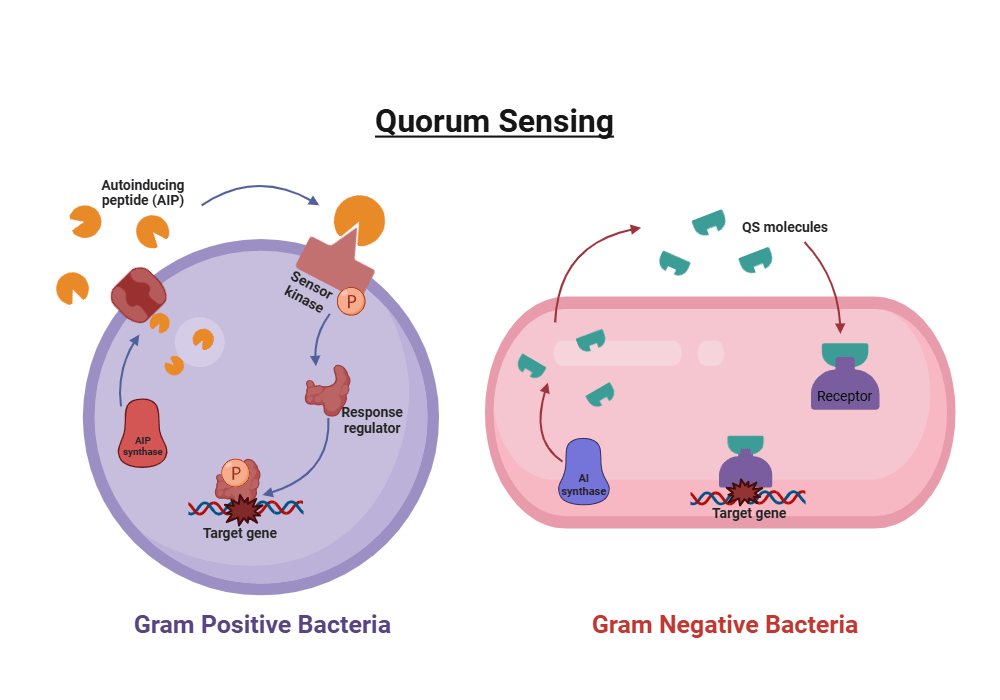
Q2. How does the quorum sensing mechanism function?
- Individual bacteria secrete signalling molecules (autoinducers).
- Signal concentration increases as bacterial population grows.
- Once threshold concentration is reached:
- Signal detected by bacterial receptors.
- Response genes activated.
- Coordinated behaviours are triggered.
Why is a threshold important?
- Many bacterial processes are effective only at high population density.
- Ensures resource efficiency.
- Prevents premature activation of virulence genes.
Q3. What are the components of a standard quorum sensing pathway?
- Bacterial population.
- Signal molecules (autoinducers).
- Signal detection system (receptors).
- Behaviour-regulating genes.
Q4. What types of behaviours are regulated by quorum sensing?
- Virulence factor production.
- Biofilm formation.
- Horizontal gene transfer.
- Genetic competence (DNA uptake).
- Toxin secretion.
- These behaviours often enhance survival and pathogenicity.
Q5. Who first discovered quorum sensing and in what context?
- First observed in the mid-1960s by Alexander Tomasz.
- Studied DNA uptake in Streptococcus pneumoniae.
- Demonstrated density-dependent gene activation.
Q6. Do all bacteria use the same quorum sensing system?
- No, mechanisms vary across species.
- Gram-negative bacteria often use acyl-homoserine lactones.
- Gram-positive bacteria commonly use peptide-based signals.
- Some bacteria possess multiple quorum sensing circuits.
- Cross-species communication (inter-species quorum sensing) also exists.
Q7. How does quorum sensing contribute to disease?
- Example:
- Pseudomonas aeruginosa
- Regulates virulence genes.
- Forms antibiotic-resistant biofilms.
- Pseudomonas aeruginosa
- Causes pneumonia and bloodstream infections.
- Impact:
- Coordinated toxin release.
- Increased antibiotic resistance via biofilm protection.
- Greater infection severity.
Q8. Is quorum sensing always harmful?
- No, quorum sensing is not always harmful.
- Example: Rhizobium leguminosarum
- Uses quorum sensing for symbiotic nitrogen fixation.
- Supports plant growth.
- Thus, quorum sensing also supports beneficial microbial processes.
Q9. Why is quorum sensing being targeted in modern medicine?
- Problem:
- Rising antibiotic resistance.
- Antibiotics exert selective pressure, leading to resistant strains.
- Need: Alternative therapy that reduces virulence without killing bacteria.
- Mechanism: Anti-quorum sensing therapy blocks signal production or detection.
- Impact:
- Prevents coordination of pathogenic behaviour.
- Reduces virulence and biofilm formation.
- Slows resistance development.
Q10. How do anti-quorum sensing therapies differ from antibiotics?
| Basis | Antibiotics | Anti-Quorum Sensing Therapy |
| Action | Kill/inhibit bacteria | Block communication |
| Selection Pressure | High | Lower |
| Resistance Risk | Rapid | Potentially slower |
| Target | Essential survival pathways | Virulence & coordination pathways |
Q11. What are the technological and research challenges?
- Identifying universal signal inhibitors.
- Avoiding disruption of beneficial bacteria.
- Ensuring stability of quorum sensing inhibitors in vivo.
- Limited large-scale clinical trials.
Q12. What are the public health implications?
- Could supplement antibiotics in resistant infections.
- Useful in biofilm-associated infections (catheters, implants).
- May improve chronic infection management.
- Supports global AMR mitigation strategies.
Q13. What are the concerns and ethical considerations?
- Off-target effects on microbiome balance.
- Ecological impact on microbial communities.
- Over-commercialisation without adequate testing.
- Regulatory uncertainty in classifying such therapies.
Q14. What safeguards and oversight mechanisms are necessary?
- Rigorous clinical trials for efficacy and safety.
- Monitoring of microbial ecological impact.
- Clear regulatory classification frameworks.
- Antimicrobial stewardship integration.
- Post-market surveillance.
Conclusion
Quorum sensing represents a paradigm shift in infection control by targeting bacterial coordination rather than survival. Anti-quorum sensing strategies may reduce virulence and resistance pressure while preserving beneficial microbes. Their success will depend on careful clinical validation and integration into broader antimicrobial resistance frameworks.