Context: On January 12, 2026, ISRO’s PSLV-C62 mission failed during its third stage, resulting in the loss of the strategic EOS-N1 satellite and 15 other payloads. This marks the second consecutive failure of the “workhorse” rocket within eight months, raising serious concerns about manufacturing quality and India’s commercial space reputation.
You will learn very important aspects for following important questions for UPSC Pre/ Mains/ Interview:
- What is the PSLV rocket and its purpose/utility?
- How does the PSLV-C62 mission failure compare to its historically high success rate?
- Who are the primary institutional and private stakeholders impacted by the loss?
- When did the “roll rate disturbance” occur, and what does it mean for the mission?
- Which larger strategic and commercial goals are now at risk for India?
- Why is the “transparency gap” in reporting failures a concern for future space missions?
1. What is the PSLV rocket and its purpose/utility?
- PSLV stands for Polar Satellite Launch
- It is India’s third-generation launch
3. It is the first Indian rocket to use liquid stages.
- Core Purpose: It was primarily developed to launch Indian Remote Sensing (IRS) satellites into Sun-synchronous orbits (SSO), which are crucial for Earth observation and mapping.
- Sun-Synchronous Orbit (SSO): Allows satellites to pass over a spot at the same local mean solar time, ensuring consistent lighting for images.
- Utility Beyond Earth Orbit: While its name suggests a “polar” focus, the PSLV is versatile enough to launch small satellites into Geostationary Transfer Orbit (GTO) and was the vehicle behind historic missions like Chandrayaan-1 (Moon) and Mangalyaan (Mars).
- GTO (Geostationary Transfer Orbit): Elliptical transition path used to reach high-altitude (36,000 km)
- Sub-GTO: A lower-altitude elliptical orbit used for lighter communication
- Commercial Utility: Through NewSpace India Limited (NSIL), the PSLV has become a global favorite for “rideshare” missions, launching hundreds of small satellites for over 36 countries.
- The rocket has four stages alternating between solid and liquid
- Stage 1 (PS1): Uses solid fuel and provides massive initial
- Stage 2 (PS2): Uses the liquid-fueled Vikas
- Stage 3 (PS3): A high-thrust solid motor used at high
- Stage 4 (PS4): A liquid-fuel stage for precise final orbital
2. How does the PSLV-C62 mission failure compare to its historically high success rate?
- PSLV is famously known as the “Workhorse of “
- It has completed over 60 missions in 30 years.
- It maintained a near-perfect 94% success rate before
- The PSLV-C62 failure is the second setback in just eight This follows the PSLV-C61 failure on May 18, 2025.
- This is the first time the PSLV has failed These back-to-back failures have dented its reputation for extreme reliability.
3. How did the “roll rate disturbance” cause failure of PSLV C-62 mission?
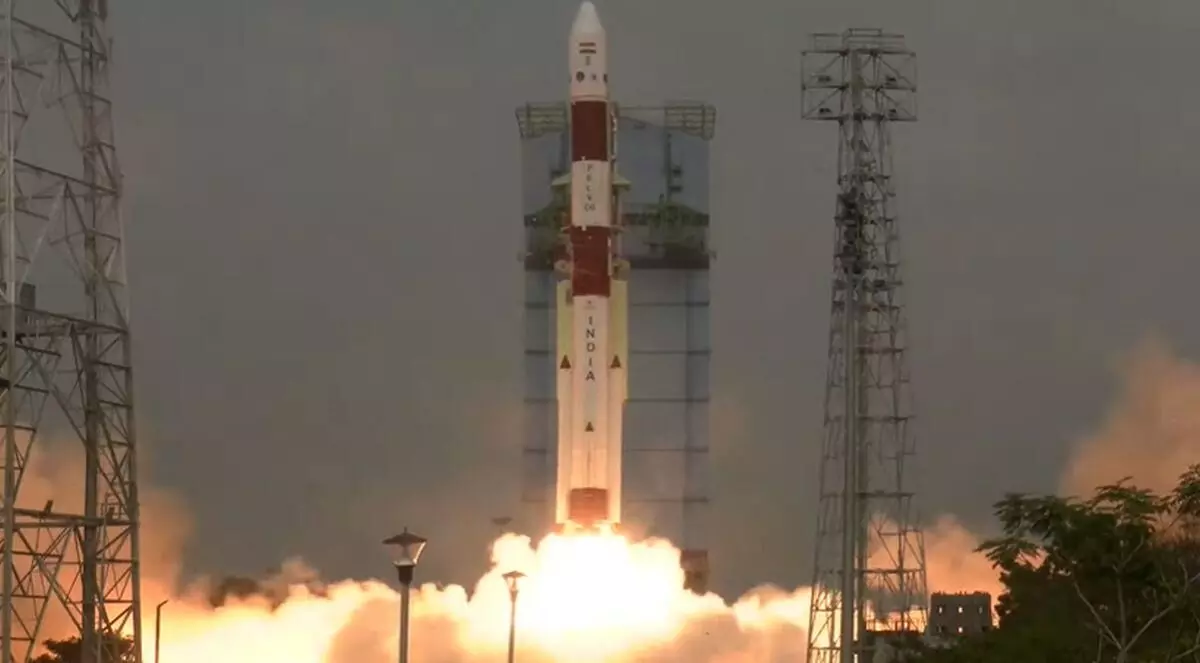
- Liftoff occurred on January 12, Stages 1 and 2 performed exactly as expected.
- During Stage 3 (PS3) “roll rate disturbance” caused the rocket to spin The spin was too strong for the Stage 4 stabilizers to correct.
- The rocket strayed off-course and failed to reach orbital
4. Who are the primary institutional and private stakeholders impacted by the loss?
- DRDO: Lost the primary strategic payload, EOS-N1 (Anvesha), which was critical for national security and border
- NewSpace India Limited (NSIL): ISRO’s commercial arm, which contracted the 15 co-passenger satellites for global and domestic clients.
- Space Startups: Indian firms like Dhruva Space and OrbitAid lost technology demonstrators, stalling their “flight heritage”
- OrbitAid Aerospace: Specifically lost AayulSAT, India’s first on-orbit satellite refuelling demonstrator, intended to test propellant-transfer technologies.
- Flight Heritage: Proven operational success of a space component; vital for startups to gain commercial
- Eon Space Labs: Lost the MIRA telescope, India’s lightest space
- International Partners: Research groups from Brazil, Nepal, and Thailand lost
5. Which larger strategic and commercial goals are now at risk for India?
- National Security: The loss of EOS-N1 delays advanced border
- Hyperspectral Imaging: This tech allows identifying material compositions from
- Global Market Share: Repeated failures may push global customers toward
- Space Policy 2023: India’s goal to reach 8% of the global space economy faces a
- Insurance Costs: Launch prices may rise as insurance premiums increase for
- Flight Heritage: Startups cannot prove their tech works, affecting their future
- In-orbit Servicing: The loss of AayulSAT delays India’s entry into the emerging market for satellite refuelling and
6. Why is the “transparency gap” in reporting failures a concern for future space missions?
- ISRO did not publicly release the full report for the 2025 (C61)
- This creates a “transparency gap” for commercial partners and
- Global insurers need detailed data to assess and cover future launch
- A secret report makes it hard to verify if manufacturing defects were truly
- Experts argue that open disclosure is critical for maintaining international