- Recently, a mud volcano suddenly erupted in Diglipur, located in the Andaman Islands.
- What Is a Mud Volcano?
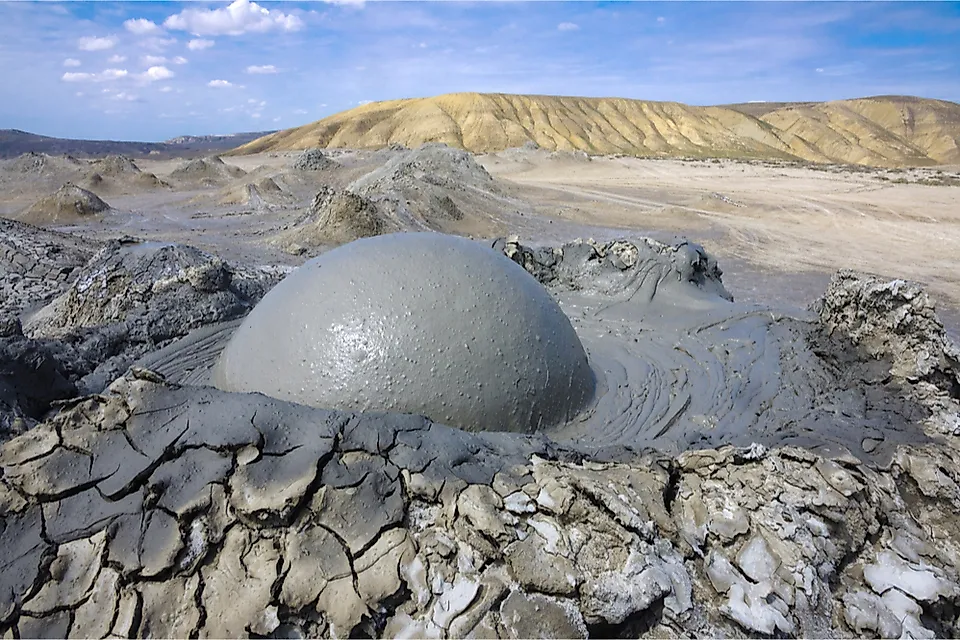
- A mud volcano is not like a normal lava volcano. It is a mound of mud that is pushed upward through layers of sediment beneath the Earth.
- Instead of molten lava, mud volcanoes release: Mud, Water and Gases such as methane. That is why they are also called “sedimentary volcanoes” or “gas–oil volcanoes.”
- They have shallow craters (small bowl-like depressions).
- They form cone-shaped hills, which keep getting rebuilt but are easily worn away by wind and rain.
- They are similar to magmatic volcanoes in a way that they also erupt forcefully and can produce flames several hundred metres tall.
- How Do Mud Volcanoes Form (2 ways)?
- Hot-spring related mud volcanoes: Here, hot water and gases react with surrounding rocks and create boiling mud. Special forms include:
- Porridge pots – boiling mud basins that erode surrounding rocks
- Paint pots – boiling mud coloured yellow, green, or blue by minerals
- Oil-field related mud volcanoes: These occur in young regions with soft sediments. Under strong underground pressure methane and hydrocarbon gases mix with mud, the mixture forces its way upward and it bursts onto the surface, forming a cone.
- Hot-spring related mud volcanoes: Here, hot water and gases react with surrounding rocks and create boiling mud. Special forms include:
- Because this material comes from deep inside the Earth, the mud is often hot and may be accompanied by steam clouds.
- Mud Volcanoes can be found on land and on the sea floor. Some can even form small islands and banks, changing coastlines.
- Globally, around 1,000 mud volcanoes have been identified on land and in shallow waters. In India, the only known mud volcano is on Baratang Island (Andaman island chain).