Context
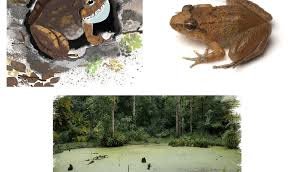
A new frog species, Limnonectes motijheel, has been discovered in Namdapha Tiger Reserve, highlighting the region’s rich amphibian biodiversity.
About Limnonectes motijheel
- It is a newly identified frog species belonging to the genus Limnonectes.
- Discovered in Namdapha Tiger Reserve, Arunachal Pradesh.
- Named after Motijheel Lake, known for high amphibian diversity.
- It is part of the “fanged frogs” group, characterised by small fang-like projections in males.
- With this discovery, the genus Limnonectes now includes six species in India.
- Distinctive Morphology of the Species
- Displays a dark-brown stripe between the eyes.
- Has a distinct inverted “V”-shaped ridge along the back.
- Features broken folds along the sides of the body.
- Adult size ranges between 2.3 to 3.5 cm, typical of medium-sized frogs in this group.
- The fang-like structures in males may assist in feeding or territorial behaviour.
- Breeding Behaviour:
- Unlike most frogs that lay eggs in water or on vegetation, this species constructs mud nests beneath leaf litter on the forest floor.
- This behaviour is previously unrecorded for this group in India.
- Indicates adaptation to forest floor ecosystems and specific ecological niches.
- Broader Distribution and Ecological Significance:
- Fanged frogs (genus Limnonectes) are distributed across South and Southeast Asia.
- Known for unique reproductive strategies and ecological adaptations.
- Play an important role in forest ecosystems, contributing to insect population control, food chains and biodiversity balance.
- Their diversity reflects the health of tropical forest ecosystems.
About Namdapha Tiger Reserve
- Landscape of Namdapha Tiger Reserve
- Located in Changlang district, Arunachal Pradesh, along the India–Myanmar border.
- Lies at the junction of Indian and Indo-China biogeographic regions.
- Surrounded by Mishmi Hills (Dapha Bum ridge) and Patkai ranges.
- The Namdapha River flows north to south through the reserve.
- It shares a boundary with Kamlang Wildlife Sanctuary.
- Vegetation types: Tropical evergreen forests, Moist deciduous forests, Temperate forests and Alpine scrub.
- Flora:
- Unique species like Pinus merkusii and Abies delavayi
- Rare orchid Blue Vanda
- Medicinal plant Mishimi Teeta (Coptis teeta)
- Fauna: Elephants, Himalayan black bear, sun bear, hoolock gibbon (India’s only ape), slow loris
- Unique feature: Only park globally with four big cats: Tiger, Leopard, Snow Leopard, and Clouded Leopard
Conclusion
The discovery of Limnonectes motijheel underscores the ecological richness of Northeast India. Protecting such habitats is essential for biodiversity conservation and scientific advancement.