Context
The Large Hadron Collider (LHC) has identified a new particle called Xi-cc⁺, adding to earlier discoveries like the Higgs Boson and exotic hadrons. This strengthens our understanding of the fundamental structure of matter.
Q1. What is the newly discovered particle Xi-cc⁺?
- Xi-cc⁺ is a type of baryon (a particle made of three quarks).
- It is composed of Two charm quarks + one down quark
- Comparison:
- Proton = 2 up quarks + 1 down quark
- Xi-cc⁺ = 2 charm quarks + 1 down quark
- Because charm quarks are heavier than up quarks, this particle is about 4 times heavier than a proton.
Q2. What are quarks and why are they important?
- Quarks are the basic building blocks of matter.
- They come in six types (flavours): Up, Down, Charm, Strange, Top, Bottom.
- Quarks are never found alone. They always exist in combinations (like protons, neutrons, or new particles like Xi-cc⁺)
- Studying such particles helps scientists understand how matter is formed.
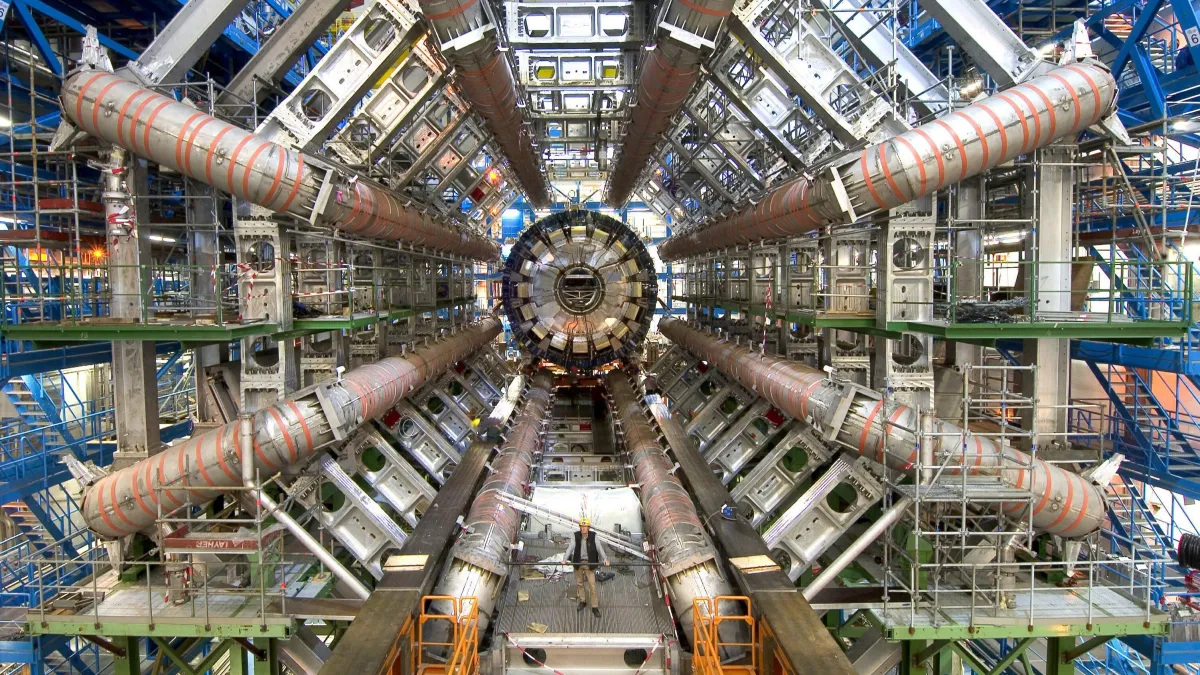
Q3. What is the Large Hadron Collider (LHC) and how does it work?
- The LHC is the world’s largest and most powerful particle accelerator.
- Located about 100 meters underground, it has a 27 km circular tunnel.
- How it works: Two beams of particles (protons/ions) are accelerated to near light speed & then collided with each other. These collisions create new particles, which scientists study.
- Purpose: To understand the origin of mass, fundamental forces and concepts like dark matter and dark energy.
Q4. What is CERN (European Organization for Nuclear Research)?
- CERN is the world’s leading research centre for particle physics.
- Located on the France–Switzerland border near Geneva
- Established in 1954
- Has 25 member countries (India is an associate member)
Conclusion
The discovery of Xi-cc⁺ highlights how advanced experiments at the LHC continue to reveal new forms of matter, helping scientists better understand the fundamental structure and origin of the universe.