| Important questions for UPSC Pre/ Mains/ Interview:
1. Why is Ladakh becoming India’s premier astronomy hub? 2. What is the National Large Solar Telescope (NLST)? 3. What scientific objectives will the NLST address? 4. How will the NLST strengthen India’s solar research ecosystem? 5. What is the National Large Optical–Near Infrared Telescope (NLOT)? 6. What scientific questions will the NLOT explore? 7. How does India’s experience in the TMT project support NLOT construction? 8. What is the significance of upgrading the Himalayan Chandra Telescope (HCT)? 9. How will the upgraded HCT integrate with global scientific facilities? 10.What are the administrative and institutional implications? 11.What are the strategic and security dimensions? 12.What technological advancements will be required? 13.What are the benefits of the Ladakh telescope expansion? 14.What concerns and challenges must be addressed? 15.What safeguards and oversight mechanisms are necessary? |
Context
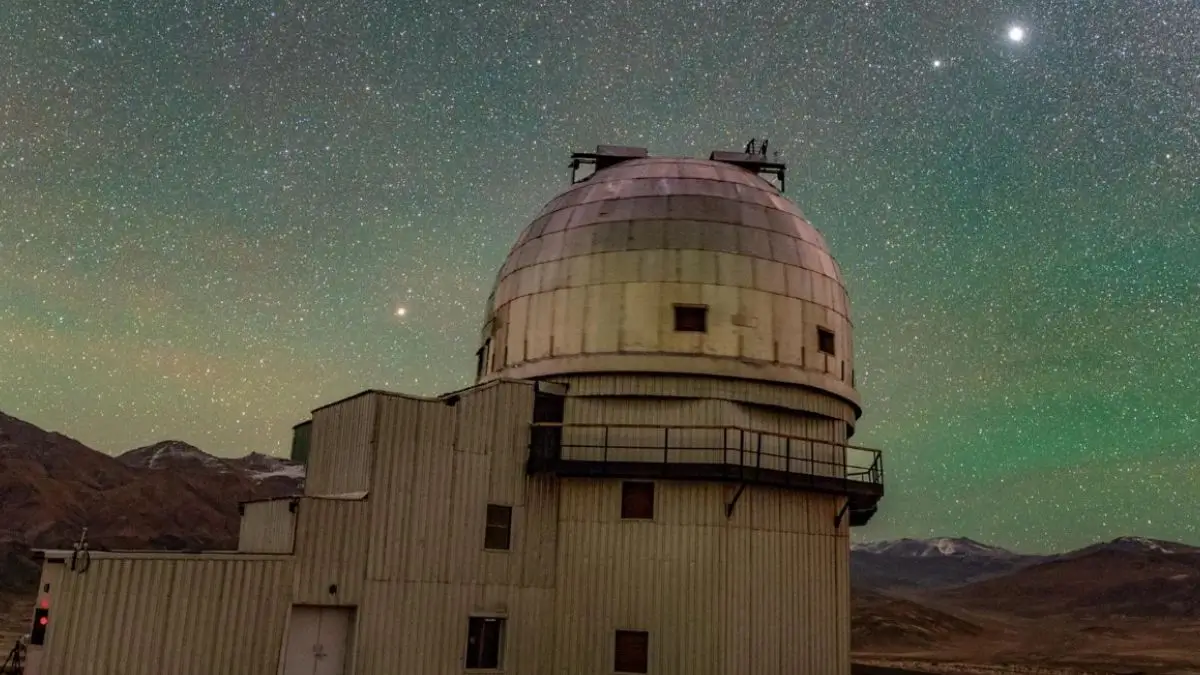
The Union Budget has approved two new major telescopes in Ladakh—a solar telescope and a large optical–infrared telescope—along with the upgrade of an existing facility. The decision strengthens India’s ground-based astronomy infrastructure and enhances its role in global space science and deep-sky exploration.
Q1. Why is Ladakh becoming India’s premier astronomy hub?
- High altitude reduces atmospheric turbulence and light scattering.
- Cold and dry climate ensures minimal water vapour interference.
- Clear skies enable long-duration observation windows.
- Presence of Hanle Dark Sky Reserve, India’s first notified Dark Sky Reserve.
- Geographic longitude fills observational gaps in global telescope coverage.
Q2. What is the National Large Solar Telescope (NLST)?
- A 2-metre aperture ground-based solar telescope planned near Pangong Tso (Merak region).
- Operates in visible and near-infrared wavelengths.
- Designed for high-resolution observation of solar surface and atmosphere.
- Why specialised solar design is necessary?
- Different electromagnetic wavelengths interact differently with Earth’s atmosphere.
- Solar radiation requires adaptive optics and heat-resistant instrumentation.
- Precision tracking systems are essential for dynamic solar observation.
Q3. What scientific objectives will the NLST address?
- Study solar magnetism and plasma dynamics.
- Observe solar flares and coronal mass ejections.
- Analyse space weather processes affecting Earth.
- Why is this important?
- Solar disturbances affect:
- Satellites
- Communication systems
- Solar disturbances affect:
- GPS networks
- Power grids
- Enhances space-weather forecasting capacity.
Q4. How will the NLST strengthen India’s solar research ecosystem?
NLST will complement:
- Kodaikanal Solar Observatory (est. 1899).
- Udaipur Solar Observatory (est. 1975).
- Aditya-L1 (space-based solar observatory).
Ground-based and space-based integration:
- Improves continuous solar monitoring.
- Provides redundancy and cross-validation of data.
- Strengthens India’s contribution to heliophysics research.
Q5. What is the National Large Optical–Near Infrared Telescope (NLOT)?
- A 7-metre aperture segmented-mirror telescope to be built in Hanle.
- Mirror composed of 90 hexagonal segments functioning as one optical surface.
- Designed for optical and near-infrared astronomy.
Q6. What scientific questions will the NLOT explore?
- How do exoplanets form and evolve?
- What drives stellar and galactic evolution?
- How do supernovae occur?
- What are the origins of the universe?
Why is optical–infrared capability significant?
- Infrared light penetrates cosmic dust.
- Enables detection of faint and distant galaxies.
- Crucial for early-universe cosmology.
Q7. How does India’s experience in the TMT project support NLOT construction?
- India participates in the Thirty Meter Telescope (TMT).
- India’s contributions include:
- Designing the Segment Support Assembly.
- Supplying hexagonal mirror segments.
- Impact:
- Builds domestic expertise in segmented mirror alignment.
- Reduces technological risk for NLOT fabrication.
Q8. What is the significance of upgrading the Himalayan Chandra Telescope (HCT)?
- The Himalayan Chandra Telescope:
- Currently 2-metre aperture.
- To be upgraded to 3.7-metre segmented mirror system.
- Enhances sensitivity in optical–infrared range.
- What research does it support?
- Transient astronomy (e.g., supernovae).
- Rapid follow-up of gravitational wave and radio detections.
Q9. How will the upgraded HCT integrate with global scientific facilities?
- Coordination expected with:
- LIGO-India
- Square Kilometre Array
- Impact:
- Enables multi-messenger astronomy.
- Combines optical, radio, and gravitational-wave data.
- Strengthens India’s role in frontier astrophysics.
Q10. What are the administrative and institutional implications?
- Major capital allocation under Union Budget.
- Enhances India’s scientific self-reliance.
- Provides assured observation time to Indian scientists.
- Reduces dependency on foreign telescopes.
Q11. What are the strategic and security dimensions?
- Strengthens space-weather prediction for satellite safety.
- Enhances protection of national space assets.
- Reinforces scientific infrastructure in strategically sensitive Ladakh region.
Q12. What technological advancements will be required?
- Adaptive optics systems.
- High-precision segmented mirror calibration.
- Advanced infrared detectors.
- High-performance data processing infrastructure.
Q13. What are the benefits of the Ladakh telescope expansion?
- Elevates India among leading astronomy nations.
- Strengthens Global South presence in big science.
- Generates high-quality astronomical data.
- Enhances national research autonomy.
Q14. What concerns and challenges must be addressed?
- Long gestation period (5–10 years).
- High capital and operational costs.
- Environmental sensitivity of Himalayan ecosystems.
- Logistical challenges at high altitude.
- Need for sustained skilled manpower.
Q15. What safeguards and oversight mechanisms are necessary?
- Environmental impact assessments and monitoring.
- Transparent allocation of observation time.
- Peer-reviewed scientific governance structures.
- Long-term financial planning for maintenance.
- Institutional collaboration for data-sharing.
Conclusion
The Ladakh Telescope Expansion represents a strategic investment in India’s scientific and technological future. By combining solar observation, deep-space exploration, and multi-messenger astronomy, the initiative enhances national capability while contributing to global research. Sustained institutional support and ecological safeguards will be essential to translate this ambition into lasting scientific leadership.