Important questions for UPSC Pre/ Mains/ Interview:
|
Context
The United States recently carried out a bombing raid on Kharg Island, Iran’s primary oil export hub in the Persian Gulf, amid escalating West Asia conflict. While oil infrastructure was not targeted, the incident highlights the island’s critical role in global energy security.
Q1. Where is Kharg Island and why is it geographically important?
- Kharg Island is located in the northern Persian Gulf, about 25–30 km off Iran’s mainland coast.
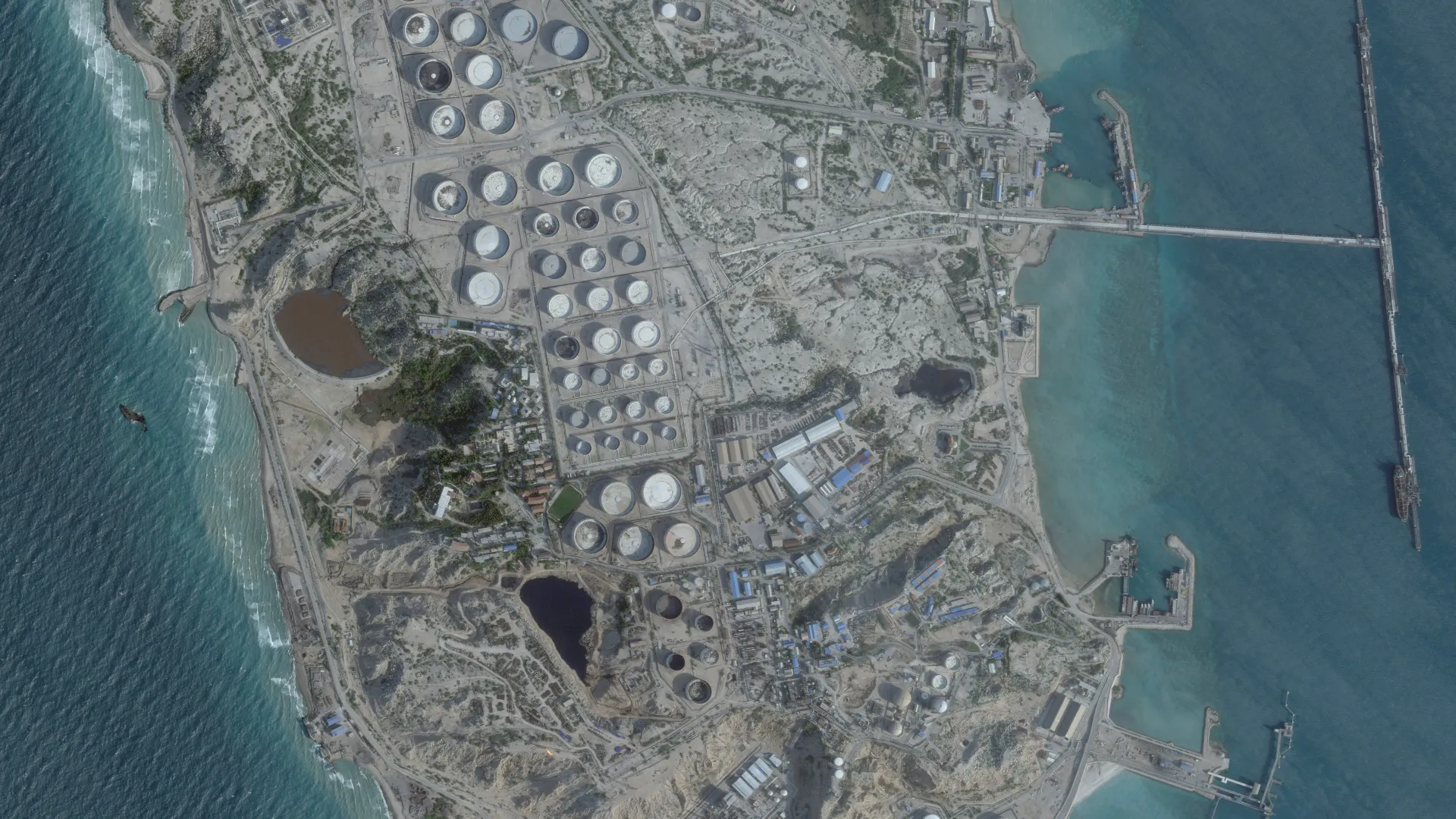
- It is a small coral island (~20 sq. km, ~8 km long) but heavily industrialised.
- The island has:
- Deep-water access suitable for supertankers
- Oil terminals, jetties, and storage tanks
- Most of Iran’s coastline is shallow, making Kharg Island uniquely suited for large-scale oil exports.
- Its location near major shipping routes enhances its role as a strategic maritime energy node.
Q2. Why is Kharg Island central to Iran’s oil economy?
- Kharg Island handles around 90% of Iran’s crude oil exports.
- It serves as the main export terminal connected via pipelines to key oil fields:
- Ahvaz
- Marun
- Gachsaran
- It exports approximately 1.5 million barrels/day, with capacity rising to ~3 million barrels/day during crises.
- It also has large storage capacity (~18 million barrels) to ensure supply continuity.
- Thus, it is the backbone of Iran’s oil revenue and economic stability.
Q3. What energy infrastructure exists on Kharg Island?
- The island hosts critical facilities such as:
- Oil storage tanks and export terminals
- Deep-water jetties for crude loading
- Airstrip and logistics infrastructure
- Key operators include:
- Falat Iran Oil Company (~500,000 barrels/day production)
- Kharg Petrochemical Company
- The infrastructure was originally developed by American Oil Company (Amoco) and later nationalised after the 1979 Iranian Revolution.
- The concentration of infrastructure makes the island a high-value strategic asset.
Q4. Why is Kharg Island strategically significant in global geopolitics?
- It is a critical chokepoint-like energy hub, though not a transit route like Hormuz.
- Any disruption can:
- Severely reduce Iran’s export capacity
- Affect global oil supply chains
- Its proximity to the Strait of Hormuz increases its vulnerability during conflicts.
- Military targeting decisions often avoid oil facilities to prevent global market shocks.
- Control or disruption of Kharg Island has implications for:
- Energy security
- Geopolitical leverage in West Asia
Q5. How can disruptions at Kharg Island impact global oil markets?
- Since it handles the bulk of Iran’s exports, disruption can:
- Reduce global oil supply significantly
- Trigger sharp price spikes (potentially up to $150/barrel)
- Oil markets are highly sensitive to:
- Supply disruptions
- Conflict near energy infrastructure
- Even non-direct attacks (military strikes nearby) increase uncertainty, raising prices.
- It can also impact:
- Shipping insurance costs
- Global energy inflation
- Energy-importing economies like India
Q6. What is the historical importance of Kharg Island?
- Historically part of Persian Gulf trade routes, often referred to as the “orphan pearl”.
- Controlled at different times by:
- Dutch
- British
- Developed into a major oil hub in the 20th century.
- Became Iran’s primary export terminal after:
- Infrastructure expansion
- Strategic pipeline connections
- Its evolution reflects the shift from colonial trade node to modern energy hub.
Q7. What are the key risks associated with Kharg Island?
- Energy Security Risks: High dependence (90% exports) creates single-point vulnerability.
- Geopolitical Risks: Located in a conflict-prone region near West Asia flashpoints.
- Infrastructure Concentration: Centralised facilities increase risk of large-scale disruption from targeted attacks.
- Market Volatility: Any instability leads to global oil price fluctuations.
Conclusion
Kharg Island is not just an energy facility but a strategic linchpin in global oil markets. While recent attacks avoided oil infrastructure, its vulnerability underscores the delicate balance between geopolitical conflict and energy security. Ensuring stability around such critical nodes remains essential for both regional and global economic stability.