Context
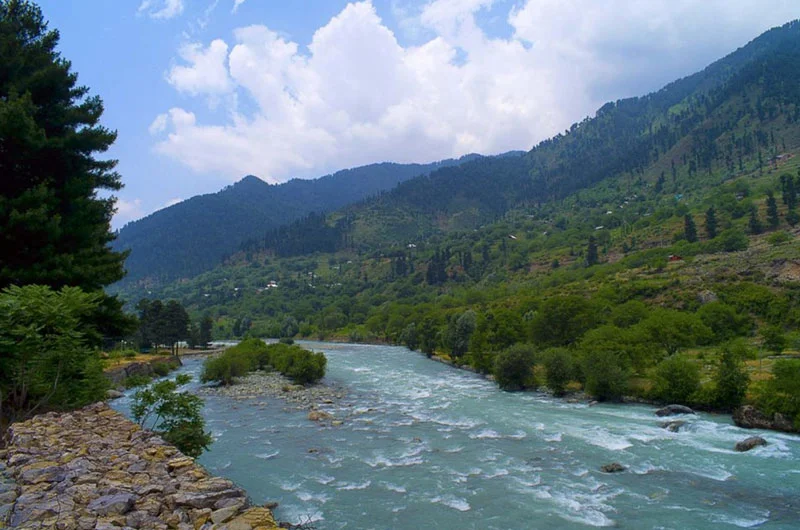
The Jhelum River’s (lifeline of Kashmir Valley) water level has fallen below the zero-gauge level during an unusually early spring, while the region is experiencing record high temperatures.
Q1. What is the Jhelum River?
- It is a tributary of Indus river which flows through north-western India and eastern Pakistan.
- Historically, it has been known by many names (Vitasta in Sanskrit, Hydaspes in Greek & Bidasp in Persian).
- Among the five rivers of Punjab, it is the largest and the westernmost and flows through the Jhelum District (North of Punjab province, Pakistan).
Q2. What is the course of the Jhelum River?
- It originates from Verinag Spring (Anantnag) at foothills of Pir Panjal Range in Kashmir Valley.
- From its source, it flows northwest through the Kashmir Valley.
- It passes through Wular Lake near Srinagar, which helps regulate its flow.
- The river then cuts through a deep and narrow gorge before entering Pakistan.
- Finally, it merges with the Chenab River near Trimmu (Pakistan).
- The river has an approximate total length of about 725 km.
Q3. What controls the hydrology of the Jhelum River?
- The river’s water flow mainly depends on snowmelt from the Karakoram Range and the Himalayas during spring.
- It is also significantly influenced by the southwest monsoon, which brings heavy rainfall to the region between June and September.
Q4. What are the major tributaries of the Jhelum River?
- Largest tributary: Kishenganga (Neelum) River – joins Jhelum near Muzaffarabad before entering Pakistan’s Punjab province.
- Second-largest tributary: Kunhar River – meets Jhelum near Kohala Bridge in Kaghan Valley.
- Other tributaries: Sandran, Bringi, Arapath, Watlara, Lidder, and Veshaw rivers.
Conclusion
The Jhelum River is a crucial river system of the Indus basin and the lifeline of the Kashmir Valley, with its flow largely dependent on snowmelt and monsoon rainfall, making it highly sensitive to climatic changes.
FAQs
Q1. What is the Jhelum River and why is it important?
The Jhelum River, historically known as Vitasta (Sanskrit), Hydaspes (Greek), and Bidasp (Persian), is a major tributary of the Indus River and the lifeline of the Kashmir Valley.
Q2. Where does the Jhelum River originate and what is its course?
It originates from Verinag Spring in Anantnag (Pir Panjal Range), flows through the Kashmir Valley, passes Wular Lake near Srinagar, enters Pakistan through a gorge, and finally merges with the Chenab River near Trimmu. Its total length is about 725 km.
Q3. Why is the Jhelum River sensitive to climate change?
Its water levels are highly dependent on snowmelt and rainfall patterns, making it vulnerable to temperature rise, early spring warming, and changing monsoon cycles.