Context
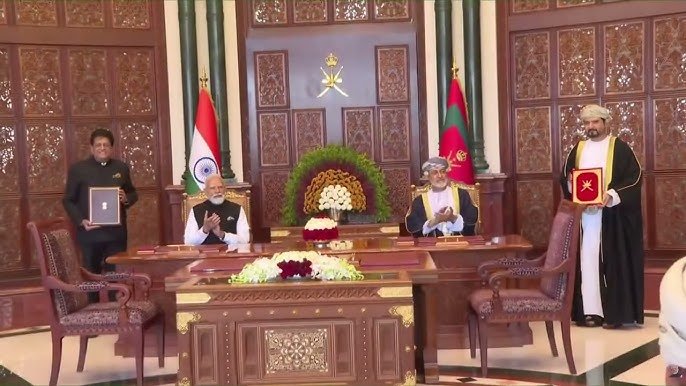
- India and Oman have signed a Comprehensive Economic Partnership Agreement (CEPA) in Muscat.
- The agreement aims to liberalise trade, boost services, enhance labour mobility, and strengthen investment ties.
- This is Oman’s first bilateral trade agreement since 2006 and India’s second CEPA with a Gulf Cooperation Council (GCC) country, after the UAE (2022).
What is CEPA?
- A Comprehensive Economic Partnership Agreement (CEPA) is a deep trade agreement that goes beyond traditional Free Trade Agreements.
- It covers:
- Reduction or elimination of tariffs on goods
- Liberalisation of services
- Investment facilitation
- Mobility of professionals and workers
- Cooperation in MSMEs, innovation, and emerging sectors
- CEPAs aim to create long-term, rules-based economic integration between partner countries.
Key Features of the India–Oman CEPA
- Oman has offered duty-free access on 98.08% of its tariff lines, covering 38% of India’s exports to Oman.
- India has offered liberalised tariffs on 77.79% of its tariff lines, covering 81% of imports from Oman.
- The agreement includes important concessions in services, particularly benefiting:
- Indian professionals
- Skilled and semi-skilled workers
- The CEPA is expected to promote investment flows, technology collaboration, and business confidence.
India–Oman Trade Profile
- In 2024–25, India exported goods worth $4.06 billion to Oman, accounting for 93% of India’s total exports.
- India imported goods worth $6.5 billion from Oman, making up 91% of total imports.
- Although bilateral trade volume is modest, the CEPA aims to expand trade rapidly by removing structural barriers.
Strategic and Regional Significance
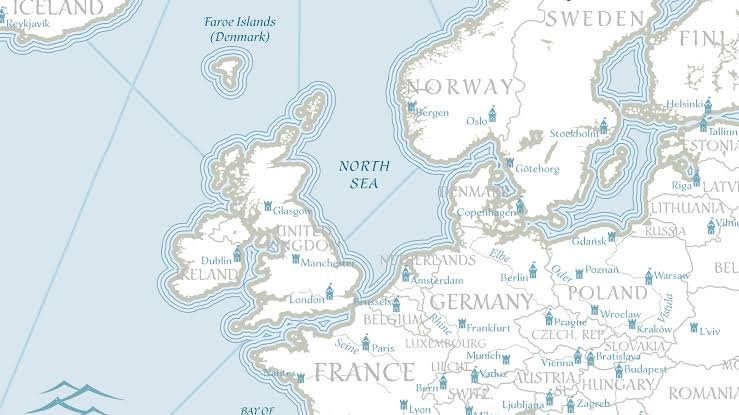
- Oman is a strategically located country at the mouth of the Strait of Hormuz, a critical global energy chokepoint.
- The CEPA positions Oman as a gateway for India to:
- The Gulf Cooperation Council (GCC)
- Eastern Europe
- Central Asia
- Africa
- This aligns with India’s broader goals of diversifying trade partners and strengthening West Asia engagement.
Benefits to Labour-Intensive and Domestic Sectors
- The agreement is expected to significantly benefit labour-intensive sectors, which generate large-scale employment.
- Key beneficiaries include:
- Micro, Small and Medium Enterprises (MSMEs)
- Artisans and traditional industries
- Women-led enterprises
- Enhanced market access and services liberalisation will support inclusive growth and job creation, especially for youth.
Services Sector and Labour Mobility
- Services concessions under the CEPA are important for India, given its comparative advantage in skilled manpower.
- Easier movement of professionals will:
- Strengthen people-to-people ties
- Increase remittances
- Improve employment opportunities for Indian workers in Oman
- This complements India’s long-standing role as a human resource provider to the Gulf region.
Geopolitical and Economic Implications
- The CEPA strengthens India’s presence in the Gulf amid global trade fragmentation.
- It reflects India’s shift towards bilateral and regional trade agreements after exiting RCEP.
- The deal enhances India’s image as a reliable economic partner and supports its ambition to be a global manufacturing and services hub.
Challenges and Way Forward
| Challenges | Way Forward |
| Limited awareness among MSMEs about CEPA benefits | Conduct outreach programmes and trade facilitation support |
| Risk of import surge in sensitive sectors | Use safeguard measures and phased tariff liberalisation |
| Implementation gaps in services and mobility provisions | Establish joint monitoring and dispute-resolution mechanisms |
| Need to scale up exports beyond traditional goods | Promote value-added exports and new sectors |
Conclusion
The India–Oman CEPA marks a significant step in deepening India’s economic engagement with the Gulf region. By offering near-complete market access, strengthening services trade, and supporting labour-intensive sectors, the agreement promotes growth, employment, and strategic connectivity. If implemented effectively, the CEPA can serve as a model for India’s future trade partnerships and reinforce its role in the emerging multipolar global economy.
| EnsureIAS Mains Question
Q. Discuss the significance of the India–Oman Comprehensive Economic Partnership Agreement (CEPA) for India’s trade, services sector, and strategic engagement with the Gulf region. (250 Words) |
| EnsureIAS Prelims Question
Q. Consider the following statements regarding the India–Oman Comprehensive Economic Partnership Agreement (CEPA): 1. Under the agreement, Oman has offered duty-free access to more than 98% of its tariff lines covering almost all of India’s exports to Oman. 2. India has provided tariff liberalisation on more than three-fourths of its tariff lines covering imports from Oman. 3. The India–Oman CEPA is India’s first trade agreement with a country from the Gulf Cooperation Council (GCC). Which of the statements given above are correct? A. 1 and 2 only Answer: A. 1 and 2 only Explanation: Statement 1 is correct: Oman has granted duty-free market access on 98.08% of its tariff lines, covering about 99.38% of India’s exports, making the agreement highly favourable for Indian merchandise exports. Statement 2 is correct: India has offered tariff liberalisation on 77.79% of its tariff lines, which together account for around 94.81% of India’s imports from Oman, reflecting a balanced but liberal trade commitment. Statement 3 is incorrect: India’s first CEPA with a Gulf Cooperation Council country was signed with the United Arab Emirates in February 2022, making the Oman agreement the second such deal. |