Context
A study by the University of Utah found that freshwater extends deep (up to ~13,000 feet) beneath the Great Salt Lake, revealing new insights into its underground water system.
Q1. Where is the Great Salt Lake located and what makes it unique?
- Located in northern Utah (USA).
- It is the largest saltwater lake in the Western Hemisphere and one of the most saline inland water bodies in the world.
Q2. What are its sources of water and why is it called a “closed lake”?
- Fed by three rivers: Bear River, Weber River and Jordan River.
- It has no outlet to the sea. It means that water comes in, but does not flow out, so it is called a closed basin lake.
Q3. Why does the size of the lake keep changing?
- The lake expands or shrinks depending on the amount of river inflow & the rate of evaporation.
- More evaporation = lake shrinks and More inflow = lake expands.
Q4. Why is the Great Salt Lake highly saline?
- Located in a dry (arid) region
- Water evaporates faster than it is replaced
- Result: Salt gets left behind and accumulates. Over time, salinity becomes higher than ocean water. Similar to the Dead Sea, but even more concentrated in some parts.
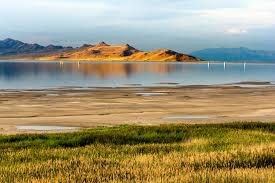
- Surrounded by salt flats, sandy areas and marshlands. This makes the lake appear isolated from nearby human settlements.
Q5. What kind of wildlife is found here?
- It is an important avian habitat despite harsh conditions.
- Example: American avocet, California gull, Wilson’s phalarope, Peregrine falcon, American white pelican etc.
Conclusion
The Great Salt Lake is a unique closed-basin saline lake shaped by evaporation and limited outflow, making it both ecologically important and scientifically significant.