Context
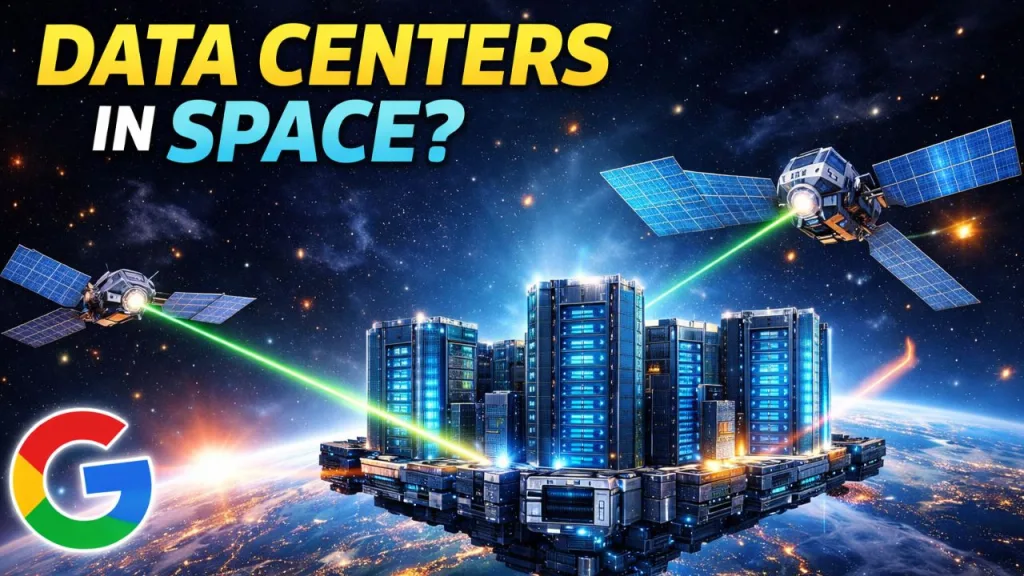
- Google has announced Project Suncatcher, a long-term research initiative to deploy solar-powered AI data centres in space, starting with prototype satellites by 2027.
- CEO Sundar Pichai stated that within a decade, space-based data centres could become common, signalling a major shift in global digital infrastructure.
What is Project Suncatcher?
- Project Suncatcher is Google’s plan to move part of its AI computing infrastructure into space.
- It aims to deploy solar-powered satellite constellations equipped with Tensor Processing Units (TPUs) for large-scale machine learning tasks.
- Satellites will be connected using laser-based optical links, allowing coordinated computing similar to Earth-based data centres.
- Google has tested its chips for radiation tolerance, ensuring they can function in space conditions.
- As a first step, two prototype satellites will be launched with Planet Labs by early 2027 to test feasibility and performance.
Why Are Data Centres Being Moved to Space?
- The rapid AI boom has sharply increased the demand for computing power.
- Terrestrial data centres consume huge amounts of electricity and water and depend heavily on fossil fuels.
- According to estimates, global data centre power demand could grow by up to 165% by 2030, intensifying climate concerns.
- Space offers an alternative that reduces environmental stress on Earth.
How Space-Based Data Centres Work and Why They Are Attractive?
- Energy, Stability, and Reliability Advantages
- Space offers continuous and predictable solar energy, especially on the lunar surface.
- This reduces dependence on fragile Earth-based power grids.
- Space-based systems are protected from natural disasters, extreme weather, and undersea cable disruptions.
- Data Sovereignty and Legal Flexibility
- Many countries impose data localisation laws, restricting where data can be stored or processed.
- Under the 1967 Outer Space Treaty, no country can claim sovereignty over outer space.
- This could allow multi-country data hosting from a single space-based facility, offering legal flexibility.
- Technological Enablers
- Advances in rocket and launch technologies have reduced the cost of space missions.
- This makes it feasible to launch experimental computing payloads and test space data infrastructure.
Implications of Project Suncatcher
- Marks a shift towards clean-energy-based digital infrastructure.
- Could significantly reduce the carbon and water footprint of AI computation.
- May reshape global rules around data governance and sovereignty.
- Positions space as a new frontier for critical digital infrastructure.
- Encourages innovation in satellite computing, optics, and energy systems.
Challenges and Way Forward
| Challenges | Way Forward |
| High construction and launch costs | Gradual scaling starting with small prototypes |
| Difficulty of repairs and maintenance | Develop autonomous systems and remote diagnostics |
| Latency in data transmission | Use space computing mainly for non-time-sensitive AI tasks |
| Cybersecurity risks in space | Build space-specific encryption and security protocols |
| Need for skilled intervention | Advance robotics and AI-led maintenance systems |
| Legal and regulatory uncertainty | Develop international norms for space data infrastructure |
Conclusion
Project Suncatcher reflects a growing push to shift energy-intensive digital infrastructure beyond Earth. While challenges remain, advances in space technology and AI could make space-based data centres a viable solution for sustainable computing in the future.
| Ensure IAS Mains Question
Q. Why are technology companies exploring space-based data centres? Discuss the advantages and challenges of initiatives like Google’s Project Suncatcher. (250 words) |
| Ensure IAS Prelims Question
Q. Consider the following statements regarding space-based data centres: 1. Space offers continuous solar energy that can power data centres sustainably. 2. The Outer Space Treaty allows countries to claim exclusive sovereignty over orbital data infrastructure. 3. Rising AI-driven power demand is a major reason for exploring space-based computing. Which of the statements are correct? a) 1 and 3 only b) 1 and 2 only c) 2 and 3 only d) 1, 2 and 3 Answer: a) 1 and 3 only Explanation Statement 1 is correct: Space provides continuous and predictable solar radiation, making it suitable for solar-powered data centres. Statement 2 is incorrect: The 1967 Outer Space Treaty prohibits national sovereignty claims over outer space. Statement 3 is correct: The rapid growth of AI has sharply increased power demand, pushing companies to seek alternatives like space-based data centres. |