Important questions for UPSC Pre/ Mains/ Interview:
|
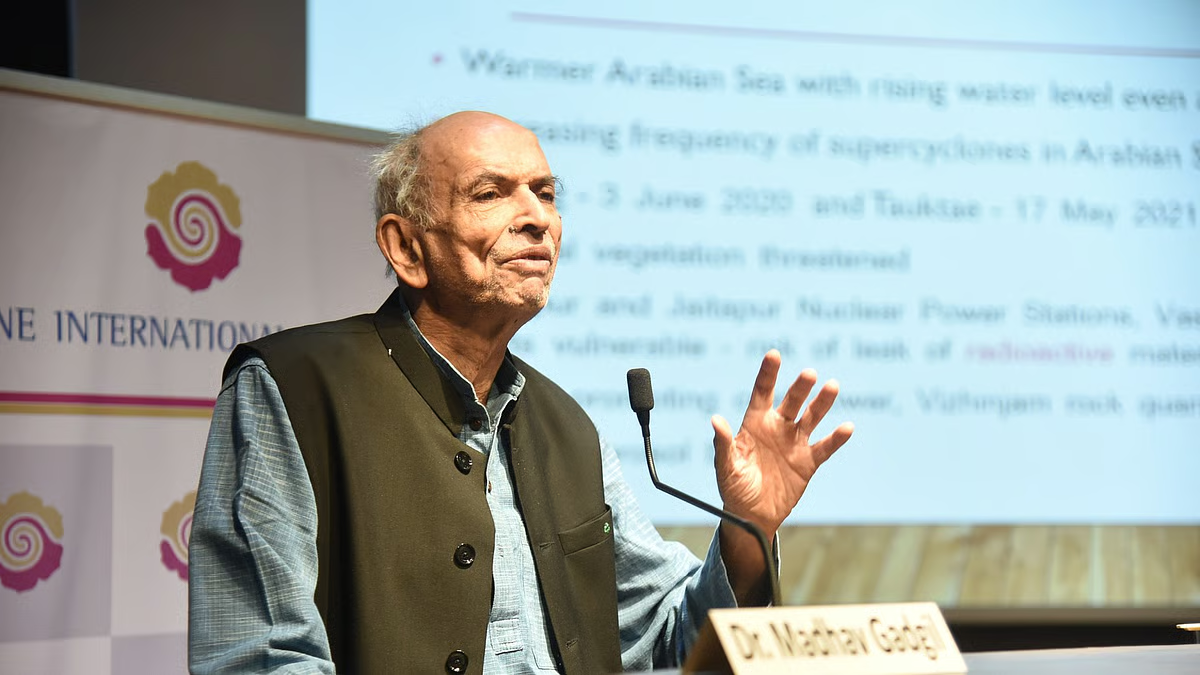
Q1. What is the Gadgil Report and why was it prepared?
- The Gadgil Report was prepared by the Western Ghats Ecology Expert Panel to assess ecological sensitivity and recommend conservation-oriented development strategies for the Western Ghats.
- Objectives:
- Prevent irreversible environmental damage
- Regulate destructive activities
- Promote sustainable livelihoods
- The report follows science-led environmental governance, arguing that long-term economic growth depends on ecological stability, not exploitation.
Q2. Why are the Western Ghats ecologically significant?
- The Western Ghats are a global biodiversity hotspot and play a vital role in monsoon regulation, river systems, and climate stability.
- Ecological importance:
- High endemic species diversity
- Water security for peninsular India
- Natural disaster regulation
- Environmental economics recognises such ecosystems as natural capital, whose degradation creates long-term economic and social costs.
Q3. What core environmental principles guide the Gadgil Report?
- The report is guided by three major principles:
- Precautionary Principle – prevent damage before it occurs
- Sustainable Development – balance ecology and economy
- Intergenerational Equity – protect future generations
- These principles are central to global environmental governance and climate policy, making the report conceptually strong and forward-looking.
Q4. Why did the Gadgil Report face political and social resistance?
- Resistance arose due to fears that strict regulations would limit mining, infrastructure, and economic growth. States also viewed it as restricting federal autonomy.
- Underlying issue: Short-term development vs long-term sustainability
- Environmental policies often fail not due to weak science, but due to conflict between ecological goals and political-economic interests.
Q5. How does the Gadgil Report apply the precautionary principle?
- The report advocates regulating activities before irreversible damage occurs, especially in fragile zones.
- Key idea: Environmental thresholds, once crossed, cannot be reversed
- Environmental economics shows prevention is cheaper than disaster response. Recent floods and landslides have validated this preventive logic.
Q6. Why does the Gadgil Report remain relevant despite non-implementation?
- The report remains relevant because repeated ecological disasters have confirmed its warnings.
- Why relevance persists: Science was accurate and Policy failure was political, not technical.
- This reflects a gap between knowledge and governance, a common issue in climate and environmental policy worldwide.
Q7. How does the report explain the development–environment conflict?
- The report argues that development ignoring ecological limits leads to disasters, livelihood loss, and economic instability.
- Key argument:
- Environment is not anti-development
- It is a foundation for sustainable growth
- Sustainable development theory views ecology and economy as complementary, not contradictory.
Q8. What lessons does the Gadgil Report offer for sustainable development policy?
- Major lessons:
- Science must guide policy
- Local communities must participate
- Prevention is better than disaster relief
- Long-term development requires respecting ecological limits. Ignoring them leads to higher social and economic costs.
Conclusion
The Gadgil Report endures because it offers a theory-backed, future-oriented vision of development. Its continued relevance reflects the cost of ignoring ecological science.