Context
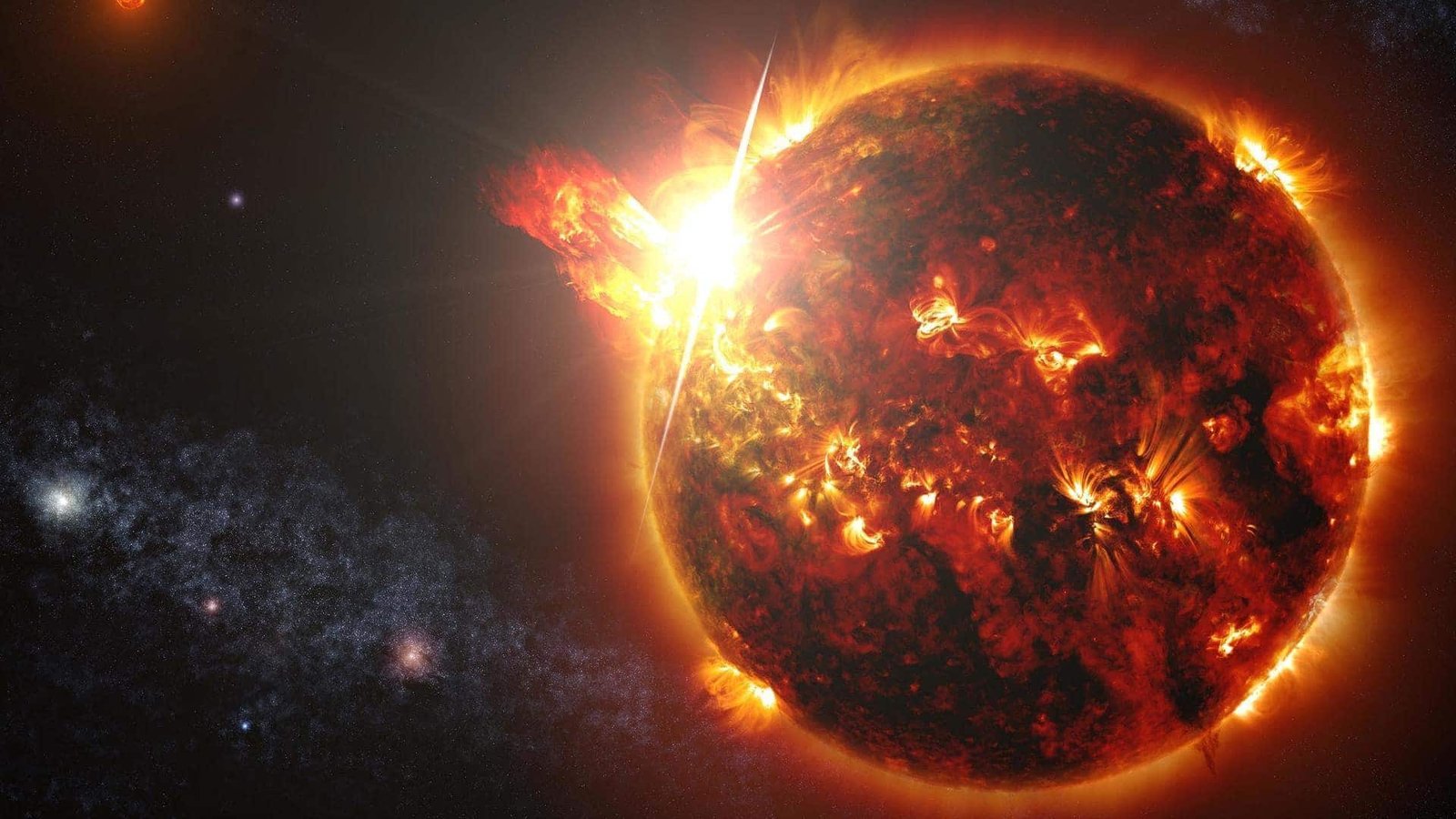
- Astronomers have for the first time detected a coronal mass ejection (CME) on a star other than the Sun.
- The discovery used radio data from the European network of telescopes called LOFAR and identified a brief but extremely violent explosion on red dwarf star StKM 1-1262 (≈133 light-years away) that occurred on 16 May 2016.
- The event was estimated to be ≥10,000 times stronger than known solar storms.
What is Coronal Mass Ejection?
A coronal mass ejection (CME) is a huge burst of plasma and magnetic field that erupts from the outer atmosphere (corona) of a star.
Key Features:
- It is a massive cloud of charged particles violently thrown into space from a star’s surface.
- CMEs carry strong magnetic fields and can travel very fast.
- When they hit a planet, they can disturb its magnetic field, affect satellites, disrupt communication systems, and even strip away the atmosphere if the storm is extremely powerful, causing habitability concerns.
- On the Sun, CMEs sometimes cause auroras on Earth.
Why do red dwarfs matter?
Red dwarfs are common and frequently host Earth-sized exoplanets; but they may be magnetically active and erratic, producing frequent energetic storms.
Why do CMEs take place?
CMEs are driven by magnetic field instabilities in the star’s outer atmosphere. Stars with strong, tangled magnetic fields (like many red dwarfs) can produce far more energetic eruptions than the Sun.
How was the Discovery made?
- Instrumentation: Astronomers used LOFAR, a powerful low-frequency radio telescope network in Europe, which continuously observes the sky for energetic cosmic events.
- Data Processing: A specialised system recorded background radio signals from stars while LOFAR tracked other objects. In 2022, researchers re-examined this stored data and found a one-minute radio burst from 2016.
- Event Classification: Using the signal’s shape, timing, and radio frequency behaviour, scientists confirmed it was a coronal mass ejection (CME) — not a flare or any ordinary transient. Energy estimates showed it was at least 10,000 times stronger than solar CMEs.
- Scientific Interpretation: The detection proves that violent stellar storms occur on other stars, especially red dwarfs, which are far more magnetically active than the Sun. This has major implications for exoplanet atmospheres and habitability.
| The Sun’s Internal Structure (from inside to outside)
1. Core a. Central region where nuclear fusion occurs. b. Extremely hot (≈ 15 million K) and dense. c. Produces all of the Sun’s energy through hydrogen fusion into helium. 2. Radiative Zone a. Energy moves outward by radiation (photons). b. Very slow movement — photons may take thousands to millions of years to pass through. c. Temperature gradually decreases outward. 3. Convective Zone a. Outer layer of the Sun’s interior. b. Energy is transported by convection — hot plasma rises, cool plasma sinks. c. Creates granulation patterns seen on the surface. The Sun’s Atmosphere (layered outer regions) 1. Photosphere a. The visible surface of the Sun. b. Temperature ≈ 5,500°C. c. Shows sunspots, granules. d. Emits most of the sunlight we see. 2. Chromosphere a. Reddish layer above the photosphere. b. Visible during solar eclipses as a red rim. c. Site of spicules (jet-like eruptions). 3. Corona a. Outermost layer; extends millions of kilometres. b. Very hot (≈ 1–3 million K). c. Source of solar wind and coronal mass ejections (CMEs). d. Visible during total solar eclipses as a white halo. |
Implications
- Exoplanet habitability: Planets orbiting active red dwarfs may lose atmospheres or suffer harmful radiation, making them less hospitable to life than previously hoped.
- Target selection for life searches: Astronomers may need to prioritise planets around less active stars or check stellar activity history before labelling a planet “potentially habitable.”
- New field — exo-space weather: This detection opens a research area studying how stellar storms affect exoplanet atmospheres, climate and biosignatures.
- Observational strategy shifts: Telescopes and surveys will increasingly monitor stellar radio activity and re-examine archival data for more CMEs.
- Planetary protection & modelling: Models of atmospheric escape, magnetic shielding by planets, and long-term habitability must be updated to include extreme stellar storms.
Challenges & Way Forward
| Challenge | Way forward |
| Rarity & brevity of signals | Expand continuous low-frequency monitoring and build automated real-time detection pipelines |
| Limited sample size | Re-analyse archives (LOFAR and others) and run dedicated surveys across many stars |
| Measuring true energy & impact | Combine radio data with X-ray, UV and optical observations; develop multi-wavelength campaigns |
| Understanding atmospheric loss | Improve atmospheric escape models, lab plasma experiments, and coupled magnetosphere simulations |
| Red dwarf habitability re-assessment | Reprioritise target lists for biosignature searches; factor stellar activity into habitability indices |
| Technology limits | Invest in next-generation low-freq arrays, space-based radio observatories, and international collaborations |
| Public & policy interpretation | Communicate balanced science: storms are risky but planetary magnetic fields and atmospheres can offer resilience |
Conclusion
The LOFAR detection of a stellar CME is a breakthrough: it proves that stellar space weather can be far more extreme than the Sun’s and that such events can endanger planetary atmospheres. For exoplanet science and the search for life, this means revising habitability criteria, investing in continuous multi-wavelength monitoring, and developing better models of atmospheric resilience. The discovery marks the start of a focused study of exo-space weather — essential for understanding which worlds could actually support life.
| EnsureIAS Mains Question
Q. The detection of a coronal mass ejection on a red dwarf has implications for exoplanet habitability and observational strategy. Discuss the scientific significance of this discovery and outline how future research and observation programmes should change to assess habitability of planets around active stars. (250 Words) |
| EnsureIAS Prelims Question
Consider the following Statements: 1. The first radio detection of a coronal mass ejection (CME) on a star beyond the Sun was made using the LOFAR telescope network. 2. The detected CME on red dwarf StKM 1-1262 was estimated to be roughly 10,000 times more violent than strong solar storms and therefore certainly guaranteed to strip the atmosphere of any nearby planet. Choose the correct answer: Answer: A — 1 only Explanation: Statement 1 is correct: The detection was made by analysing radio observations from LOFAR. A research team reprocessed archival and ongoing LOFAR data, identified a minute-long radio burst from the red dwarf StKM 1-1262 (May 16, 2016), and classified it as a CME — the first such radio identification beyond the Sun. Statement 2 is incorrect (overstated): While estimates indicate the CME was extremely energetic — at least 10,000 times stronger than many known solar storms — saying it is “certain” to strip planetary atmospheres is too absolute. Atmosphere loss depends on many factors (planetary magnetic field, atmosphere thickness, distance, and frequency of storms). The CME could severely damage atmospheres or speed long-term erosion, but guaranteed stripping requires more evidence and modelling. |