Important questions for UPSC Pre/ Mains/ Interview:
|
Context
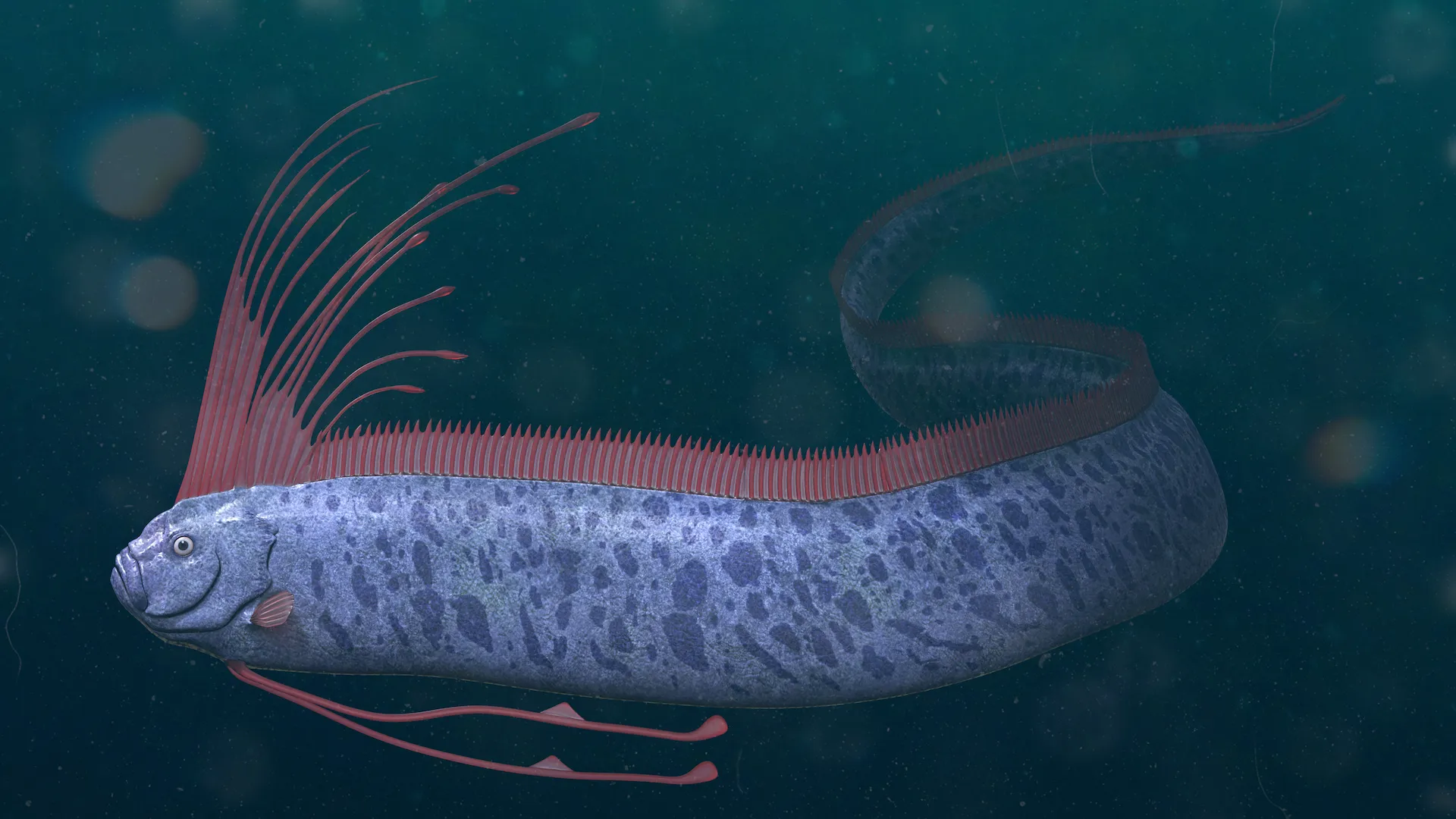
Two giant Oarfish, often called “doomsday fish,” were recently sighted near the coast of Cabo San Lucas.
Q1. What is the Doomsday Fish?
- It is a rarely observed deep-sea fish (as it typically lives far below the ocean surface), which is considered one of the longest bony fish species in the world.
- Scientific name: Regalecus glesne
Q2. Where do Oarfish live?
- They mainly inhabit the mesopelagic zone of the ocean (also called “twilight zone” because sunlight penetration is minimal) which extends roughly 200–1,000 metres below the ocean surface and is home to many deep-sea organisms adapted to low-light environments.
- Because oarfish live in this deep region, they rarely approach coastal waters, making sightings unusual.
Q3. What are the main physical features of the Oarfish?
- Long ribbon-like body that can reach up to 30 feet (around 9 metres).
- Bright red dorsal spines, forming a crown-like structure on the head.
- Large eyes adapted for dim deep-sea conditions.
- Silvery reflective body, which helps it blend with surrounding light in deep water.
- Another notable feature is its vertical swimming posture, where the fish sometimes floats upright in the water column.
Q4. What does the Oarfish eat?
- The oarfish is a filter feeder. It feeds by filtering small organisms from the surrounding water, which are abundant in deep-sea ecosystems.
- Its diet mainly includes Krill, Plankton and Small crustaceans.
Q5. Why is the Oarfish called the “Doomsday Fish”?
- The nickname originates from folklore linking oarfish sightings to natural disasters.
- In Japanese tradition, the fish is known as “Ryugu no tsukai,” meaning “Messenger from the Sea God’s Palace.” According to folklore, the appearance of oarfish near the surface may signal earthquakes or other disasters.
- However, scientists emphasize that no scientific evidence supports a link between oarfish sightings and natural disasters.
Conclusion
The oarfish is a fascinating deep-sea species known for its extraordinary length & unusual appearance. Although cultural traditions have associated it with disaster predictions, scientific understanding views it as an important species for studying deep-ocean ecosystems & marine biodiversity.
FAQs
Q1. What is the Doomsday Fish (Oarfish)?
The Oarfish (Regalecus glesne) is a rare deep‑sea species, considered one of the longest bony fish in the world, often nicknamed “doomsday fish.”
Q2. Where do Oarfish live in the ocean?
They inhabit the mesopelagic zone (200–1,000 m depth), also called the twilight zone, and are rarely seen near coastal waters.
Q3. What are the main physical features of the Oarfish?
A ribbon‑like body up to 30 feet, bright red dorsal spines, large eyes for dim light, silvery reflective skin, and a unique vertical swimming posture.
Q4. What do the Oarfish eat in deep‑sea ecosystems?
It is a filter feeder, consuming krill, plankton, and small crustaceans abundant in deep waters.
Q5. Why is the Oarfish called the “Doomsday Fish”?
In Japanese folklore, sightings are believed to signal earthquakes or disasters. However, scientists confirm no evidence links oarfish appearances to natural calamities.