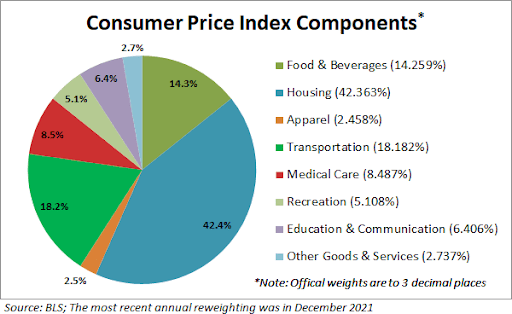
- The Consumer Price Index (CPI) is a measure that tracks the average change in prices of a fixed basket of goods and services (like food, fuel, household essentials, etc.) commonly consumed by households over time, showing how much the cost of living has increased or decreased compared to a base year.
- It is essential for an economy because it reflects the real inflation (actual rise in prices of goods and services) faced by the households which also helps the Monetary Policy Committee (MPC) for interest rate decisions and guides the decisions of the Reserve Bank of India (RBI) (like adjusting the repo rate, reverse repo rate, etc to maintain price stability and support economic growth).
- Base Year Update (2012 → 2024)
- Earlier, the base year (reference year used as a benchmark to measure changes in economic indicators like inflation, GDP, consumption patterns etc.) for CPI was 2012. But, since then, the economic conditions of India have changed a lot due to rapid urbanisation, more digitalization and growing service sector spending.
- The old base year no longer reflected how people live and spend today. So, a structural update was needed and the base year has been updated to 2024 recently.
- Also, based on the Household Consumption Expenditure Survey 2023–24, the basket of goods and services has been updated. The old basket included outdated items (e.g., kerosene dominance) and did not fully capture digital and service spending.
- The new basket gives greater weight to household essentials, replaces kerosene dominance with LPG, captures online prices of goods & services, has higher inclusion of services & digital spending, uses computer-assisted price collection, includes rail fares, postal charges, fuel prices & PDS and represents lifestyle shifts better.
- This helps to improve cross-country comparability and reflects the realities of 2025+ consumption patterns better.
- This CPI reform will lead to many positive implications like more accurate inflation targeting, better monetary policy decisions, better adjustment of welfare benefits, enhanced credibility of economic data and near real-time digital price capture.
- These CPI reforms come along with wider economic changes such as fiscal restructuring (16th Finance Commission), improved taxpayer data, reduced cost of tax collection and modernisation of statistical systems showcasing that India is upgrading its economic institutions with structural reforms.