Context
Interest in neurotechnology has surged as Brain-Computer Interfaces (BCIs) are advancing globally. India is strengthening its neuroscience ecosystem, while countries like the U.S., China and EU are rapidly creating technologies, laws, and ethical frameworks. BCIs are emerging as major tools for healthcare, human enhancement, and strategic advantage.
What is Neurotechnology?
- Technology that interacts directly with the brain to record, analyse, or influence neural activity.
- Uses sensors, electrodes, AI, and computing tools to understand or stimulate brain signals.
- Helps decode thoughts or intentions into digital commands.
- Enables communication with machines such as robotic limbs, wheelchairs or computers.
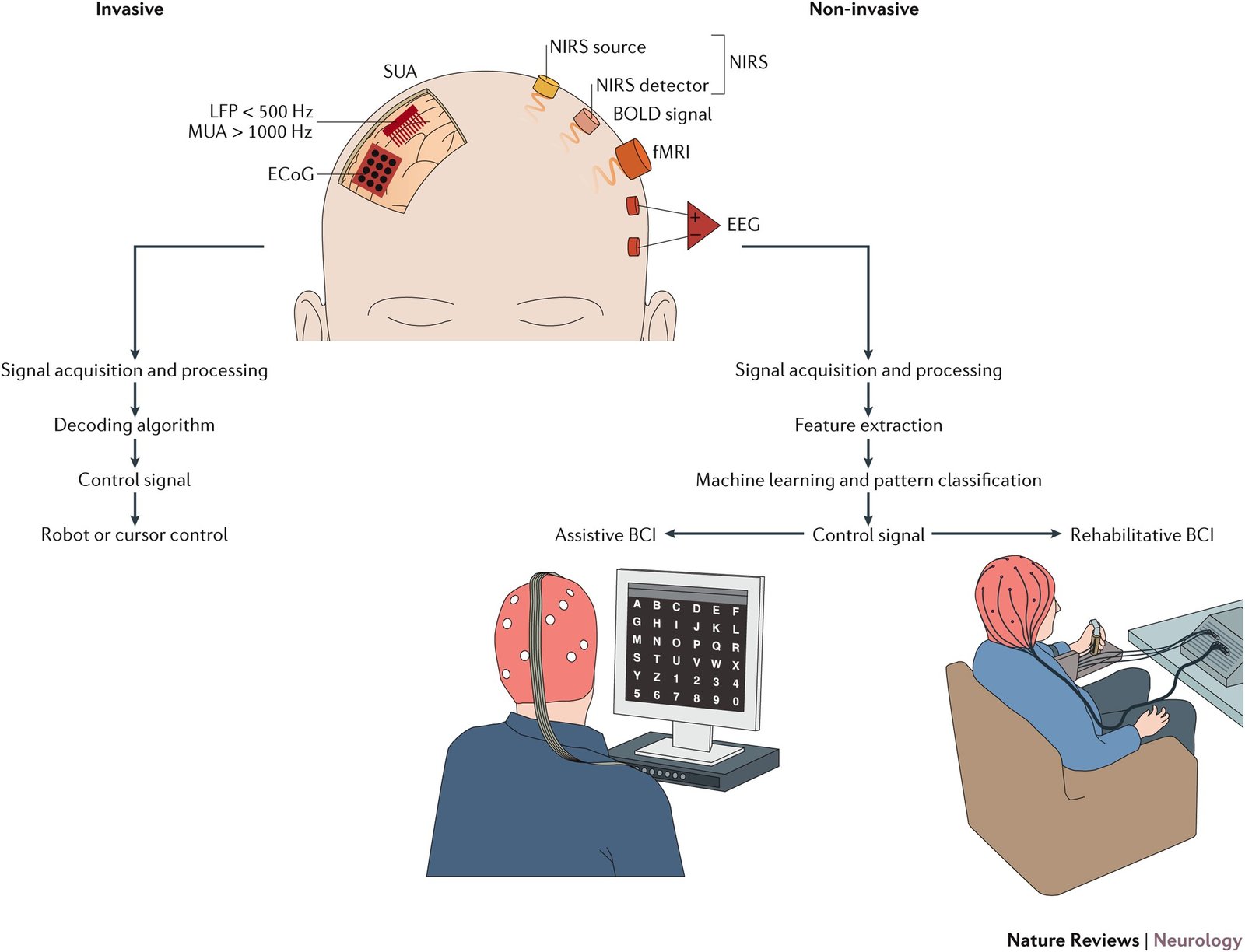
- Includes non-invasive systems (EEG) and invasive systems (implanted electrodes).
Difference between Invasive and Non-invasive Systems
| Feature | Invasive Systems | Non-Invasive Systems |
| Placement | Inside the brain via surgery | Outside the scalp |
| Accuracy | Very high | Moderate to low |
| Risk | High (surgery, infection) | Very low |
| Use Cases | Paralysis, Parkinson’s, severe neurological injury | Research, mild therapy, training, communication |
| Cost | Very high | Low to moderate |
What is a Brain-Computer Interface?
- A system that captures brain signals and converts them into commands for external devices.
- Allows control of robotic arms, prosthetics, wheelchairs, or computer cursors using thought.
- Can be used for diagnosis, rehabilitation, cognitive research, and neuroprosthetics.
- Helps patients with paralysis, stroke, spinal cord injuries, or degenerative diseases.
- Some BCIs also stimulate parts of the brain to reduce symptoms of depression or Parkinson’s disease.
Why Does India Need Neurotechnology?
- High burden of non-communicable neurological disorders such as stroke, epilepsy and Parkinson’s disease.
- Rising number of injury-related neurological disabilities due to accidents and spinal cord injuries.
- Potential for restoring mobility, speech and communication for paralysed individuals.
- Reduces long-term dependence on medication in mental health disorders through targeted stimulation.
- Strengthens India’s position in biotechnology, AI and medical innovation.
How Neurotechnology Helps Neurological Disorders?
- Stroke & paralysis: BCIs restore limb movement through robotic exoskeletons or prosthetics.
- Parkinson’s disease: Deep brain stimulation delivers electrical impulses to reduce tremors.
- Depression: Stimulating specific neural circuits can improve mood and treatment-resistant depression.
- Spinal cord injury: BCIs can bypass damaged nerves to restore communication between brain and limbs.
- Cognitive rehabilitation: Helps patients regain speech, memory or decision-making abilities.
India’s Progress in Neurotechnology
- IIT Kanpur created a BCI-controlled robotic hand for stroke rehabilitation.
- National Brain Research Centre (NBRC) and IISc Bengaluru are advancing neuroscience research.
- Startups are emerging—e.g., systems analysing animal neural signals for disease detection.
- Growth in AI, biomedical engineering, and robotics strengthens the ecosystem.
- India’s genomic diversity and large patient base provide significant research opportunities.
How Other Nations are Advancing?
- United States: The BRAIN Initiative accelerates innovative neurotechnologies; Neuralink has FDA approval for human trials.
- China: China Brain Project focuses on cognition, brain-inspired AI and neuro-disorder therapies.
- European Union: Leading global efforts on neurorights, ethics, and regulation of BCIs.
- Chile: First nation to legislate “neurorights” in its constitution.
- Global trend: Increasing investment in neurological therapies, military research, and human-machine integration.
Can BCIs Be Used for Human Enhancement or Military Advantage?
- Technically possible: Enhanced cognition, faster reaction time, improved memory or attention.
- Military interest: Control of drones, machines or communication tools through thought.
- Dual-use technology: Therapies can evolve into performance-enhancing tools.
- Ethical concerns: Autonomy, surveillance, manipulation, hacking of neural data.
- Requires strong regulation: Safeguards, consent norms, and global ethical frameworks.
Implications
- Healthcare transformation: Potential to treat severe neurological disorders and disabilities.
- Economic opportunity: Creates a high-value biotechnology and AI industry.
- Ethical challenges: Raises concerns about privacy, consent, and manipulation of brain data.
- Security dimension: BCIs could influence future warfare and national security doctrines.
- Global leadership: Nations with strong regulatory ecosystems will shape norms for emerging neurotechnologies.
Challenges and Way Forward
| Challenges | Way Forward |
| Lack of specific BCI regulations in India | Create tailored regulatory pathways for invasive and non-invasive BCIs |
| Ethical risks: privacy, autonomy, brain data misuse | Introduce neurorights and ethical guidelines |
| High cost, limited access | Promote public-private partnerships and indigenous manufacturing |
| Limited public awareness | Launch nationwide public engagement on benefits and risks |
| Fragmented research initiatives | Create a national neurotechnology mission with multi-disciplinary hubs |
Conclusion
Neurotechnology and BCIs represent the next frontier in healthcare, human capability and economic growth. India’s neurological disease burden and expanding research capacities create a strong need for such innovations. To harness their full potential, India must develop a clear regulatory framework, ensure ethical safeguards, and nurture cross-disciplinary research that strengthens both health systems and national innovation.
| EnsureIAS Mains Question
Q. “Brain–Computer Interfaces can transform healthcare but also raise serious ethical and strategic concerns.” Discuss the opportunities and challenges of neurotechnology for India. (250 Words) |
| EnsureIAS Prelims Question
Q. Consider the following statements regarding Brain–Computer Interfaces (BCIs): 1. BCIs can convert neural signals into commands to control external devices. 2. All BCIs require surgical implantation of electrodes in the brain. 3. Neurotechnology can be used for treating neurological disorders such as Parkinson’s disease. 4. India currently has no institutions engaged in BCI-related research. Which of the statements given above are correct? (a) 1 and 3 only Answer: (a) 1 and 3 only Explanation: Statement 1 is Correct: BCIs record neural activity and translate it into digital instructions for robotic arms, wheelchairs, cursors, etc. Statement 2 is Incorrect: BCIs can be invasive (implanted electrodes) or non-invasive (EEG caps, external sensors). Statement 3 is Correct: Neurotechnology such as deep brain stimulation is used for conditions like Parkinson’s disease, depression, and stroke rehabilitation. Statement 4 is Incorrect: Institutions like IIT Kanpur, NBRC, IISc Bengaluru and several startups are actively developing or researching BCIs. |