Context
- India has launched Bodhan AI as part of its broader Bharat AI Stack to transform education using Artificial Intelligence.
- The initiative comes ahead of the Global AI Action Summit (February 2026).
- It reflects India’s push to build Digital Public Infrastructure (DPI) for education, similar to UPI in finance.
What is Bodhan AI?
- Bodhan AI is an AI-powered education initiative designed by IIT Madras, under the Bharat AI Stack, aimed at improving learning outcomes from KG to PhD through personalised, technology-enabled education.
- It seeks to create a public, open, and interoperable AI education ecosystem.
Digital Public Infrastructure (DPI)
- DPI refers to government-backed digital platforms that are:
- Open-source
- Widely accessible
- Interoperable
- Examples:
- UPI (payments)
- Aadhaar (identity)
- ONDC (commerce)
- Bodhan AI aims to become UPI-like infrastructure for education.
Why AI in Education?
- Based on the Bloom’s Two Sigma Problem, students perform far better with:
- One-to-one tutoring
- Personal mentoring
- Adaptive learning
- Traditional classroom teaching alone cannot achieve this at scale.
- AI enables mass personalisation of education.
Structure of Bodhan AI (Layered Model)
- Foundation Layer
- Open-source algorithms
- Cloud computing
- GPUs for processing
- AI Model Layer
- Education-specific AI models
- Indian language support
- Application Layer
- AI tutors and chatbots
- Learning apps
- Content platforms (videos, infographics, lectures)
Students can access these through mobile phones, laptops, and tablets.
Purpose of Bodhan AI
India aims to move from Digital India to Intelligent India by:
- Bridging learning gaps
- Providing personalised tutoring at scale
- Supporting teachers in:
- Lesson planning
- Paper grading
- Student assessment
- Helping parents track learning progress
- Generating data for better education policy design
- Promoting inclusivity through all Indian languages
Implementation and Collaborations
- Developed by IIT Madras under Bharat AI Stack
- Open-source design allows startups and developers to build tools
- Integrated with smartphones and digital platforms
Collaborations include:
- IIT Bombay
- Columbia University
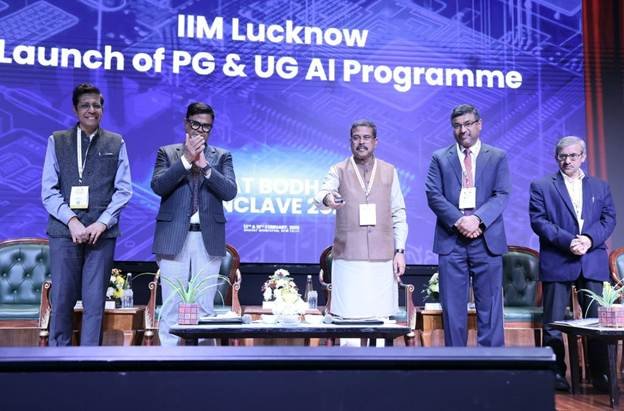
- IIM Lucknow
- IIM Jammu
- Bangkok institutions
- Rajiv Gandhi Institute
The initiative will be showcased and expanded during the Global AI Action Summit 2026.
Implications
- Education
- Personalised learning for millions
- Reduced dependence on costly private coaching
- Improved teacher productivity
- Better learning outcomes
- Governance
- Data-driven education policymaking
- National-level performance tracking
- Economy
- Boost to ed-tech startups
- Strengthening India’s AI ecosystem
- Social
- Democratization of quality education
- Support for regional language learners
- Reduced urban–rural education divide
Challenges and Way Forward
| Challenges | Way Forward |
| Digital divide | Expand broadband and device access |
| Teacher adaptability | Continuous teacher training |
| Data privacy risks | Strong data protection framework |
| AI bias | Inclusive datasets |
| Overdependence on technology | Maintain human oversight |
| Infrastructure gaps | Public investment in cloud and compute |
| Regional disparities | Targeted rollout in backward districts |
Conclusion
Bodhan AI marks India’s shift toward intelligent education governance. If implemented inclusively and ethically, it can democratise personalised learning, strengthen human capital, and position India as a global leader in AI-driven public education systems.