| Important Questions for UPSC Prelims / Mains / Interview
1. What is the “Board of Peace” initiative, and what are its objectives and geopolitical implications? 2. How is the Board of Peace structured, and what does its composition reveal about emerging global alignments? 3. Why did India choose to participate as an observer instead of becoming a full member? 4. How does this initiative intersect with India’s commitment to multilateralism and the United Nations system? 5. What do the financial commitments announced under the Board of Peace signify in strategic and diplomatic terms? 6. How does the India-Pakistan dimension shape New Delhi’s cautious engagement with the platform? 7. What are India’s regional diplomatic and economic stakes in West Asia in the context of this initiative? 8. How does India’s observer participation reflect calibrated outreach toward the United States while preserving strategic autonomy? |
Context
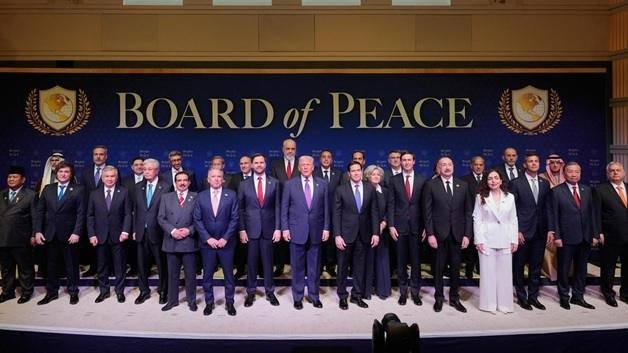
The United States convened the first meeting of the “Board of Peace” to discuss Gaza’s reconstruction, later expanding its mandate to broader global conflicts. India attended as an observer, signalling cautious engagement. While New Delhi supports peace efforts aligned with UN Security Council resolutions, it refrained from full membership, reflecting concerns about institutional legitimacy, geopolitical balance, and strategic flexibility.
Q1. What is the “Board of Peace” initiative, and what are its objectives and geopolitical implications?
- The Board of Peace is a US-led diplomatic platform initially focused on coordinating international reconstruction efforts in Gaza following the Israel-Gaza conflict.
- Its mandate appears to have expanded beyond Gaza to include broader “global conflict” engagement, which introduces ambiguity about its long-term purpose.
- The initiative aims to mobilise financial commitments and diplomatic cooperation outside the traditional UN-led frameworks.
- Geopolitically, it signals a trend toward coalition-based diplomacy where major powers create issue-specific forums.
- The absence of key global powers such as Russia and China limits its universal legitimacy and raises concerns about selective participation.
- The expanded mandate creates uncertainty regarding:
- Scope of intervention
- Institutional authority
- Overlap with UN mechanisms
- Supporters argue that smaller coalitions can deliver faster decisions compared to multilateral institutions.
- However, critics fear it could fragment global governance and weaken established collective security structures.
Q2. How is the Board of Peace structured, and what does its composition reveal about emerging global alignments?
- The Board comprises 27 member countries, including key West Asian nations such as Israel, Egypt, Saudi Arabia, UAE, Qatar, Jordan, Turkey, and Bahrain.
- It includes countries outside the immediate conflict region, reflecting broader geopolitical outreach.
- The participation of Pakistan introduces a South Asian dimension with strategic implications.
- Notably absent are permanent UN Security Council members such as Russia and China, which limits global representativeness.
- Twenty-two countries have joined as observers, including major European economies and Japan, indicating cautious engagement rather than full endorsement.
- The composition suggests alignment patterns based on:
- Bilateral ties with the United States
- Strategic interests in West Asia
- Desire for diplomatic visibility
- The mix of members reflects geopolitical pragmatism rather than universal consensus.
- Overall, the structure highlights evolving diplomatic coalitions shaped by power politics rather than formal multilateral legitimacy.
Q3. Why did India choose to participate as an observer instead of becoming a full member?
- India opted for observer status to maintain engagement without committing to an uncertain institutional framework.
- Observer participation allows diplomatic presence while preserving policy flexibility.
- India supports peace initiatives in Gaza but prefers them to align with UN Security Council resolutions.
- The Board’s evolving and undefined global mandate raised concerns about future scope expansion.
- India is cautious about platforms perceived as personality-driven or politically volatile.
- Observer status provides an “exit option” in case the initiative loses relevance after leadership changes in the US.
- It allows India to monitor proceedings, especially where issues may indirectly affect its interests.
- This approach reflects strategic hedging, balancing cooperation with institutional caution.
Q4. How does this initiative intersect with India’s commitment to multilateralism and the United Nations system?
- India has historically advocated for rule-based multilateralism anchored in the United Nations.
- The emergence of parallel diplomatic forums risks fragmenting global governance.
- Although US officials have stated that the Board will work alongside the UN, its charter lacks explicit structural integration.
- India is concerned that such platforms may dilute the authority of established multilateral institutions.
- The expanded global mandate increases the possibility of overlap with UN peace and security functions.
- India supports reforming multilateral institutions rather than replacing them with ad hoc coalitions.
- Participation as an observer ensures alignment with UN Security Council resolutions without endorsing institutional bypass.
- The stance reflects India’s broader foreign policy principle of principled multilateralism combined with pragmatic engagement.
Q5. What do the financial commitments announced under the Board of Peace signify in strategic and diplomatic terms?
- Several member countries pledged significant funding for Gaza’s reconstruction, indicating financial backing for the initiative.
- The United States announced a substantial financial commitment, framing it as an investment in regional stability.
- Financial pledges serve as instruments of influence in post-conflict reconstruction processes.
- Funding can enhance diplomatic leverage over governance and institutional rebuilding in Gaza.
- However, lack of clarity regarding allocation mechanisms raises concerns about transparency.
- The scale of funding reflects:
- Strategic intent to shape the post-war environment
- Attempt to build credibility for the Board
- Financial commitments may encourage additional countries to engage.
- At the same time, sustainability of funding remains uncertain without institutionalised oversight.
Q6. How does the India-Pakistan dimension shape New Delhi’s cautious engagement with the platform?
- Pakistan’s membership raises concerns about potential attempts to raise bilateral issues in a multilateral setting.
- India has consistently rejected third-party mediation in its disputes with Pakistan.
- Observer participation ensures India is not excluded from discussions where narratives may affect its interests.
- Staying completely outside could risk diplomatic isolation in certain deliberations.
- Observer status allows India to:
- Monitor discussions
- Intervene diplomatically if required
- Prevent internationalisation of bilateral matters
- India’s approach reflects strategic vigilance rather than passive engagement.
- Participation demonstrates confidence in its diplomatic position.
- The stance ensures presence without legitimising any mediation attempts.
Q7. What are India’s regional diplomatic and economic stakes in West Asia in the context of this initiative?
- West Asia remains critical for India’s energy security and trade routes.
- Stability in Gaza contributes to broader regional stability affecting India’s diaspora and investments.
- India supports a two-state solution and sustainable peace in the region.
- Economic initiatives such as connectivity corridors depend on a stable geopolitical environment.
- Regional instability could disrupt:
- Energy supplies
- Maritime trade
- Infrastructure investments
- India maintains balanced relations with both Israel and Arab states.
- Observer status ensures diplomatic presence ahead of high-level regional engagements.
- Engagement strengthens India’s image as a responsible stakeholder in regional peace.
Q8. How does India’s observer participation reflect calibrated outreach toward the United States while preserving strategic autonomy?
- India and the United States are working to strengthen trade and technology cooperation.
- Participating as an observer avoids signalling diplomatic disengagement from Washington.
- At the same time, India avoids full endorsement of a potentially controversial initiative.
- The approach recognises policy unpredictability in US domestic politics.
- Strategic autonomy remains a core pillar of India’s foreign policy.
- Observer participation balances goodwill with independence.
- The move prevents unnecessary friction while retaining policy flexibility.
- Overall, the decision reflects pragmatic diplomacy in an evolving global order.
Conclusion
India’s observer participation in the Board of Peace reflects a nuanced diplomatic calculation. By engaging without committing, New Delhi supports peace efforts while safeguarding multilateral principles and strategic autonomy. The initiative underscores the broader transformation of global governance toward flexible coalitions, requiring India to balance institutional commitment, regional interests, and great–power diplomacy.