| Important Questions for UPSC Prelims / Mains / Interview
1. What is Bharat Taxi, and why is it being seen as a significant innovation in India’s urban transport sector? 2. How does Bharat Taxi differ fundamentally from private ride-hailing aggregators like Uber and Ola? 3. What is the cooperative ownership and governance model behind Bharat Taxi? 4. How does Bharat Taxi’s pricing and commission structure aim to improve driver incomes and passenger affordability? 5. What role does the government play in Bharat Taxi, and how is it different from a state-run enterprise? 6. What are the early outcomes and adoption trends observed in Bharat Taxi’s pilot phase? 7. What challenges are emerging in the initial rollout of Bharat Taxi? 8. How does Bharat Taxi strengthen the cooperative movement in India? 9. What factors will determine the long-term success of Bharat Taxi in India’s ride-hailing market? |
Context
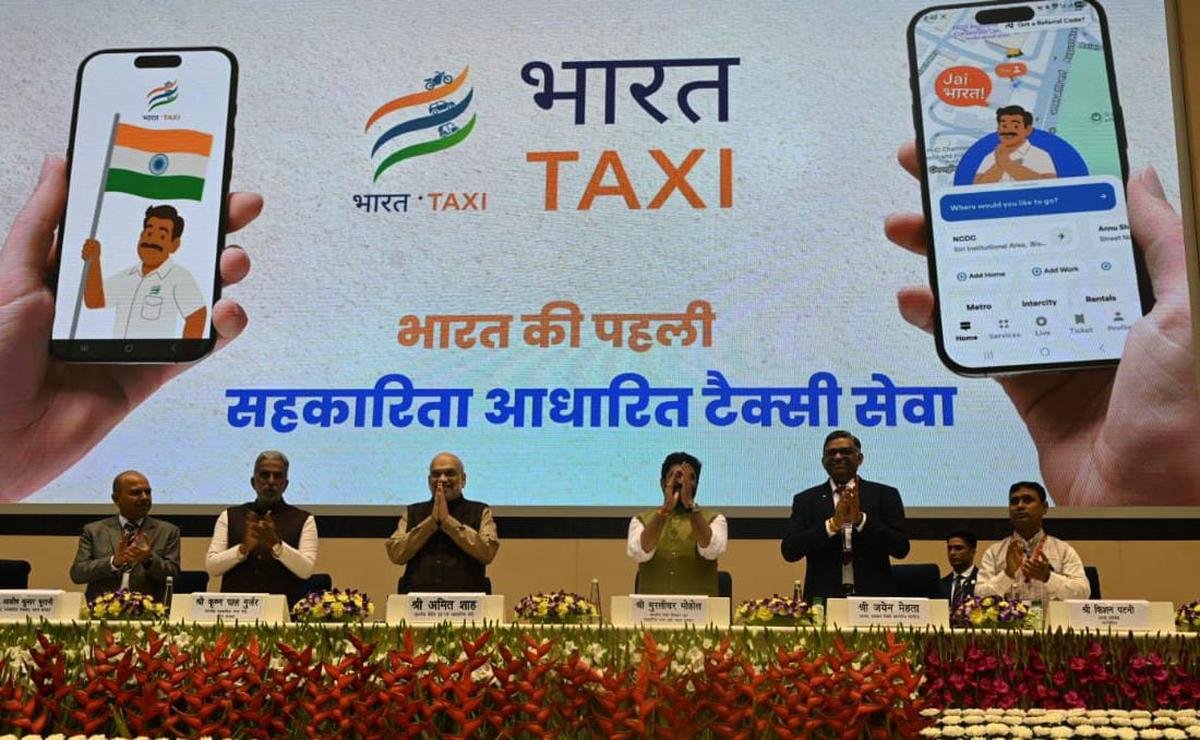
Union Cooperation Minister Amit Shah has launched Bharat Taxi, India’s first cooperative-based ride-hailing platform.
The initiative seeks to reduce driver dependence on commission-heavy digital aggregators while promoting people-owned platforms aligned with India’s cooperative ethos.
Q1. What is Bharat Taxi, and why is it being seen as a significant innovation in India’s urban transport sector?
- Bharat Taxi is India’s first ride-hailing platform built on a cooperative ownership model.
- It is designed as an alternative to private cab aggregators that dominate urban mobility.
- The platform places drivers, called Sarathis, at the centre of ownership and control.
- It seeks to ensure fair income distribution rather than profit maximisation.
- Bharat Taxi reflects a shift toward people-centric digital platforms.
- It aligns urban transport with cooperative economic principles.
- The initiative marks an attempt to democratise the gig economy.
Q2. How does Bharat Taxi differ fundamentally from private ride-hailing aggregators like Uber and Ola?
- Private aggregators are investor-owned, while Bharat Taxi is driver-owned.
- Bharat Taxi does not charge per-ride commission from drivers.
- Decision-making power lies with cooperative members, not shareholders.
- Earnings are more predictable due to fixed platform fees.
- Surge pricing is avoided to ensure transparency.
- Drivers are stakeholders rather than service contractors.
- The model prioritises sustainability over rapid profit extraction.
Q3. What is the cooperative ownership and governance model behind Bharat Taxi?
- Bharat Taxi is operated by Sahakar Taxi Cooperative Limited.
- Every driver becomes a cooperative member upon joining.
- Each Sarathi holds five shares, giving ownership rights.
- Members have voting power in key decisions.
- Profits are redistributed within the cooperative ecosystem.
- Governance follows cooperative principles of democratic control.
- This structure reduces power asymmetry between platform and drivers.
Q4. How does Bharat Taxi’s pricing and commission structure aim to improve driver incomes and passenger affordability?
- Drivers pay a fixed daily platform fee instead of commission.
- The fee is ₹30 per day for taxis and ₹18 for auto-rickshaws.
- No percentage cut is taken from each ride.
- This increases drivers’ take-home earnings per trip.
- Lower operational costs allow fares to be reduced.
- Officials estimate fares to be up to 30% cheaper.
- Pricing remains stable and predictable for passengers.
Q5. What role does the government play in Bharat Taxi, and how is it different from a state-run enterprise?
- The government provides policy and institutional support.
- Bharat Taxi is not directly operated by the government.
- It functions as an independent cooperative entity.
- The state acts as an enabler, not a service provider.
- The model avoids bureaucratic control over operations.
- This preserves operational flexibility and innovation.
- It reflects the government’s push for cooperative entrepreneurship.
Q6. What are the early outcomes and adoption trends observed in Bharat Taxi’s pilot phase?
- Bharat Taxi pilots began in Delhi-NCR and Rajkot.
- Expansion has already reached cities like Ahmedabad.
- Over four lakh drivers have registered on the platform.
- More than 10,000 rides are being completed daily.
- Driver interest is high due to the zero-commission model.
- Passenger awareness is gradually increasing.
- Early data suggests strong potential for scaling.
Q7. What challenges are emerging in the initial rollout of Bharat Taxi?
- Initial booking volumes are lower than established platforms.
- Drivers report temporary income dips during early adoption.
- Operational staff are still adapting to new software systems.
- Some passengers face longer queues and delays.
- Pricing inconsistencies exist at select locations.
- Platform algorithms are still being refined.
- Scaling user trust remains a short-term challenge.
Q8. How does Bharat Taxi strengthen the cooperative movement in India?
- It applies cooperative principles to the digital economy.
- Drivers collectively own and govern the platform.
- Income distribution is fairer and more transparent.
- The model draws inspiration from cooperatives like Amul.
- It revives cooperatives in a modern, tech-driven context.
- Collective ownership builds long-term economic resilience.
- It expands the scope of cooperatives beyond agriculture.
Q9. What factors will determine the long-term success of Bharat Taxi in India’s ride-hailing market?
- Ability to scale ride volumes across cities.
- Sustained passenger trust and service quality.
- Efficient pricing and matching algorithms.
- Strong cooperative governance and accountability.
- Continuous driver engagement and satisfaction.
- Competitive response from private aggregators.
- Alignment between technology, affordability, and equity.
Conclusion
Bharat Taxi represents a structural rethink of the gig economy, shifting power from platforms to workers.
If it succeeds in combining scale, efficiency, and cooperative values, it could redefine urban mobility in India—showing that digital platforms need not come at the cost of worker dignity and income security.