Important Questions for UPSC Prelims, Mains and Interview
|
Context
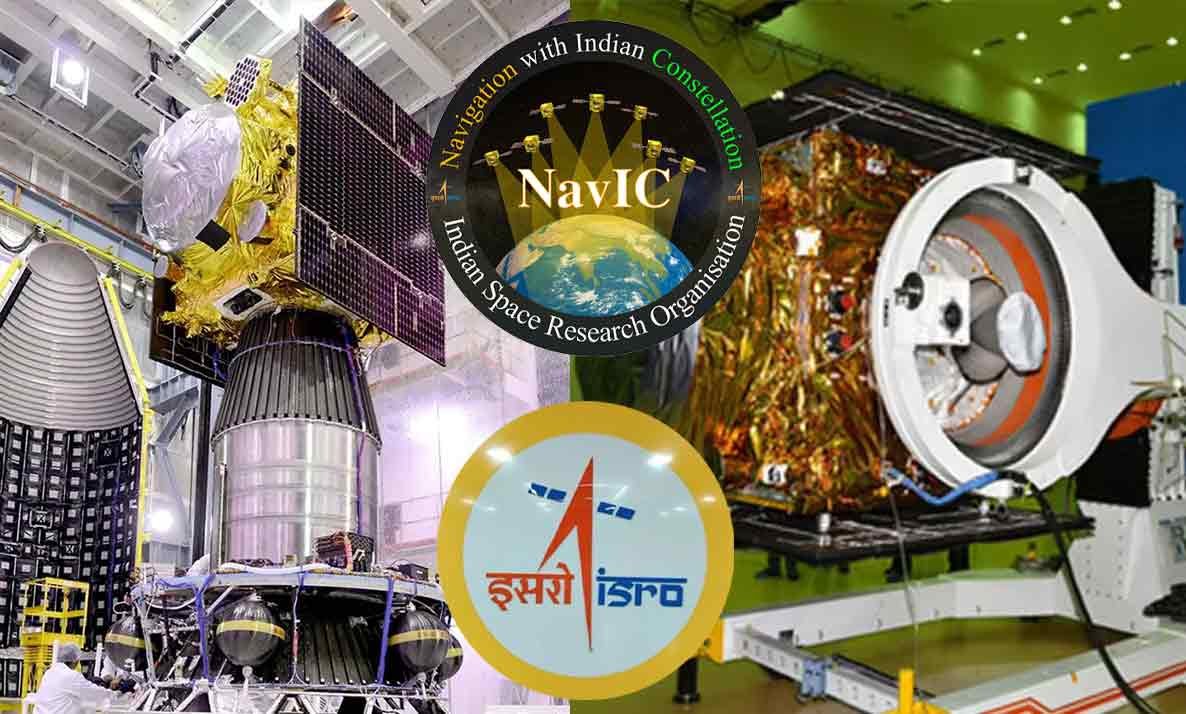
The atomic clock onboard the IRNSS-1F, part of India’s NavIC navigation network developed by Indian Space Research Organisation, recently failed. This has reduced the operational strength of India’s indigenous satellite navigation system.
Q1. What is an Atomic Clock?
- An atomic clock is an extremely precise time-keeping device that measures time using the natural oscillations of atoms, usually caesium or rubidium.
- Atoms are exposed to microwave radiation, which causes them to shift between energy states.
- This transition occurs at a very stable and constant frequency, which is used to measure time.
- Atomic clocks are the most accurate clocks ever developed, losing or gaining less than a second over millions of years.
Q2. Why are Atomic Clocks Important?
- Satellite Navigation: Systems like Global Positioning System, GLONASS, Galileo, BeiDou, and NavIC depend on atomic clocks for accurate positioning.
- Global Time Standard: Atomic clocks define Coordinated Universal Time (UTC).
- Telecommunications: They ensure precise time synchronisation in mobile networks, internet communication, and financial systems.
- Scientific Research: Used in space missions, physics experiments, and deep-space navigation.
Q3. How do Atomic Clocks Enable Satellite Navigation?
- Satellite navigation works by calculating distance using signal travel time.
- Satellites transmit signals containing the exact time of transmission.
- A receiver on Earth measures the time difference between transmission and reception.
- Since signals travel at the speed of light, extremely accurate timing is required.
- Even a 1 nanosecond error can cause position errors of several centimetres.
- Therefore, navigation satellites carry multiple atomic clocks as backups to maintain accurate timing.
Q4. How does the failure of the IRNSS-1F atomic clock affect NavIC?
- Atomic clocks ensure precise timing for navigation signals.
- After the failure of the clock onboard IRNSS-1F, the number of satellites with functioning clocks has decreased.
- At least four satellites are required for reliable navigation services, but currently only three are fully operational.
- This weakens the reliability and coverage of India’s NavIC navigation system.
Q5. What is the current status of the NavIC satellite constellation?
- Since 2013, nine IRNSS satellites have been launched, and eight reached their intended orbit.
- Several satellites experienced failures in their onboard atomic clocks, with some losing all three clocks.
- IRNSS-1F, launched in March 2016, completed its 10-year mission life in March 2026.
- After the clock failure, the satellite can only provide limited services such as one-way broadcast messaging.
Q6. What steps are being taken to strengthen NavIC?
To improve the system, ISRO has initiated several measures:
- Development of indigenous rubidium atomic clocks instead of imported ones.
- Earlier clocks were imported from SpectraTime.
- Launch of NVS-01 in 2023, carrying an indigenous atomic clock.
- NVS-02 launched in 2025, but it failed to reach the intended orbit.
- Three replacement satellites are planned to be launched by 2026 to replace ageing satellites.
Conclusion
Atomic clocks are the core technology enabling accurate satellite navigation. The failure of the IRNSS-1F clock highlights the need for stronger and indigenous technology to maintain the reliability of India’s NavIC navigation system.