Significance: GS II; Polity and Governance; Powers of President;
Why in the News?
President Droupadi Murmu recently, has used Article 143 to seek the Supreme Court’s advisory opinion on whether the Court can set deadlines for the President and Governors to act on Bills sent by state legislatures.
- This follows a recent SC’s ruling that fixed a 3 month deadline for such decisions and introduced the idea of ‘deemed consent’ if no action is taken within that period.
- The President’s reference includes 14 questions challenging the Court’s authority to impose these timelines, making this a rare and significant use of Article 143.
|
Background of the recent Case:
SPECIAL HIGHLIGHTS MADE BY SC: What is the nature of SC’s Opinion under Article 143? The Court acknowledged that its advisory opinion under Article 143 is not binding. However, it holds high persuasive value and should ordinarily be accepted by both the legislature and the executive. The non-binding nature does not undermine the Court’s reasoning or principles used to assess constitutionality. Why is Judicial Scrutiny required?
Key Judicial Principles Addressed:
CASE STUDIES: Comparative Constitutional practices around the Globe:
Recommendations given by the Sarkaria Commission and the Punchhi Commission:
|
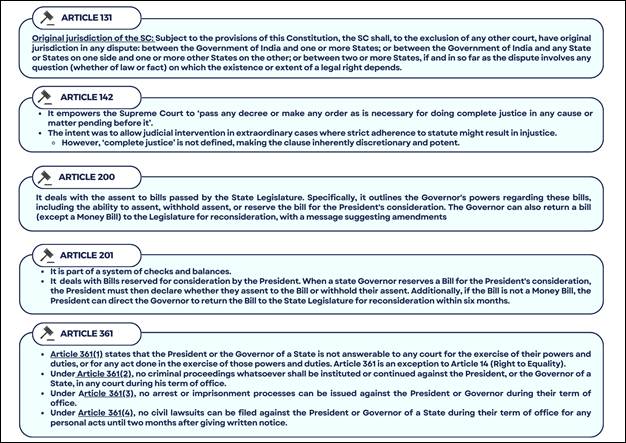
Is the present Presidential reference only about the April 8 ruling?
The presidential reference is not just about the April 8 ruling. It includes 14 legal questions-most related to the April 8 case, but some are about bigger issues. The last three questions focus on how the Supreme Court uses its special powers.
- What constitutional choices are available to a Governor under Article 200?
- Is the Governor bound by the aid and advice tendered by the Council of Ministers while exercising all the options available with him when a Bill is presented before him under Article 200?
- Is the exercise of constitutional discretion by the Governor under Article 200 justiciable?
- Is Article 361 an absolute bar to judicial review in relation to the actions of a Governor under Article 200?
- Is there any timeline prescribed in the Constitution for the exercise of powers by the Governor under Article 200?
- Can the Supreme Court, in the exercise of its powers under Article 142 or otherwise, fix a timeline for the Governor to exercise powers under Article 200?
- Is the concept of “deemed assent” by the Governor or President, in case of non-exercise of powers within a fixed timeline, consistent with the constitutional scheme?
- Can the Supreme Court direct the President to act within a particular period on a Bill reserved for consideration under Article 201?
- Is there any timeline prescribed in the Constitution for the President to act under Article 201?
- Can the Supreme Court, in the exercise of its powers under Article 142 or otherwise, fix a timeline for the President to act under Article 201?
- Is the concept of “deemed assent” by the President, in case of non-exercise of powers within a fixed timeline, consistent with the constitutional scheme?
- Is it necessary for the Supreme Court, before issuing directions or orders of the nature in question, to first determine whether the case involves a substantial question of law as to the interpretation of the Constitution that requires reference to a larger Bench?
(This question asks whether the SC must first determine if a case involves a “substantive question of law” or requires “interpretation of the Constitution” that only a larger Bench can hear. This question essentially asks whether smaller Benches can hear such important matters.)
- Are the powers of the Supreme Court under Article 142 limited to matters of procedural law, or do they extend to issuing directions or passing orders contrary to or inconsistent with existing substantive or procedural provisions of the Constitution or law in force?
- Does the Constitution bar any other jurisdiction of the Supreme Court to resolve disputes between the Union Government and State Governments except by way of a suit under Article 131?
Can the SC overturn its April 8 decision through the presidential reference? (Way Forward)
- The Supreme Court cannot overturn its April 8 decision through a presidential reference under Article 143.
-
- In its Cauvery Water Disputes Tribunal of 1991 opinion, the Court made it clear that Article 143 is not meant for the executive to seek a review or reversal of established Supreme Court judgments.
- The Court cannot use a presidential reference to sit in appeal over its own settled decisions. However, the government can still seek a review or file a curative petition against the April 8 ruling.
- Since the judgment was by a two-judge bench and similar cases are pending (Kerala and Punjab), a larger Constitution Bench might eventually reconsider the issue.
Conclusion:
By urging the President to seek SC’s opinion on constitutionality before assenting to a reserved Bill, the SC judgement sets a constitutional framework for handling Bills perceived as unconstitutional. At the same time, SC acknowledged its own limitations when the reference involves policy or politics.
|
PYQ Relevance: Prelims: Consider the following statements: 1) No criminal proceedings shall be instituted against the Governor of a State any court during his term of office. 2) The emoluments and allowances of the Governor of a State shall not be diminished during his term of office. Which of the statements given above is/are correct?
Mains: Discuss the essential conditions for exercise of the legislative powers by the Governor. Discuss the legality of re-promulgation of ordinances by the Governor without placing them before the Legislature. (UPSC CSE 2022) |