| Important questions for UPSC Pre/ Mains/ Interview:
1. What is the significance of Humayun’s Tomb as a UNESCO World Heritage Site (1993)? 2. What are the architectural features of the Humayun’s Tomb Site Museum that link the past with contemporary design. 3. How does the reuse of salvaged red sandstone in the museum façade reflect sustainability and heritage conservation practices? 4. What is the role of gardens in Mughal architecture and how is this principle integrated into the museum design? 5. What is the relevance of site museums in India today as spaces for reflection, public engagement, and cultural continuity? |
Q1. What is the significance of Humayun’s Tomb as a UNESCO World Heritage Site (1993)?
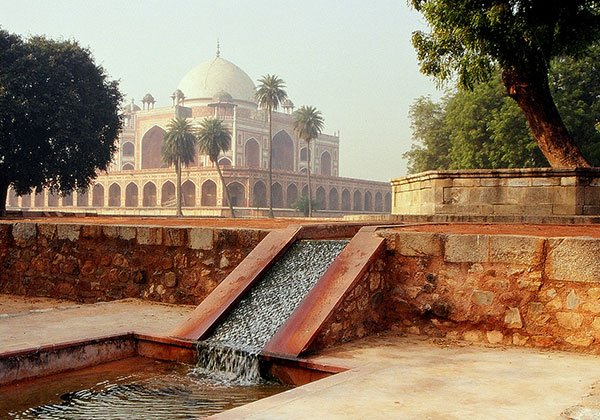
Humayun’s Tomb, built in 1570, is significant because:
- It is the first garden tomb in India, commissioned by Humayun’s wife Bega Begum and completed by Emperor Akbar, becoming a precursor to the Taj Mahal and later Mughal monuments.
- The ASI and Aga Khan Trust for Culture manage the site, ensuring its preservation and protection.
- It introduced Persian Charbagh (four-part garden) planning into Indian architecture.
- The monument reflects a fusion of Persian, Central Asian, and Indian traditions, marking the evolution of Indo-Islamic architecture.
- It symbolises Mughal imperial power, order, and ideas of paradise.
- Its designation as a UNESCO World Heritage Site (1993) highlights its outstanding universal value and the need for long-term preservation.
- It acts as a historical anchor for Delhi, linking medieval heritage with modern urban identity.
Q2. What are the architectural features of the Humayun’s Tomb Site Museum that link the past with contemporary design.
The Humayun’s Tomb Site Museum blends heritage with contemporary design through:
- Salvaged red sandstone façade, maintaining material continuity with Mughal architecture.
- White marble jaali screen, inspired by Mughal lattice work, reinterpreted in a modern form.
- Subterranean galleries inspired by baolis (stepwells), creating cool, shaded, skylit spaces.
- A terrace plaza patterned like Persian carpets, linking landscape art with architecture.
- Minimalist design that does not compete visually with the monument.
- The design emphasizes harmony between built structures and gardens, reflecting Mughal ideals while serving modern public needs.
Q3. How does the reuse of salvaged red sandstone in the museum façade reflect sustainability and heritage conservation practices?
The reuse of salvaged red sandstone reflects:
- Environmental Sustainability by reducing construction waste and promoting eco‑friendly building practices.
- Heritage Authenticity by integrating the original Mughal materials into the new architecture.
- Adaptive reuse, where heritage remnants are given new life in contemporary structures.
- Sustainable traditional craftsmanship, as artisans work with familiar materials and techniques.
- Approach for sustainable conservation in future heritage projects across India.
Q4. What is the role of gardens in Mughal architecture and how is this principle integrated into the museum design?
- In Mughal Architecture
- Gardens symbolised paradise, cosmic order, and balance.
- The Charbagh layout integrated water, symmetry, and architecture.
- Gardens served as spaces of reflection and imperial symbolism.
- In the Museum
- It is surrounded by greenery, following the Mughal idea that buildings should sit inside nature.
- Sunken courtyard with fountains and plants mirrors Mughal garden aesthetics.
- Mature trees and shaded spaces recreate the Mughal garden experience.
- Gardens connect the tomb (past), the museum (present) and the city (today’s visitors), becoming a bridge between history and modern life.
Q5. What is the relevance of site museums in India today as spaces for reflection, public engagement, and cultural continuity?
- Site museums contextualize monuments by providing historical narratives and architectural reconstructions.
- In contemporary India, site museums bridge heritage with modern urban life, encouraging reflection on the past while inspiring visions for the future.
- They create spaces for public engagement through galleries, auditoriums, and cultural events.
- By integrating gardens, plazas, and interactive exhibits, they foster community participation and tourism.
- They sustain traditional crafts by employing artisans in construction and exhibition design.