Context
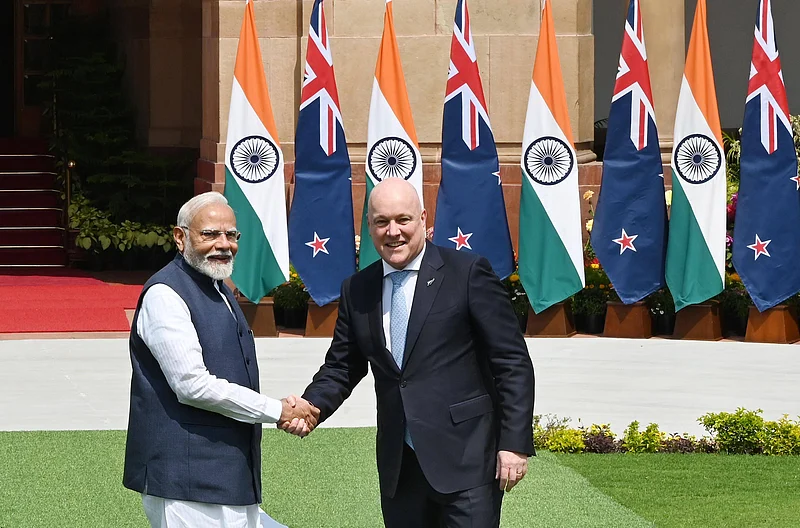
India and New Zealand concluded a Free Trade Agreement (FTA) in December 2025, under which New Zealand will provide zero-duty access on 100% of Indian exports and commit $20 billion in FDI by 2030. The agreement reflects India’s accelerating push for trade diversification amid global uncertainty and U.S. tariff pressures.
What is the India-New Zealand FTA?
- The FTA is a comprehensive trade and investment agreement covering goods, services, investment, mobility, and cooperation.
- Market access:
- New Zealand will impose zero duty on all Indian exports.
- India will relax tariffs on 95% of New Zealand imports, with 57% becoming duty-free immediately.
- Investment commitment:
- New Zealand has committed $20 billion FDI over the next 15 years, with clawback clauses if targets are not met.
- Services and mobility:
- Easier movement for Indian professionals, students, and youth.
- Work permits up to 20 hours per week during study and extended post-study visas.
- New areas:
- First-time facilitation of trade in Ayurveda, yoga, and traditional medicine services.
- MSMEs and labour-intensive sectors:
- Benefits for textiles, apparel, leather, footwear, gems and jewellery, engineering goods, and processed foods.
Why is the FTA Important for India?
- It provides full market access to a high-income economy (per capita income ~$49,380).
- Acts as a gateway to Oceania and Pacific Island markets.
- Supports employment generation through labour-intensive exports.
- Strengthens services exports and skill mobility.
- The Indian diaspora in New Zealand (~3 lakh, ~5% of population) enhances people-to-people and soft power ties.
- Aims to double bilateral trade from the current $1.3 billion in the next five years.
- The agreement was concluded in a record nine months, reflecting India’s new FTA approach.
How the Agreement Works (Key Bargains and Safeguards)?
- Trade Liberalisation with Protection
- India opened most tariff lines but excluded sensitive sectors such as:
- Dairy and agriculture (milk, cheese, butter, yogurt)
- Onions, sugar, edible oils, spices, rubber
- This protects Indian farmers and MSMEs from import surges.
- India opened most tariff lines but excluded sensitive sectors such as:
- Sectoral Cooperation
- New Zealand will assist India in improving productivity and quality in:
- Exotic fruits (kiwifruit, apples)
- Honey
- Cooperation includes centres of excellence, better planting material, post-harvest practices, food safety, and supply chains.
- New Zealand will assist India in improving productivity and quality in:
- Investment and Skill Linkages
- FDI targeted at 118 sectors, focusing on services, employment, and skill development.
- India becomes a key supplier of skilled workers in IT, healthcare, education, construction, yoga, culinary arts, and music.
Why is India Accelerating FTAs?
- To reduce dependence on traditional markets like the S., EU, and China.
- To offset the impact of S. tariffs, especially after exports to the U.S. fell sharply in late 2025.
- FTAs allow WTO-plus commitments in services, digital trade, and investment beyond multilateral rules.
- Aligns with domestic initiatives such as Make in India and PLI schemes, integrating India into global value chains.
- FTAs are increasingly used as tools for strategic and geopolitical partnerships, not just trade.
- The India-New Zealand FTA is India’s third FTA in 2025, after agreements with the UK and Oman.
Criticisms of the Agreement
- In New Zealand:
- Criticised for excluding dairy and agriculture, the country’s largest industry.
- Coalition partners argue the deal is “neither free nor fair” and may oppose it in Parliament.
- In India:
- Concerns that FTAs often widen trade deficits and lead to asymmetric gains.
- Skepticism remains about whether safeguards will work in practice.
Implications
- Signals India’s shift from protectionism to calibrated openness.
- Strengthens India’s position as a services and skilled labour exporter.
- Helps diversify trade partners amid geopolitical uncertainty.
- Success will depend on effective implementation, not just signing.
Challenges and Way Forward
| Challenges | Way Forward |
| Risk of trade deficits | Ensure strong rules of origin and safeguard mechanisms |
| Limited competitiveness of some Indian sectors | Invest in quality standards, R&D, and productivity |
| Pressure on MSMEs | Targeted support and integration into global value chains |
| Past FTAs delivering low gains | Continuous monitoring and mid-course correction |
| Global market volatility | Diversify exports and strengthen domestic manufacturing |
Conclusion
The India-New Zealand FTA marks India’s transition toward long-term, strategic trade alliances. If backed by domestic competitiveness and careful implementation, it can boost exports, jobs, and India’s global economic footprint.
| Ensure IAS Mains Question
Q. Discuss the significance of the India-New Zealand Free Trade Agreement. How does it reflect India’s changing approach towards trade policy and strategic diversification? (250 words) |
| Ensure IAS Prelims Question
Q. With reference to the India-New Zealand Free Trade Agreement, consider the following statements: 1. New Zealand will provide zero-duty access on all Indian exports. 2. India has opened its dairy and agriculture sectors fully under the agreement. 3. The FTA includes commitments related to services, investment, and skilled labour mobility. Which of the statements are correct? a) 1 and 3 only b) 1 and 2 only c) 2 and 3 only d) 1, 2 and 3 Answer: a) 1 and 3 only Explanation: Statement 1 is correct: Under the India–New Zealand FTA, New Zealand has agreed to provide zero-duty market access on 100% of Indian exports, significantly improving export opportunities for Indian goods. Statement 2 is incorrect: India has not opened its dairy and key agricultural sectors under the agreement, as these items were deliberately excluded to protect Indian farmers and small and medium agricultural producers. Statement 3 is correct: The FTA goes beyond goods trade and includes commitments on services, investment, and skilled labour mobility, facilitating easier movement of professionals, students, and service providers. |