Context
Recent research published in Nature Climate Change has revealed an unexpected carbon ‘anomaly’ in the Southern Ocean, where observations show increased carbon absorption despite climate models predicting a weakening of its carbon sink due to stronger winds and rising greenhouse gases.
About Southern Ocean
- Also known as: Antarctic Ocean.
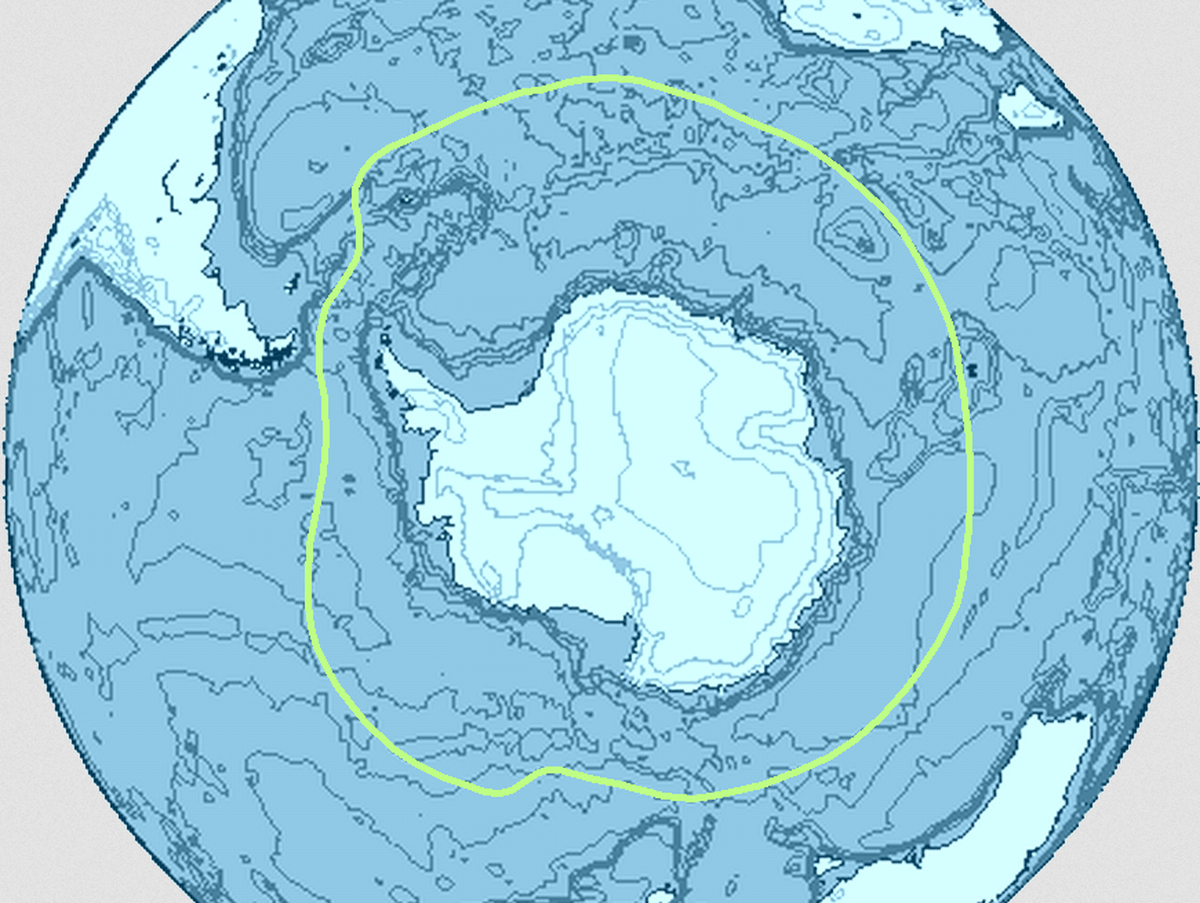
- Location: It is one of the five major ocean basins of the Earth, encircling and surrounding the Antarctic continent.
- Origin and formation:
- It came into existence around 34 million years ago when Antarctica drifted away from South America.
- This separation resulted in the opening of the Drake Passage between the Antarctic Peninsula and southern South America.
- Areal extent:
- Consists of the southern portions of the Pacific, Atlantic, and Indian Oceans.
- Includes their marginal seas lying south of 60° South latitude around Antarctica.
- Climatic features:
- Characterised by strong westerly winds, frequent and intense storms, and very low temperatures.
- Experiences marked seasonal variations in ice cover and weather conditions.
- Oceanic circulation:
- Dominated by the Antarctic Circumpolar Current (ACC).
- The ACC is the longest, strongest, and deepest-reaching ocean current on Earth.
- Direction and significance of currents:
- The ACC flows clockwise around Antarctica.
- It transports more water than any other ocean current and connects the world’s major oceans.
- Biological productivity:
- High productivity is driven by phytoplankton growth near the Antarctic Convergence.
- Forms the base of a rich marine food web.
- Marine biodiversity: Supports diverse marine life including whales, penguins, seals, and orcas, which depend on the nutrient-rich waters of the Southern Ocean.
| Antarctic Convergence (Antarctic Polar Front)
● The Antarctic Convergence is a natural oceanic boundary in the Southern Ocean where two very different water masses meet. ● It is the zone where cold, dense Antarctic waters move northward and collide with relatively warmer sub-Antarctic waters moving southward. ● Instead of mixing easily, the colder water sinks below the warmer water, creating a sharp boundary. |
What is the Southern Ocean Carbon Anomaly?
- The Southern Ocean plays a crucial role in regulating Earth’s climate.
- It covers about 25-30% of the global ocean area.
- It absorbs nearly 40% of all human-emitted carbon dioxide absorbed by oceans.
- This strong absorption is due to its cold and relatively fresh surface waters, which sit above warmer, saltier, carbon-rich deep waters, forming a layered structure.
- Climate models earlier predicted that with stronger westerly winds and higher greenhouse gas concentrations, deep carbon-rich waters would rise to the surface and release carbon dioxide into the atmosphere.
- However, observations since the early 2000s show the opposite: the Southern Ocean has been absorbing more carbon, not less.
- This mismatch between models and observations is termed the Southern Ocean carbon anomaly.
Why Does This Anomaly Matter?
- The Southern Ocean acts as a major carbon sink, slowing global warming.
- Any shift from absorption to emission could accelerate climate change.
- Understanding why models failed is essential to improve climate predictions and policy decisions.
- It highlights limits of current climate models in capturing complex ocean processes.
How the Southern Ocean Behaved Differently from Model Predictions?
- What Climate Models Predicted?
- Rising greenhouse gases would strengthen westerly winds in the Southern Hemisphere.
- Stronger winds would intensify upwelling, bringing carbon-rich deep waters to the surface.
- This would weaken the Southern Ocean’s ability to absorb carbon dioxide.
- What Observations Showed?
- Measurements across decades confirm that deep waters are rising.
- Circumpolar deep waters have moved up by around 40 metres since the 1990s.
- Subsurface carbon dioxide pressure increased by about 10 microatmospheres, matching model projections.
- Despite this, carbon was not released into the atmosphere.
- What Models Missed?: Surface Freshwater Layer
- Increased rainfall and Antarctic glacier melt have made surface waters fresher and lighter.
- This fresh layer strengthened stratification (layering of ocean waters).
- Strong stratification acted like a lid, trapping carbon-rich waters 100-200 metres below the surface.
- As a result, carbon dioxide could not escape into the atmosphere.
- Why Stratification Is Hard to Model?
- Stratification depends on processes occurring at very different scales.
- Eddies are only a few kilometres wide, while ice-shelf cavities are much larger.
- Limited long-term ocean data also reduces model accuracy.
Implications
- The Southern Ocean’s carbon sink has shown greater resilience than expected, due to strengthened surface stratification.
- This resilience is temporary, as carbon-rich deep waters are already moving closer to the surface.
- If stratification continues to weaken, the predicted weakening of the carbon sink may re-emerge sooner than expected.
- This could lead to a sudden release of carbon dioxide into the atmosphere rather than a gradual change.
- The findings show that climate models are broadly correct in identifying long-term risks but missed key surface processes.
- Rather than discrediting models, the study reinforces their role in highlighting vulnerabilities in the climate system.
- Observations complement models by explaining why real-world behaviour sometimes differs from projections.
- There is a strong need for continuous, year-round ocean observations to track future changes.
- Whether the Southern Ocean absorbs or releases carbon in coming decades will have major implications for global climate outcomes.
Challenges and Way Forward
| Challenges | Way Forward |
| Climate models miss key surface processes and may create a false sense of long-term stability by temporarily masking risks | Improve climate models to better capture surface stratification, eddies, and ice-ocean interactions, and treat current resilience as temporary, not permanent |
| Carbon-rich deep waters are already closer to the surface, increasing uncertainty about the Southern Ocean’s future role | Develop early-warning systems and integrate Southern Ocean risks more strongly into global climate policy and assessments |
| Limited long-term, continuous, year-round observational data in the Southern Ocean | Expand continuous monitoring using satellites, autonomous floats, and research vessels |
| Difficulty in modelling processes occurring at very different spatial scales and weak coordination between models and observations | Use high-resolution regional models and strengthen model-observation integration to improve projections |
Conclusion
The Southern Ocean carbon anomaly highlights the complexity of Earth’s climate system, where real-world processes can temporarily defy model predictions. While strengthened stratification has delayed carbon release, this protection is fragile and may weaken sooner than expected. Improving climate models through continuous observations is essential to better anticipate future climate risks and global warming trajectories.
| Ensure IAS Mains Question
Q. The Southern Ocean carbon anomaly challenges earlier climate model projections. Explain the reasons behind this anomaly and discuss its implications for climate modelling and global climate change mitigation. (250 words) |
| Ensure IAS Prelims Question
Q. Consider the following statements regarding the Southern Ocean Carbon Anomaly: 1. Climate models predicted that stronger westerly winds would weaken the Southern Ocean’s Carbon Sink. 2. Increased freshwater input strengthened surface stratification, limiting carbon dioxide release. 3. Rising surface salinity has strengthened the Southern Ocean’s long-term carbon sink. Which of the statements given above are correct? a) 1 and 2 only b) 2 and 3 only c) 1 and 3 only d) 1, 2 and 3 Answer: a) 1 and 2 only Explanation: Statement 1 is correct: Climate models projected that stronger westerly winds would increase upwelling of carbon-rich deep waters, weakening the Southern Ocean’s capacity to absorb carbon dioxide. Statement 2 is correct: Freshwater from rainfall and Antarctic glacier melt strengthened surface stratification, which trapped carbon-rich waters below the surface and reduced carbon dioxide release. Statement 3 is incorrect: Rising surface salinity weakens stratification, allowing deeper carbon-rich waters to mix upward, which can reduce the Southern Ocean’s effectiveness as a carbon sink. |