Context
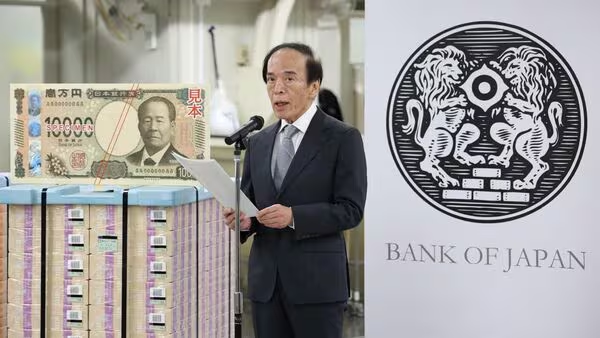
In December 2025, the Bank of Japan raised its policy interest rate to 0.75%, the highest level in nearly 30 years. This marked a decisive shift away from Japan’s long-standing near-zero interest rate policy, with global implications, especially for the yen carry trade and for Indian companies borrowing in Japanese yen.
What is the Decision and Its Global Significance?
- Japan has maintained ultra-low interest rates for decades, making the yen a preferred currency for global borrowing.
- The rate hike of 25 basis points signals the beginning of monetary policy normalisation.
- Though 75% remains low by global standards, the move is symbolically important as Japan was the last major economy with near-zero rates.
- The decision affects global liquidity because Japanese capital has long funded investments across the world.
- The biggest global impact is on the yen carry trade, which depends on cheap borrowing in yen.
What is the Yen Carry Trade?
- Investors borrow money in Japanese yen at very low interest rates.
- This money is invested in higher-yielding assets abroad, such as:
- US Treasury bonds
- Emerging market bonds
- Equities and alternative assets
- Profits arise from the interest rate difference and a stable or weakening yen.
Why Does the Rate Hike Matters?
- Carry trades depend on:
- Low borrowing costs in Japan
- Currency stability
- Japan’s rate hike threatens both:
- Borrowing becomes costlier
- The risk of yen appreciation increases
- A stronger yen can wipe out profits when investors convert returns back into yen.
Why the Bank of Japan Raised Interest Rates?
- Japan is facing a cost-of-living squeeze driven by higher food and energy prices.
- A weak yen has increased import costs, making inflation politically sensitive.
- The new government under Prime Minister Sanae Takaichi wants to protect household purchasing power.
- At the same time, Japan’s very high public debt limits how sharply interest rates can be raised.
- The hike reflects a carefully calibrated shift, not an abrupt tightening, under Governor Kazuo Ueda.
Implications for India
- Impact on Indian Borrowers
- Several Indian companies have borrowed heavily in yen to benefit from low rates.
- Key borrowers include Power Finance Corporation, REC, and NLC India.
- Many of these loans are unhedged, exposing companies to currency risk.
- Yen appreciation raises repayment costs and leads to mark- to- market losses (paper losses).
- Higher forex losses can strain earnings, cash flows, and balance sheets.
- Capital Flows and Financial Markets
- If global investors unwind yen-funded positions, capital outflows may hit emerging markets.
- This could:
- Pressure the rupee
- Increase bond yields
- Cause volatility in equity markets
- Although India’s macro fundamentals are relatively strong, it is not immune to global liquidity shocks.
- Broader Macroeconomic Impact
- Tighter global liquidity may reduce the availability of cheap external funding.
- Indian firms may need to rethink foreign currency borrowing strategies.
- Risk appetite may decline temporarily, affecting investment flows.
Implications of the Rate Hike
- Signals the end of Japan’s ultra-loose monetary era.
- Raises the risk of gradual unwinding of the yen carry trade.
- Increases currency risk for unhedged foreign borrowers.
- Adds volatility to global financial markets, especially emerging economies.
- Encourages more prudent risk management by global investors and Indian corporates.
Challenges and Way Forward
| Challenges | Way Forward |
| Indian companies with unhedged yen loans face higher repayment costs due to yen appreciation. | Indian firms should adopt robust currency hedging mechanisms to reduce foreign exchange risk. |
| Possible unwinding of the yen carry trade can lead to capital outflows from emerging markets like India. | India should maintain strong macroeconomic fundamentals, including stable growth, manageable inflation, and adequate forex reserves. |
| Unwinding of carry trades can increase volatility in equity, bond, and currency markets. | Regulators should strengthen financial market resilience through monitoring, liquidity support, and timely policy responses. |
| Heavy dependence on low-cost foreign currency borrowing increases vulnerability to global shocks. | Companies should diversify funding sources and borrowing currencies to reduce concentration risk. |
| Global monetary policy shifts create uncertainty for investors and borrowers. | Firms and policymakers should improve risk assessment, stress testing, and contingency planning. |
Conclusion
Japan’s rate hike marks a turning point in global monetary conditions. While the impact may be gradual, Indian borrowers and markets must prepare for higher currency risk and potential volatility as the era of ultra-cheap yen funding slowly comes to an end.
| Ensure IAS Mains Question
Q. Explain the yen carry trade and examine how Japan’s recent interest rate hike can affect emerging economies like India. (250 words) |
| Ensure IAS Prelims Question
Q. Consider the following statements regarding the yen carry trade: 1. It involves borrowing in a low-interest currency and investing in higher-yielding assets abroad. 2. The trade becomes riskier when the funding currency appreciates. 3. Japan’s interest rate hike has no impact on global liquidity. Which of the statements are correct? a) 1 and 2 only b) 1 and 3 only c) 2 and 3 only d) 1, 2 and 3 Answer: a) 1 and 2 only Explanation Statement 1 is correct: The yen carry trade involves borrowing funds in a low-interest currency like the Japanese yen and investing them in higher-yielding assets abroad to earn returns from interest rate differentials. Statement 2 is correct: When the funding currency appreciates, borrowers must repay more in their home currency, which reduces profits and increases risk, making the carry trade less attractive. Statement 3 is incorrect: Japan’s interest rate hike affects global liquidity by raising borrowing costs and increasing the risk of unwinding yen-funded investments, which can lead to capital outflows from global markets. |