Context
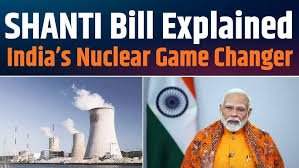
- The Lok Sabha passed the Sustainable Harnessing and Advancement of Nuclear Energy for Transforming India (SHANTI) Bill, 2025.
- The legislation triggered strong opposition, particularly over the removal of supplier liability under the existing nuclear liability framework.
- The Bill will now be taken up in the Rajya Sabha.
What is the SHANTI Bill, 2025?
- The SHANTI Bill aims to reform India’s nuclear energy sector to:
- Increase nuclear power capacity
- Attract private and foreign investment
- Support India’s clean energy and net-zero goals
- A key feature of the Bill is the modification of the Civil Liability for Nuclear Damage Act, 2010.
Major Change Introduced in New Bill
- The Bill removes the provision that allowed nuclear plant operators to seek compensation (right of recourse) from equipment suppliers if an accident occurred due to defective equipment.
India’s Current Nuclear Liability Framework
- The Civil Liability for Nuclear Damage Act, 2010 (CLNDA) was enacted after the Bhopal Gas Tragedy, reflecting strong public concern about corporate accountability.
- The Act uniquely allowed:
- The operator (usually NPCIL) to claim recourse from suppliers.
- This clause was not common internationally, where liability generally rests only with the operator.
- Impact of the Clause:
- Foreign companies were reluctant to invest due to:
- Fear of unlimited liability
- High insurance risks
- This limited the benefits of the India–US Civil Nuclear Agreement (2008) despite India receiving a waiver from the Nuclear Suppliers Group (NSG).
- Foreign companies were reluctant to invest due to:
Why Has the SHANTI Bill Become Controversial?
- Removal of Supplier Liability
- Opposition argued that removing supplier responsibility:
- Weakens public safety safeguards
- Shifts the burden of accidents onto the Indian State and public
- Congress MP Manish Tewari highlighted that the BJP had earlier opposed the absence of such a clause in 2008.
- Opposition argued that removing supplier responsibility:
- Allegations of Corporate Favouritism
- Questions were raised over:
- The timing of the Bill
- Reported interest by large conglomerates, particularly Adani, in the nuclear sector
- The government rejected these allegations, calling them baseless and damaging to parliamentary dignity.
- Questions were raised over:
- Cap on Operator Liability
- The Bill reportedly caps operator liability at ₹3,000 crore.
- Opposition MPs questioned:
- The scientific and financial basis of this figure
- Whether it is adequate to compensate victims in case of a major nuclear accident.
Government’s Justification for the Bill
- Changing Technology and Risk Profile
- According to the government:
- Technology has evolved since 2010
- India is moving towards Small Modular Reactors (SMRs)
- SMRs:
- Are smaller in size
- Have enhanced safety features
- According to the government:
- Can be installed closer to urban areas
- Lower Risk of Catastrophic Accidents
- The government argues that:
- Modern reactors significantly reduce accident risks
- The older liability framework no longer reflects technological realities
- Need for Investment and Energy Transition
- India needs massive investment to:
- Expand clean energy
- Reduce dependence on fossil fuels
- Private participation is seen as essential due to:
- Fiscal constraints
- Rising energy demand
- India needs massive investment to:
- The government argues that:
Political and Economic Dimensions
- Opposition parties linked the Bill to:
- Falling foreign investment
- Currency depreciation
- Global trade pressures
- They accused the government of compromising public interest to attract foreign capital.
- The government maintained that the Bill is policy-driven, not company-specific.
Implications
- Boost to nuclear investment: May attract domestic and foreign private players.
- Faster nuclear expansion: Supports India’s clean energy and climate commitments.
- Reduced supplier risk: Aligns India with international nuclear liability norms.
- Public safety concerns: Raises questions about victim compensation and accountability.
- Federal and parliamentary scrutiny: Highlights the need for wider consultation on sensitive sectors.
Challenges & Way Forward
| Challenges | Way Forward |
| Public concern over safety and liability | Strengthen independent nuclear regulation and transparency |
| Reduced supplier accountability | Create robust insurance and compensation mechanisms |
| Trust deficit due to lack of consultation | Refer complex laws to parliamentary committees |
| Risk of inadequate compensation | Periodically review liability caps based on risk assessment |
| Balancing investment with public interest | Ensure strong regulatory oversight alongside liberalisation |
Conclusion
The SHANTI Bill represents a major shift in India’s nuclear governance framework. While it aims to unlock investment and modernise nuclear energy, the removal of supplier liability has raised serious concerns about safety, accountability and public interest. For long-term success, nuclear expansion must be accompanied by robust regulation, transparent oversight and credible compensation mechanisms, ensuring that energy security does not come at the cost of public trust.
| EnsureIAS Mains Question
Q. The SHANTI Bill, 2025 marks a significant shift in India’s nuclear liability regime. Critically examine its implications for investment, public safety and accountability. (250 Words) |
| EnsureIAS Prelims Question
Q. Consider the following statements regarding the SHANTI Bill, 2025: 1. It seeks to encourage private sector participation in nuclear power generation. 2. It removes the right of recourse against equipment suppliers in nuclear accidents. 3. It completely eliminates the liability of nuclear plant operators. Which of the statements are correct? Answer: a) 1 and 2 only Explanation: Statement 1 is correct: The SHANTI Bill aims to incentivise both domestic and foreign private investment in nuclear power to support India’s clean energy transition. Statement 2 is correct: The Bill removes the provision under the Civil Liability for Nuclear Damage Act that allowed operators to seek recourse from suppliers. Statement 3 is incorrect: The operator continues to bear primary liability, though it is capped; liability is not eliminated. |