Context
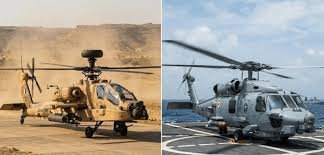
The Indian Navy has commissioned its second MH-60R Seahawk helicopter squadron (INAS 335 – Ospreys) at INS Hansa, Goa. This comes as India strengthens its maritime security and anti-submarine warfare capabilities amid evolving conventional and asymmetric threats.
What is the MH-60R Seahawk Helicopter?
- The MH-60R Seahawk is a US-origin, multi-role maritime helicopter, a naval version of the Black Hawk.
- It is distinct from the V-22 Osprey, which is a tilt-rotor transport aircraft.
- India has acquired 24 MH-60R helicopters from the United States under a deal worth over ₹15,000 crore.
- These helicopters are replacing the ageing Sea King helicopters, which had been in service for several decades.
- The first squadron (INAS 334) was inducted at INS Garuda, Kochi in March 2024, making the platform fully integrated into naval operations.
- The helicopters can operate from shore bases, aircraft carriers, and large naval ships, enhancing fleet flexibility.
Why Does the Induction Matter?
- India faces increasing submarine threats, especially in the Indian Ocean Region (IOR).
- Maritime security challenges now include terrorism, piracy, smuggling, drones, and non-state actors.
- The Navy needs modern, versatile platforms to support blue-water operations far from India’s coastline.
- The induction also marks 75 years of the Indian Navy’s Fleet Air Arm, making it symbolically and operationally significant.
How the MH-60R Enhances Naval Capabilities?
- Multi-Role Operational Capability: The MH-60R is designed for:
- Anti-Submarine Warfare (ASW)
- Anti-Surface Warfare (ASuW)
- Search and Rescue (SAR)
- Medical Evacuation (MEDEVAC)
- Vertical Replenishment (VERTREP) for ship-to-ship logistics at sea
- Advanced Sensors and Weapons
- Equipped with multi-mode radar, infrared cameras, electronic support measures, datalinks, and dipping sonar.
- Uses sonobuoys to detect submarines.
- On-board mission systems create a real-time picture of surface and underwater threats.
- Can be armed with torpedoes, air-to-ground missiles, rockets, and guns.
- Countering Conventional and Asymmetric Threats
- Conventional threats:
- Enemy submarines
- Surface warships
- Conventional threats:
- Sea denial and deep-sea operations
- Asymmetric threats:
- Maritime terrorism
- Piracy and smuggling
- Sea-borne infiltration
- Use of fishing boats for hostile activities
- Drones and autonomous vessels
- Sabotage of ports and offshore infrastructure
- Sustainment and Operational Readiness
- The Ministry of Defence signed sustainment support agreements worth ₹7,995 crore for five years.
- Support includes spares, training, repairs, maintenance facilities, and technical assistance.
- This ensures high availability, longer service life, and operations from dispersed locations and ships.
Implications of the Induction
- Strengthens India’s anti-submarine warfare capability, critical in the Indian Ocean.
- Enhances blue-water navy operations, extending the reach of warships.
- Improves India’s ability to counter new-age asymmetric maritime threats.
- Reduces dependence on obsolete platforms like Sea Kings.
- Deepens India-US defence cooperation and interoperability.
Challenges and Way Forward
| Challenges | Way Forward |
| Dependence on foreign-origin platforms | Gradually build indigenous helicopter capabilities |
| High cost of acquisition and maintenance | Ensure efficient sustainment and lifecycle management |
| Rapidly evolving asymmetric threats | Continuous upgrades in sensors and weapons |
| Need for trained personnel | Strengthen training and skill development |
| Long-term operational readiness | Develop domestic maintenance and repair ecosystem |
Conclusion
The induction of the MH-60R Seahawk squadron significantly enhances India’s maritime security, surveillance, and combat capabilities. With proper sustainment and gradual indigenisation, these helicopters will remain a key pillar of India’s naval power in the coming decades.
| Ensure IAS Mains Question
Q. Discuss how the induction of MH-60R Seahawk helicopters strengthens India’s maritime security and addresses emerging conventional and asymmetric threats. (250 words) |
| Ensure IAS Prelims Question
Q. Consider the following statements regarding the MH-60R Seahawk helicopter: 1. It is primarily designed for anti-submarine warfare. 2. It can operate from aircraft carriers and large naval ships. 3. India acquired these helicopters to replace the Mi-17 fleet. Which of the statements are correct? a) 1 and 2 only b) 2 and 3 only c) 1 and 3 only d) 1, 2 and 3 Answer: a) 1 and 2 only Explanation Statement 1 is correct: The MH-60R’s core role is detecting and neutralising enemy submarines using advanced sonar and torpedoes. Statement 2 is correct: The helicopter is fully integrated with naval ships, including aircraft carriers. Statement 3 is incorrect: The MH-60R is replacing the ageing Sea King helicopters, not the Mi-17 fleet |