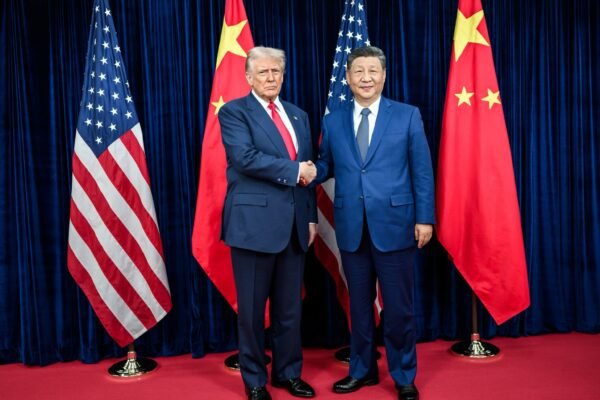
Why in the News?
U.S. President Donald Trump publicly invoked “THE G2 WILL BE CONVENING SHORTLY” on Truth Social (website) just before his meeting with Chinese President Xi Jinping in Busan, South Korea.
Key Highlights
- Trump’s public framing and optics
- The Truth Social post and subsequent public remarks highlighted parity-framed language (G2), unusual for a U.S. President given decades of U.S. reluctance to endorse a bilateral “duopoly.”
- The optics signalled an attempt to personalise and bilateralise management of major global issues between Washington and Beijing.
- About G2
- The “G-2” refers to the idea of a strategic partnership or leadership compact between the United States and China to jointly manage global economic and political issues.
- The term was coined in 2005 by economist C. Fred Bergsten, who argued that progress on key global challenges — such as trade, climate change, and financial stability — required prior agreement between the world’s two largest economies.
- It was meant to supplement, not replace, existing multilateral forums like the G-20, IMF, or WTO.
- The concept gained prominence after the 2008 global financial crisis, when the U.S.–China cooperation was seen as crucial for global recovery.
- Critics, however, warn that a G-2 framework risks marginalising other countries, creating a bipolar global order, and undermining inclusive multilateralism.
- Summit outcomes and transactional diplomacy
- The Busan meeting produced short-term trade concessions and announcements (including tariff adjustments and mutual commercial commitments), which were portrayed as pragmatic, transactional outcomes rather than comprehensive strategic realignment.
- Reports emphasised immediate economic measures (tariff adjustments, purchase commitments) and suspended or delayed some trade frictions.
- Allied concerns and regional ripple effects
- S. partners (Japan, Australia, India and others) expressed worry that a G-2 orientation could sideline regional security coalitions, complicate Quad dynamics, and create uncertainty about continued U.S. commitments.
- Diplomatic discussions in capitals are now reappraising whether bilateral détente with Beijing will affect existing alignments.
- Uncertainty and historical precedent
- While some praise pragmatic US-China engagement to stabilise global markets, analysts caution that past personalised deals under Trump (and prior administrations’ flirtation with bilateralism) have sometimes proved temporary or reversed.
Implications
- Reordering of diplomatic priorities: A visible G-2 posture elevates bilateral US-China channels and could deprioritise multilateral mechanisms for certain issues, affecting policy coherence on trade, climate, and security.
- Strategic uncertainty for regional allies: Allies may face a strategic recalculation if Washington appears willing to concede de-facto parity or prioritise bilateral settlements over alliance consultations.
- Economic short-term stability vs. long-term competition: Transactional deals (tariff adjustments, purchase commitments) can calm markets, but structural competition in tech, supply-chains and strategic minerals remains.
- Pressure on multilateral institutions: If the U.S. and China coordinate bilaterally, global forums (G-20, WTO) may be sidelined or pressured to accept bilateral pre-agreements rather than lead consensus.
- Domestic political signalling: Trump’s G-2 framing serves domestic political aims — projecting deal-making and strength — while also creating diplomatic ambiguity that partners must manage.
Challenges and Way Forward
| Challenge | Way forward |
| Allied reassurance | Institutionalise consultation: codify pre-summit briefings with key allies (Japan, Australia, India, EU) and establish a rapid consultative mechanism to align positions before bilateral US-China initiatives. |
| Preserving multilateralism | Use G-20 and sectoral forums to translate bilateral outcomes into multilateral rules; require that any US-China agreements be presented for multilateral endorsement. |
| Balancing competition and cooperation | Separate issue tracks: (a) crisis-aversion channels (trade, finance, climate), (b) structural competition channels (tech, security) with distinct guardrails and transparency. |
| Regional security coordination | Reinforce Quad consultations and deliverables (supply-chain resilience, maritime security) to show continuity of collective action even amid US-China engagement. |
| Domestic political volatility | Institutionalise bilateral agreements through formal treaties, parliamentary oversight, and multilateral backstops to reduce fragility when leaders change. |
Conclusion
Trump’s revival of the “G-2” framing in Busan reintroduced an old idea into a new strategic context: a China that is more assertive and a US administration willing to personalise diplomacy. The immediate economic results can soothe markets, but lasting global governance requires concerted allied consultation, robust multilateral institutions, and mechanisms that separate short-term management from long-term strategic competition.
| EnsureIAS Mains Question
Q. Analyse the strategic consequences of a renewed US–China “G-2” dynamic for regional security architectures in the Indo-Pacific. In your answer, evaluate how middle powers should respond to preserve strategic autonomy and multilateralism. (250 Words) |
| EnsureIAS Prelims Question
Q. Consider the following statements about the “G-2” concept and contemporary geopolitics: 1. The “G-2” concept originally referred to an informal leadership compact between the United States and China to coordinate global economic policies and supplement multilateral institutions. 2. Acceptance of a G-2 arrangement would automatically replace the need for multilateral forums such as the G-20 and the IMF. Which of the statements given above is/are correct? Answer: A Explanation: Statement 2 is incorrect: A G-2 arrangement is not intended — nor would it automatically — replace multilateral institutions. Institutional legitimacy, rule-making, and representation (e.g., for smaller states) require multilateral forums. Moreover, many states and administrations have resisted a bilateral duopoly because it risks sidelining wider multilateral processes. |